

San Elizario, TX – Presidio Chapel of San Elizario, Texas. Photo by Kathy Alexander.
The Presidio Chapel of San Elizario, Texas, was built in 1877 on the same site where an earlier Mexican chapel had stood. Located on a stretch of the Camino Real de la Tierra Adentro (Royal Highway), known locally as the Mission Trail, San Elizario marks the start of the northbound trail in the United States as it crosses the Rio Grande out of Mexico, through the lower El Paso Valley, and into New Mexico.
In 1581, three Franciscans led by Friar Agustin Rodriguez initiated an expedition to the north “to enter those new lands to preach the Gospel to the Indians,” arriving in the San Elizario area in July.
In 1598, the Spanish conquistador Don Juan de Onate led a group of 500 colonists and 7,000 head of livestock, including horses, oxen, and cattle, from southern Chihuahua to settle the province of New Mexico. Traveling in 83 wagons, the caravan traveled a northeasterly route for weeks across the desert until it reached the banks of the Rio Grande in the San Elizario area. On April 30, 1598, the travelers celebrated a Thanksgiving Mass and enjoyed a feast of fish, fowl, and deer. This is considered the first Thanksgiving to be celebrated in the present-day United States.
In 1683, the Governor of New Mexico, Don Jironza Petriz de Cruzate, established the Presidio de Nuestra Señora del Pilar y Glorioso San José in the vicinity of Our Lady of Guadalupe Mission in Juarez, Mexico.
In 1773, the Juarez mission was transferred to San Elizario and renamed Presidio de San Elizario.
In 1788, the site was chosen to locate a strategic military stronghold on New Spain’s western frontier. Soldiers from San Elzeario, a decommissioned Spanish fort in present-day Chihuahua, Mexico, occupied the new presidio to defend area residents and the El Camino Real caravans from Apache Indians. Like the fort it replaced, the new presidio was named in honor of San Elzear, the French patron saint of soldiers.
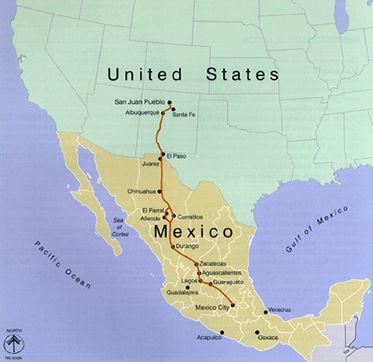
El Camino Real de Tierra Adentro Map.
The chapel was rebuilt in 1789 at its current location to protect the settlements on both sides of the river. The chapel catered to the religious needs of a presidio or military outpost. The presidio was relocated to its present site in 1790 to protect travelers and settlers along the Camino Real. This route ran from Mexico City through Paso del Norte to Santa Fe, New Mexico. Its proximity to the Ysleta and Socorro missions also protected them.
The self-contained garrison was equipped with 12-foot-high walls, a chapel, officers’ quarters, soldiers’ barracks, and storerooms. Its construction represented a shift in local building practices, moving away from the jacal technique of sealing vertical logs with adobe plaster to a more widespread use of adobe bricks, ceiling beams, and more linear building layouts. The massive walls of the Presidio provided a sense of security and permanence, serving as a central nucleus and point of orientation for a settlement that rapidly developed inside and around it.
When Mexico became independent from Spain in 1821, the military presence at the presidio decreased.
In 1829, a flood of the Rio Grande destroyed the chapel. The torrent also carved a new river channel that set San Elzeario on the Rio Grande’s north side.
Afterward, residents looked to higher ground before rebuilding the church, and by 1841, a new chapel served a town of more than 1,000 residents.
During the Mexican-American War, after the United States occupied San Elizario, Texas, volunteers from California were stationed at the presidio to prevent the re-occupation. After the war, community neglect and ongoing floods damaged the chapel again.
American troops were stationed there in 1850. At about that time, the name San Elizario, an Anglicized version of the Spanish name, began to be used.
Still another flood in 1852 left the chapel and presidio in ruins. Residents salvaged part of their adobe remains to construct a small temporary church.
During the Civil War, volunteers from California were stationed in the area to prevent Confederate forces from reoccupying it.
A new chapel was constructed between 1877 and 1882, and the bell tower was constructed later. The exterior appearance has changed very little since then.
In 1879, five Sisters of Loretto arrived in San Elizario and opened the first Catholic school in the region, St. Joseph Academy. The Academy flourished as a boarding and day school for girls from the Mission Valley, El Paso, and Mexico.
The Sisters of Loretto moved it to El Paso in 1892.
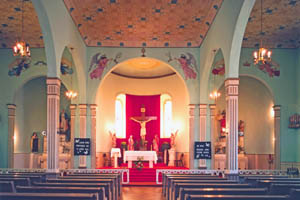
San Elizario, TX – Chapel by the Historic American Building Survey.
The Camino Real de la Tierra Adentro remained part of San Elizario’s physical and cultural landscape until the railroad bypassed the community in the late 19th century. Afterward, El Camino Real lost its commercial luster, and San Elizario returned to its quiet rural roots.
Under the Jesuits in the early 20th century, San Elizario served as the center of missionary work throughout the Mission Valley.
In 1935, an electrical fire ravaged the chapel interiors, causing severe damage. Miraculously, the fire left the exterior walls largely intact. Dramatic alterations followed, including the installation of a pressed tin ceiling over traditional vigas. Plain wood column supports were replaced by ornate neoclassical posts. Pictorial stained glass windows combined religious and patriotic images from the Sacred Heart to the Star of Texas.
One of the late examples of adobe architecture in West Texas, the Presidio Chapel is an outstanding example of late adobe church architecture of the Spanish colonial period. It was listed on the National Register of Historic Places in 1972 and is also designated a Texas historic site located in the Mission Valley on El Paso’s Historic Mission Trail.
Today, the Presidio Chapel is the centerpiece of the town plaza in San Elizario and continues its proud tradition of serving Catholics in the Mission Valley. The historic church receives visitors and tourists daily, and the parish is the site of the town’s summer festival.
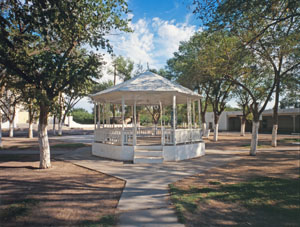
Plaza Gazebo in San Elizario, Texas, by the Historical American Building Survey.
©Kathy Alexander/Legends of America, updated August 2025.
Also See:
Camino Real de la Tierra Adentro
Forts & Presidios Across America
Sources:
National Park Service
Web Archive
Wikipedia – Presidio Chapel
Wikipedia – San Elizario