
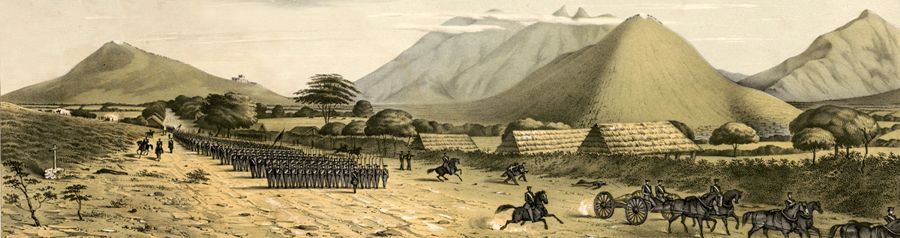
Battle of Monterey, Mexico by Daniel P. Whiting, 1847.
The Mexican-American War, which lasted from 1846 to 1848, was an armed conflict that occurred after the U.S. annexation of Texas in 1845.
Despite the 1836 Texas Revolution, Mexico continued to consider Texas part of its territory. The Mexican Congress never recognized Texan independence, seeing the Republic as a rebellious territory that would eventually be retaken. After annexing Texas as a state in December 1845, Mexico immediately broke off diplomatic relations with the United States. Disputes arose regarding the southern boundary of Texas, which had now become the southern boundary of the United States. The Mexicans said Texas extended only to the Nueces River, while the Texans declared it extended to the Rio Grande.
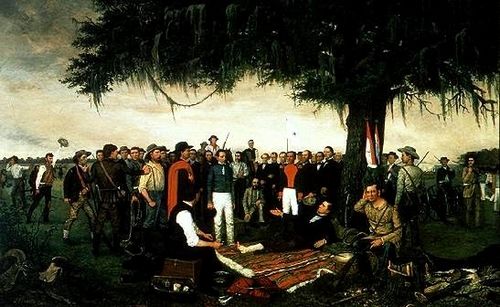
The Texas Revolution ended after the Battle of San Jacinto.
Territorial expansion of the United States to the Pacific Coast was the goal of President James K. Polk, who proceeded to defend the territory of the new state. Though the war was highly controversial, with the Whig Party and anti-slavery elements strongly opposed, Polk ordered General Zachary Taylor to lead his forces to the Rio Grande.
In January 1846, Taylor and 4,000 soldiers marched to the Rio Grande but were ordered not to attack the Mexicans. However, Taylor’s orders also required that he defend himself and his troops if the Mexicans instigated an assault. The troops initially patrolled the new border and scoured to see if any Mexican soldiers had crossed the Rio Grande.
On April 25, a company of some 70 Dragoons, commanded by Captain Seth Thornton, was scouting parts of the disputed area about 20 miles northwest of what is now Brownsville, Texas. Their mission was to determine whether or not the Mexican Army had crossed the Rio Grande for a possible attack on Fort Texas (later called Fort Brown). Acting on the advice of a local guide, the troops went to investigate an abandoned hacienda. They found 2,000 Mexican soldiers under the command of Colonel Anastasio Torrejón encamped in and around the hacienda.
Fighting immediately broke out, and though the vastly outnumbered U.S. troops fought ferociously, they were forced to surrender after several hours of resisting. Known as the Thornton Affair, Thornton Skirmish, or Thornton’s Defeat, 16 U.S. Dragoons were killed and five wounded, including Captain Thornton. However, one U.S. cavalryman escaped and returned to camp, reporting the Mexican opening of hostilities. Fifty men, including Captain Thornton, were taken prisoners and held at Matamoros, Tamaulipas, Mexico.
Upon learning of the incident, President Polk asked for a declaration of war before a joint session of the United States Congress, and on May 13, 1846, Congress declared war on Mexico.
The first battles were fought in Texas, including the Siege of Fort Texas, the Battle of Palo Alto, and the Battle of Resaca de la Palma. After these decisive victories, General Taylor began a campaign to invade Mexican territory.
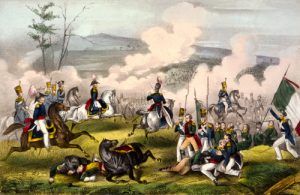
Battle of Palo Alto.

Cannon at the Palo Alto Battlefield outside Brownsville, Texas.
In Mexico, Taylor and Mexican leader General Santa Anna fought a desperate battle at Buena Vista in February 1847. Although the U.S. troops were vastly outnumbered, General Taylor placed his men so skillfully that he won a victory that ended the campaign in northern Mexico. However, this defeat and other skirmishes did not induce the Mexicans to relinquish all the territory that the United States demanded, so it was decided to send an army directly to the enemy’s capital in Mexico City.
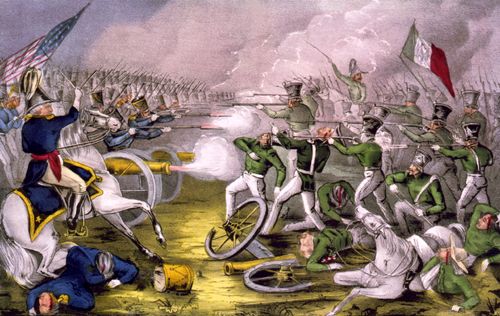
Battle of Buena Vista.
President Polk sent a second army under General Winfield Scott, who was transported by sea to the port of Vera Cruz to begin an invasion of the Mexican heartland. On March 9, 1847, Scott landed at the chief Mexican seaport on the eastern coast and captured the city.
From there, Scott and his army marched to Cerro Gordo, where the road to the capital city passes through the mountains. His plans were so skillfully executed that the Mexican army was defeated at that place and again at Pueblo. The Americans were now in the heart of Mexico, far away from their base of supplies and opposed by an army of many times their numbers, but they pressed on and captured the city’s defenses.
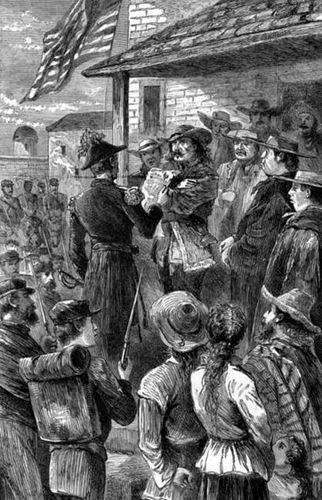
Stephen Kearny, Conquest of New Mexico.
In the meantime, citizens of California, which was still part of the Mexican Republic, also began to rebel. Unhappy with the way the Mexicans treated them, they established a republic of their own and asked the U.S. Government for help. Under the command of Commodore Robert F. Stockton, several naval vessels were sent to the Pacific Coast. Captain John C. Fremont of the U.S. Army also arrived to aid the Californians.
With a strong expedition in New Mexico, General Stephen W. Kearny was sent to capture the old Spanish-Mexican town of Santa Fe, which he did with little trouble before marching on to California. With the help of U.S. troops, the last battle was fought in California on January 9, 1847. On January 12, the last significant body of Californians surrendered to U.S. forces, marking the end of resistance in California.
Following a series of United States victories, the Treaty of Guadalupe Hidalgo, signed on February 2, 1848, brought an end to the two-year war. In return for $8,250,000, Mexico gave the U.S. undisputed control of Texas, with its border at the Rio Grande, and the U.S. agreed to withdraw its armies from Mexico. The treaty also required Mexico to relinquish its claims to California, New Mexico, and other lands now encompassed by Arizona, Nevada, Utah, Colorado, and Wyoming.
When the boundary line was to be surveyed, the American and Mexican commissioners were unable to agree. In the end, in 1853, the United States paid Mexico ten million dollars more and received a strip in the extreme southern parts of Arizona and New Mexico, thus making the southern boundary of the United States what it is today.
©Kathy Alexander/Legends of America, updated August 2025.
Also See:
The Mexican-American War on the Plains
American Wars and Military Photo Print Galleries
See Sources.