
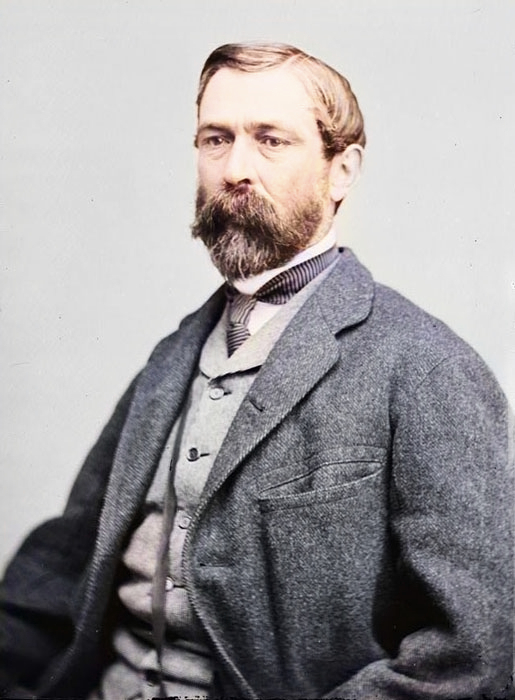
Confederate Major General Richard Taylor.
In the western part of Louisiana, Confederate Major General Richard Taylor engaged in a series of clashes with Union forces throughout 1863, primarily aimed at controlling the Bayou Teche region and disrupting Union supply lines. These operations included engagements like the Battle of Fort Bisland and the Battle of Irish Bend, where he fought against Union Major General Nathaniel P. Banks. Taylor also launched raids, including one on Brashear City (now Morgan City), capturing supplies and weapons.
LaFourche Crossing – June 20-21, 1863
Confederate Major General Richard Taylor sent an expedition under Colonel James P. Major to break Union supply lines, disrupt Union activities, and force an enemy withdrawal from Brashear (Morgan) City and Port Hudson. Major set out from Washington, Louisiana, on Bayou Teche, heading south and east. While marching, his men conducted raids on Union forces, boats, and plantations, and in the process captured animals and supplies and liberated slaves. Brigadier General William H. Emory, commanding the defenses of New Orleans, assigned Lieutenant Colonel Albert Stickney to command in Brashear City and to stem the Rebel raid if possible. Emory informed Stickney of Major’s descent on LaFourche Crossing and ordered him to send troops. Feeling that no threat to Brashear City existed, Stickney, himself, led troops off to LaFourche Crossing, arriving on the morning of the 20th.
That afternoon, Stickney’s scouts reported that the enemy was advancing rapidly. The Rebel forces began driving in Stickney’s pickets around 5:00 p.m. Confederate cavalry then advanced but was driven back. After the Union troops fired a few rounds, the Confederates withdrew in the direction of Thibodeaux. In the late afternoon of the 21st, Confederate soldiers engaged the Union pickets, and fighting continued for more than an hour before the Rebels retired. About 6:30 p.m., the Confederates reappeared in force, started an artillery duel, and charged the Union lines at 7:00 p.m. An hour later, the Confederates disengaged and retired toward Thibodeaux. The Union held the field. Despite the defeat, Major’s raiders continued to Brashear City. The Union Victory resulted in 268 total casualties, including 49 Union and 219 Confederate.
Donaldsonville II – June 28, 1963
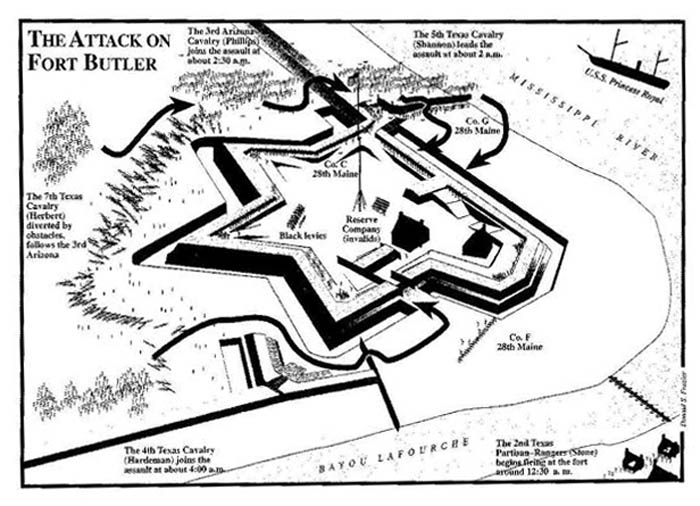
Fort Butler Attack.
As part of Taylor’s Operations in West Louisiana, the Second Battle of Donaldsonville was a Civil War battle that took place on June 28, 1863, in Ascension Parish, Louisiana. On June 28, 1863, Confederate Brigadier General Jean Alfred Mouton ordered Brigadier General Tom Green’s and Colonel James Patrick Major’s brigades to take Donaldsonville, Louisiana. The Union had built Fort Butler, which the Rebels had to take before occupying the town.
On the night of June 27, General Green, within a mile and a half of the fort, began moving troops ahead to attack. The Union forces were the Fort Butler Garrison: two companies of the 28th Maine Volunteer Infantry and some convalescents from various regiments. The Confederate forces were Tom Green’s Texas Brigade and Colonel James Patrick Major’s Texas Brigade.
The attack started soon after midnight, and the Confederates quickly surrounded the fort and began passing through the various obstructions. Unfortunately, those troops attacking along the levee came to a ditch, unknown to them, too wide to cross, that saved the day for the Union garrison. A Union gunboat, U.S.S. Princess Royal, came to the garrison’s aid and began shelling the attackers. Futile Confederate assaults continued for some time, but they eventually ceased their operations and retired. This point on the Mississippi remained in Union hands, and the Yankees occupied many other Mississippi River towns: the Confederates could harass but not eliminate these Union enclaves.
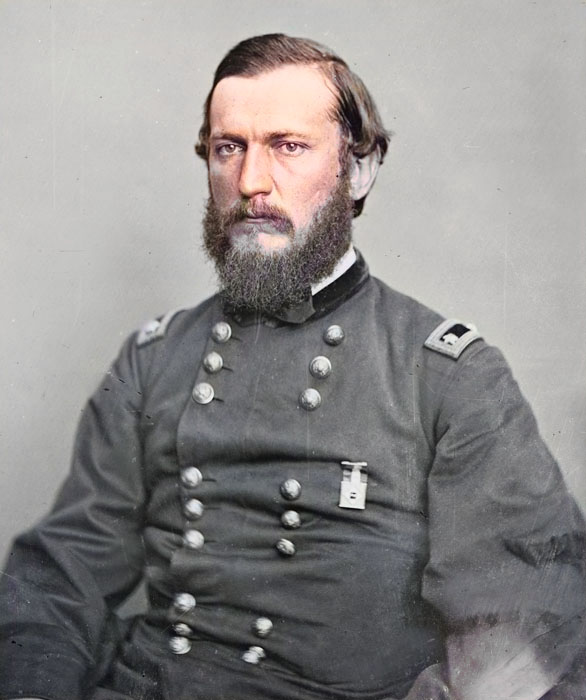
Union Brigadier General Godfrey Weitzel.
Kock’s Plantation – July 11-13, 1863 -The Battle of Kock’s Plantation, also known as Cox’s Plantation, occurred between June and September 1863 under the command of Union Brigadier General Godfrey Weitzel and Confederate Brigadier General Thomas Green.
Following the surrender of Port Hudson, two Union divisions were shifted to Donaldsonville by transports to move inland and pacify the interior. They marched up Bayou Lafourche, a division on each bank. Confederate Brigadier General Tom Green posted a brigade on the east side of the bayou and placed his second brigade on the other side.
As the Union forces advanced, skirmishing occurred on July 11 and 12. On the morning of the 13th, a foraging detachment set out along both banks of the bayou. Upon reaching Kock’s Plantation (Saint Emma Plantation), they met Rebel skirmishers who forced them back. Then, the Confederates flung their might against the Union troops, which kept retiring although they tried to make stands at various points.
The Union troops eventually fell back to the protection of the guns in Fort Butler at Donaldsonville, about six miles from Kock’s Plantation. A much smaller Rebel force had routed the Yankees. The expedition failed, leaving the Confederates in control of the interior. The Confederate Victory resulted in US 465 Union casualties and 33 Confederate casualties.
Stirling’s Plantation – September 29, 1863 – The Battle of Stirling’s Plantation, also known as Fordoche Bridge, was commanded by Union Major General Napoleon Dana and Confederate Brigadier General Thomas Green.
Following the Union defeat at Sabine Pass earlier in the month, Major General Nathaniel P. Banks intended to occupy important locations in Texas. He decided to send troops up the Bayou Teche, disembark them on the plains, and march overland to Texas. Major General Ulysses S. Grant sent him a division commanded by Major General Napoleon J.T. Dana to garrison Morganza and prevent Rebel troops from operating on the Atchafalaya River. A 1,000-man detachment, under the command of Lieutenant Colonel J.B. Leake, was at Stirling’s Plantation to guard the road to the Atchafalaya River and deter any enemy troops from passing by. Brigadier General Alfred Mouton, commander of the Sub-District of Southwestern Louisiana, decided that he had a favorable opportunity to defeat the Union forces around Fordoche Bridge.
On September 19, he instructed Brigadier General Tom Green to prepare for such an attack. Mouton provided Green with reinforcements and gave the order to attack on the 25th. Green’s force began crossing the Atchafalaya River on the 28th, and all was over after midnight of the 29th. At dawn on the 29th, Green’s men marched out. Confederate cavalry began skirmishing with Union pickets at Fordoche Bridge before noon and continued for about half an hour. Green’s other troops then hit the Union force, drove them, and captured many, although most of the Federal cavalry found an escape route. Although Dana sent reinforcements, mud and rain slowed their progress and allowed Green to get away. Green had defeated this Union force handily, but it did not deter Banks from his intended movement. The Confederate Victory resulted in 515 Union casualties and 121 Confederate casualties.
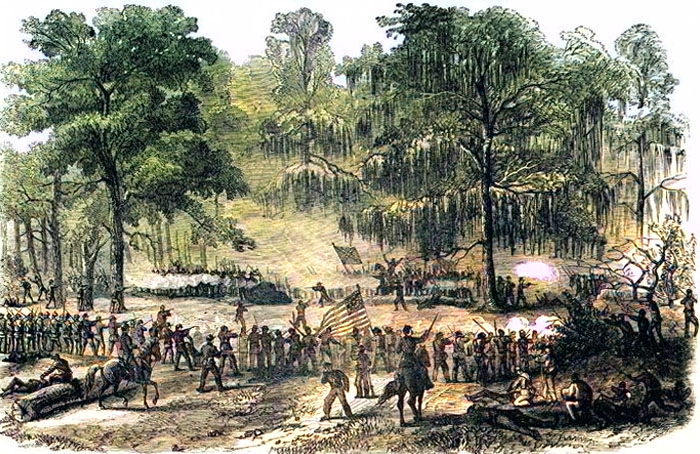
Battle of Bayou Bourbeux, Louisiana.
Bayou Bourbeux – November 3, 1863 – The Battle of Bayou Bourbeux, also known as the Battle of Grand Coteau or the Battle of Carrion Crow Bayou, was fought in Southwestern Louisiana, west of the town of Grand Coteau, Louisiana, during the Civil War. The engagement was between the forces of Confederate Brigadier General Thomas Green and Union Brigadier General Stephen G. Burbridge. Under orders from Major General Richard Taylor, Green launched the attack on the Union camp after receiving three infantry regiments on November 2. Colonel Oran M. Roberts led these regiments. Lieutenant William Marland of the 2nd Massachusetts Battery earned the Congressional Medal of Honor for his actions during this battle.
©Kathy Alexander/Legends of America, August 2025.
Also See:
Civil War – Main Page
Forts & Presidios Photo Gallery
Soldiers & Officers in American History
Sources: