
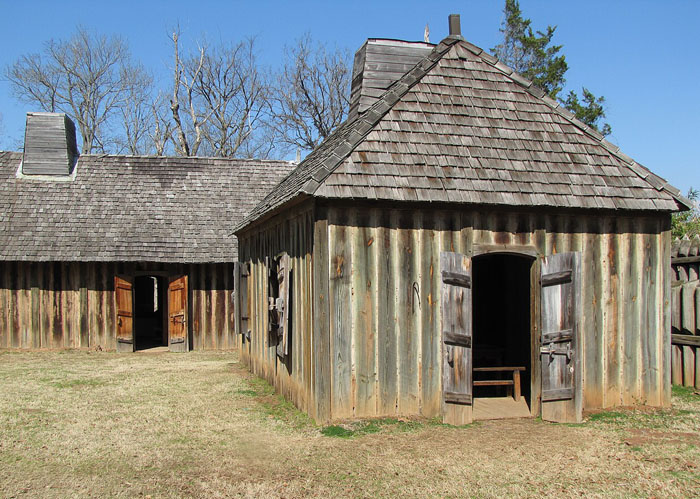
Fort St. Jean Baptiste, Louisiana, courtesy Wikipedia.
Fort St. Jean Baptiste is a Louisiana State Historic Site in Natchitoches. It is a replica of an early French fort based upon the original 1716 blueprints by Sieur Du Tisne, with the improvements made in 1731 by Boutin. The French called the original fort Fort Saint Jean Baptiste des Natchitoches. In the 1970s, the State of Louisiana anglicized the name to Fort Saint Jean Baptiste.
The fort was founded by a French Canadian, Louis Antoine Juchereau de St. Denis, in 1714 while he was traveling en route to Mexico from Mobile, Alabama, on a trade mission. When St. Denis reached the village of the Natchitoches Indians on the Red River, he had two huts constructed within the village and left a small detachment there to guard the stores and trade with the Native Americans. This became the first permanent European settlement in the territory later known as the Louisiana Purchase.
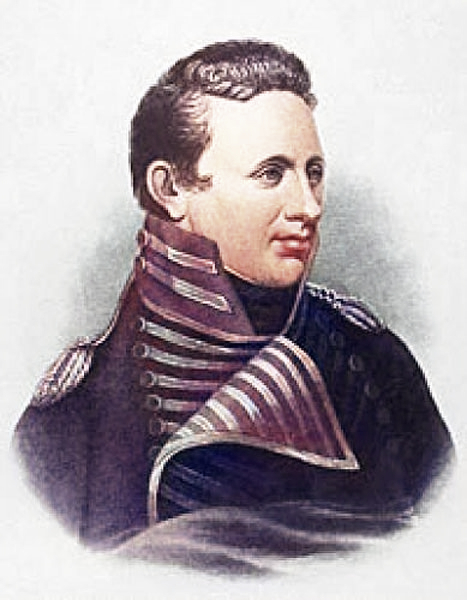
Sieur Charles Claude Du Tisne.
In 1716, Sieur Charles Claude Du Tisne was sent to Natchitoches with a small company of French colonial troops to build and garrison the outpost that would prevent the Spanish forces in the province of Texas from advancing across the border of French Louisiana. This strategic outpost was named Fort St. Jean Baptiste des Natchitoches. Economically, Natchitoches evolved into a primary French trade center in the Lower Mississippi Valley. Native American tribes of the three Caddo Confederacies played a vital role in establishing trade and communication links among the French, the Spanish, and the Native Americans of the region. The trade that developed with the Caddo forever changed the material culture of the tribes.
It was the first fortified outpost on the frontier between French Louisiana and New Spain. Its location remained internationally significant for well over a century.
In 1719, when Philippe Blondel, the garrison commander, heard of the war in Europe between Spain and France, he and a small detail of five French soldiers left Fort St. Jean Baptiste des Natchitches. They attacked the nearest Spanish fort, San Miguel de Linares de los Adaes Mission (Capital of Texas and Los Adaes), 15 miles away near the El Camino Real in present-day Robeline, Louisiana. The French captured the mission, taking the sacred vestments and other provisions, including the chickens in the henhouse. As Blondel mounted his horse after tying the chickens to the pommel of his saddle, the chickens flapped their wings, the horse reared, and the lieutenant fell in the dirt. The French victory was called the Chicken War. This caused the viceroy of Mexico to send the most significant military force in history into Louisiana.
In 1721-22, the Spanish founded a presidio at Los Adaes.
In 1722, St. Denis became commandant of the fort. The fort was established as a trading and military outpost to counter any Spanish incursions into French territory. Soon, it became a center of economic significance, particularly with neighboring Caddo tribes. In 1731, an attack by the Natchez Indians exposed the vulnerabilities of the fort, prompting French officials to send engineer Broutin to oversee the construction of a larger and stronger fortification. Spanish officials charged it was an invasion of Spanish territory, but St. Denis politely ignored their protests.
In 1731, the Natchez Indians, fresh from slaughtering the Fort Rosalie garrison in Natchez, Mississippi, attacked Fort St. Jean Baptiste. With the help of friendly Indian reinforcements, the French wiped out the attackers.
In 1737, because of recurrent floods, a new fort was built on high ground, in what is now the American Cemetery, and the old fort was abandoned.
By the mid-18th century, the Caddo tribes were almost entirely dependent upon French trade goods.
The fort continued to serve as a military outpost and commercial trade center until 1762, when France’s defeat by England in the French and Indian War forced her to cede the Louisiana colony to Spain. Under Spanish authority, the fort served as a trade center and a link in Spain’s intracolonial communications network. But since its original purpose of protecting a territorial boundary no longer applied, the Spanish eventually abandoned the fort.
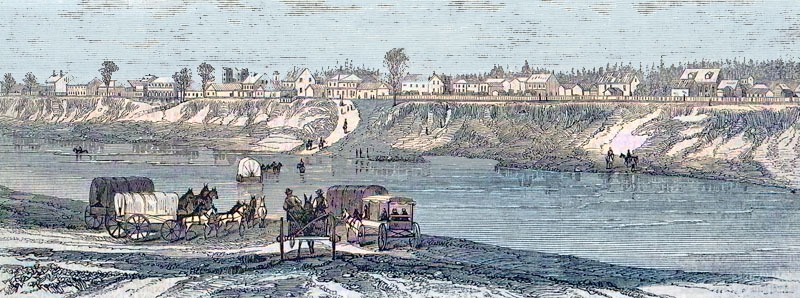
Natchitoches, Louisiana, 1864.
The newer fort was known to have been in existence in 1769. The fort was in such ruins by the time the United States acquired the area in the Louisiana Purchase in 1803 that the Americans could no longer use it, so they built Fort Claiborne nearby.
The fort turned into the city of Natchitoches, the oldest permanent European settlement in the Louisiana Purchase.
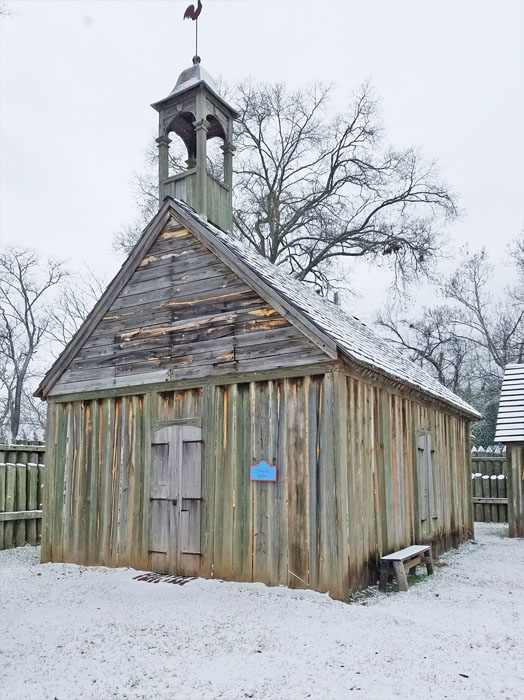
Fort St. Jean Baptiste State Historic Site.
In 1979, the site for the fort’s reconstruction was located on Cane River Lake (formerly the Red River), a few hundred yards from the original site. The fort was based upon Sieur Du Tisne and Broutin’s plans and on extensive archival research in Louisiana, Canada, and France. All of the metal hinges and latches were made at a local foundry, and most of the 2,000 treated pine logs, which form the palisade, and approximately 250,000 board feet of lumber for the buildings were sourced from within Natchitoches Parish. The fort is an attraction within the National Park Service’s Cane River National Heritage Area. The site is also host to living history re-enactments of what life in the fort was like in the 1750s. It is now a Louisiana state park unit. It is located in Natchitoches, Louisiana, along the El Camino Real de los Tejas.
©Kathy Alexander/Legends of America, August 2025.
Also See:
The Army and Westward Expansion
Forts & Presidios Photo Gallery
Soldiers & Officers in American History
Sources:
Fort St. Jean Baptiste – Facebook
Louisiana State Parks
Natchitoches.com
National Park Service
National Park Service – 2
Wikipedia