
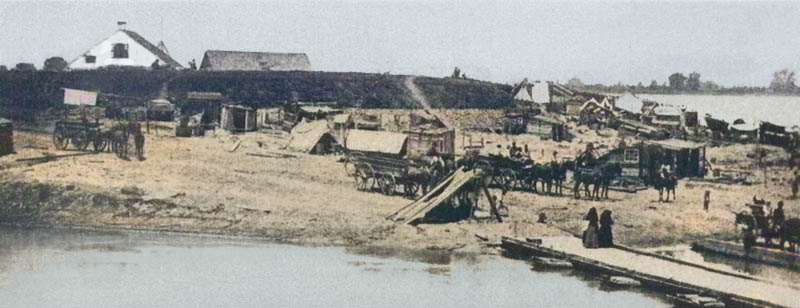
Fort Butler, Louisiana, in 1864.
Fort Butler, in Donaldsville, Louisiana, was a pivotal Civil War site, engineered by West Point, and built in 1863.
It was constructed to guard the confluence of the Mississippi River and Bayou Lafourche, a major outlet to the Gulf of Mexico. Although the fort is no longer standing today, the Fort Butler Historic Site, the five-star, star-shaped, log-and-earth construction, is now the site of an annual re-enactment.
In January 1861, Louisiana seceded from the Union and joined the Confederate States of America. Within weeks, the Civil War began on orders of President Abraham Lincoln and Confederate General Beauregard, a Louisiana Creole.
Sixteen months later, in April 1862, New Orleans quietly surrendered to an intimidating ultimatum by Admiral David Farragut. The city was quickly put under the brutal rule of General Benjamin Butler of Massachusetts.
In August 1862, Admiral Farragut threatened Donaldsonville’s Mayor Walker to lower the Confederate flag and surrender, but the mayor refused. Because of this, Farragut ordered his warships to destroy the town in the early hours of August 9. This was followed by the declaration of martial law and the military occupation of Donaldsonville, Ascension Parish, and most of the river parishes.
Within days, newspapers from New Orleans to New England reported on the event, with one writing:
“Farragut ordered his fleet to destroy Donaldsonville. There is nothing left of the place.”
Due to the town’s strategic location, the Confederacy was determined to retake it, along with New Orleans and control over the Mississippi River.
This prompted Union commander General George Strong to suggest to President Lincoln the construction of a fort on Bayou Lafourche, near the river. He stated, “A fort here will be instrumental to the control of the river.” With this suggestion approved, General Godfrey Weitzel proposed that Lieutenant John Palfrey, a Bostonian West Point graduate, be assigned to supervise the fort’s construction. Palfrey was not only educated in fortifications but also had strong ties to Louisiana, with family involved in politics and a relative who had previously lived in Donaldsonville. Additionally, Palfrey held roles as an officer, engineer, and spy. His covert mission was to build the fort while also gathering intelligence on Southern military decisions by leveraging his family connections in the region.
In October 1862, Lieutenant Palfrey and Colonel Richard Holcomb began constructing the fort with the help of fugitive slaves. The fort was designed in a star shape, built from earth and wood, and surrounded by a brick-lined moat that was 16 feet wide and 12 feet deep. The east side of the fort extended 381 feet. Stockades were built leading to the river and bayou, while rifle pits guarded the entrance. The fort was armed with seven 24-pound cannons, one 30-pound cannon, and one three-inch rifle for its defense. To the south, the land was cleared for 900 yards and arranged with camouflaged pits and felled trees, their sharpened branches facing the expected line of attack. Enemy forces would have to navigate through the moat, avoid cannon fire, and deal with small arms crossfire in order to capture the fort.
Major Joseph Bullen of the 28th Maine commanded Fort Butler, supported by two companies of the 28th Maine Volunteer Infantry, fewer than 200 men from the 1st Louisiana Volunteers, a handful of convalescents from the Louisiana Native Guard, and several fugitive slaves. These events initiated a migration of hundreds of slaves—now considered fugitives—into Donaldsonville, where they sought protection and freedom.
On February 9, 1863, Fort Butler was officially named in honor of General Benjamin Franklin Butler, a Union commander who many people in Southern Louisiana widely despised. Butler invited the residents of Donaldsonville to attend the ceremony dedicating the fort, issuing a prompt warning:
“This is the flag under which your fathers fought for freedom, the flag you have forsaken. Whoever attempts to pull it down will be shot.”
— Colonel RichardHolcomb, military commandant of Donaldsonville
While celebrated by Yankees, Southerners had critically awarded Butler the title of “Beast,” because of his orders that jailed women who insulted his troops, or anyone who was caught praying for the destruction of the United States. Additionally, because the former slaves were not free, General Butler reasoned they were fugitive property, classifying them as contraband and subject to confiscation. The Union then had a near limitless labor supply by which to carry on the war and the work on new Government Plantations, which continued as before, only under Union direction.
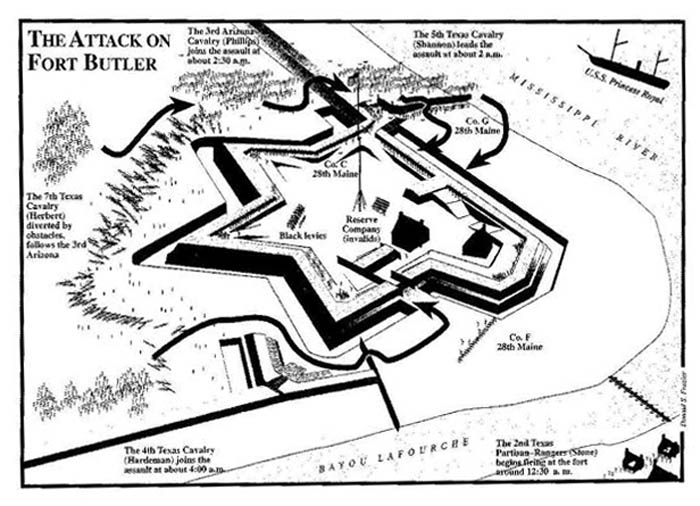
Fort Butler Attack.
The Battle of Fort Butler was critical in preventing the Confederates from regaining ground in Louisiana. In the spring of 1863, the only two remaining Confederate strongholds along the Mississippi River were Port Hudson and Vicksburg. To draw Union troops away from these locations and attempt to retake New Orleans, an attack by the Confederate soldiers on Fort Butler was planned for 2:00 a.m. on June 28, 1863. The battle lasted for hours and was led by General Richard Taylor with 800-1,000 Confederate troops and Major Joseph Bullen with only 180-200 Union troops, including white soldiers from the 28th Maine and African American troops from the Louisiana Native Guard who built the fort in the first place.
There, the Confederates found a brick-lined moat and an army surrounding the fort levee with seven 24-pound siege guns, two siege carriages, and two field guns. Although the Union soldiers were vastly outnumbered, and many were still recovering from previous battles, the Confederates were defeated by 6:00 a.m., thanks to faulty intelligence and the sharp obstacles barricading the front of the fort. Estimated casualties (dead and wounded) were 21 Union and 301 Confederate.
The fallen Confederate soldiers were placed in a mass grave adjacent to the fort.
The 28th Maine and 1st Louisiana received praise for their defense. The New Orleans Picayune wrote:
“The enemy attacked Donaldsonville and fought until repulsed. A hundred and twenty were captured.”
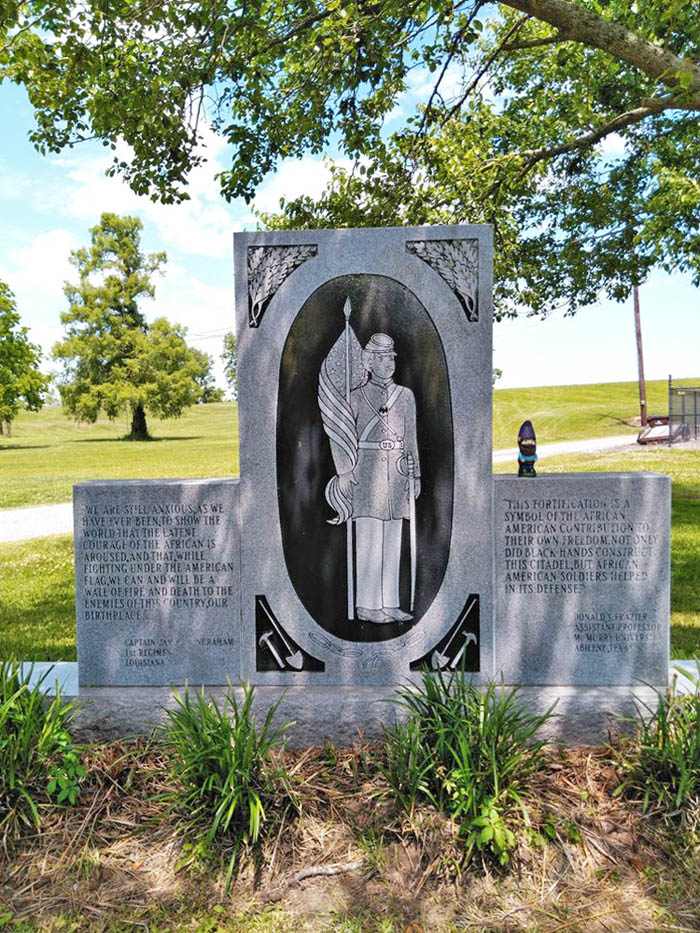
Fort Butler, Louisiana Memorial.
Throughout the rest of the war, Donaldsonville remained under Union occupation and was used as the headquarters for the Union Provost Marshall and later as a school.
In 1902, the fort’s remains were leveled with a dam at the Bayou Lafourche and then completely covered during levee construction in the 1930s.
Over time, the area was eventually converted into a parking lot.
The Fort Butler Historic Site offers a unique glimpse into the Civil War era, highlighting the fort’s role in the region’s complex history. Informative plaques detail the fort’s construction and its significance as a military outpost. Additionally, the site often hosts educational programs and events that engage visitors with interactive experiences and discussions about the historical impact of Fort Butler. The historic site is on Veterans Boulevard in Donaldson, Louisiana.
©Kathy Alexander/Legends of America, August 2025.
Also See:
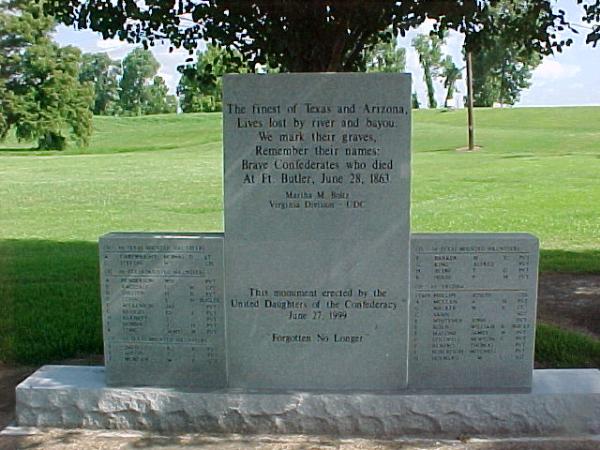
Fort Butler, Louisiana Memorial.
Civil War – Main Page
Forts & Presidios Photo Gallery
Soldiers & Officers in American History
Sources: