
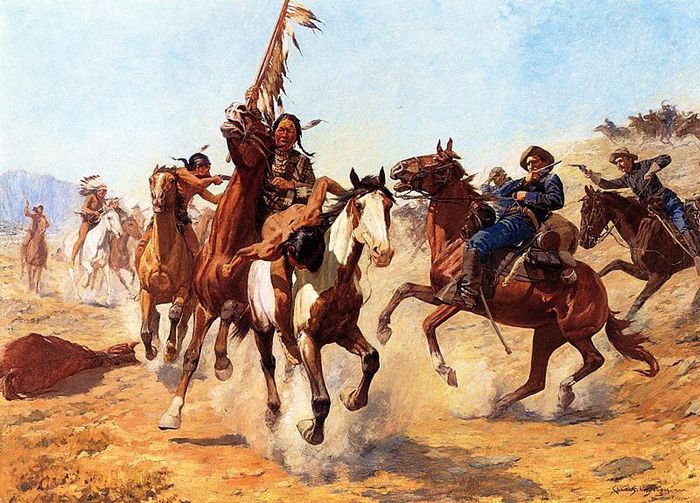
Indian Battle
The Battle of Pease Bottom was a conflict between the United States Army and the Sioux on August 11, 1873, along the Yellowstone River opposite the mouth of the Bighorn River near present-day Custer, Montana. The main combatants were units of the 7th U.S. Cavalry under Lieutenant Colonel George Armstrong Custer, and Native Americans from the village of the Hunkpapa Sioux medicine man, Sitting Bull.
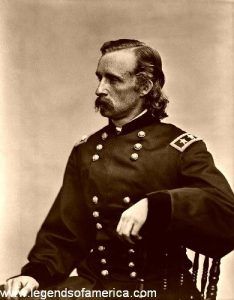
George A. Custer
Custer and ten companies of the 7th Cavalry were part of the Yellowstone Expedition of 1873, a military column commanded by Colonel David S. Stanley accompanying the Northern Pacific Railroad survey party surveying the north side of the Yellowstone River west of the Powder River in eastern Montana. Stanley’s column consisted of a 1,300-man force of cavalry, infantry, and three artillery pieces, 275 mule-drawn wagons, and 353 civilians involved in the survey. Twenty-seven Indian and mixed-blood scouts supported the column.
This was Lieutenant Colonel George A. Custer’s first skirmish with the Lakota Sioux, which occurred along the north side of the Yellowstone River during the summer of 1873. The 7th Cavalry was comprised of eight companies numbering about 450 men.
On August 11, 1873, Lieutenant Custer engaged the Lakota in response to an attack on the Seventh Cavalry’s camp below the mouth of the Bighorn River.
At dawn, the Lakota began firing their rifles into the troopers’ camp from the safety of the cliffs on the south side of the Yellowstone River. Lakota War parties then crossed the river for a series of attacks and feints on the cavalry. Late in the afternoon, Colonel Stanley’s infantry companies arrived, including the artillery units. Cannon fire directed across the river finally chased off the Indians.
The Sioux forces from Sitting Bull’s village were estimated at anywhere from 400 to 500 lodges. It included Hunkpapa Sioux under Chief Gall, accompanied by the warchief Rain in the Face, Oglala Sioux under Crazy Horse, and Miniconjou and Cheyenne. The warrior force was estimated at between 800 and 1,000 warriors.
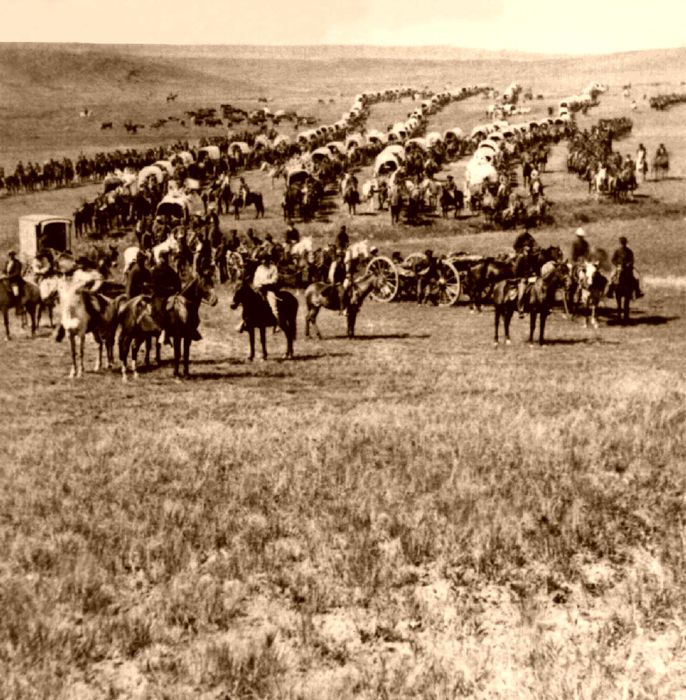
George Custer leads an expedition into the Black Hills in 1874.
Although casualties were light, with one man killed and several wounded, the Seventh Cavalry spent the better part of the day in a futile chase of the Lakota. The day’s events probably confirmed what Custer and most of the officer corps already believed about their adversary – that Indians would flee in the face of any attack by the cavalry, an assumption with fatal consequences three years later.
One other skirmish between the Seventh and the Lakota occurred a few days later near Pompey’s Pillar when the Lakota fired on Seventh Cavalry troopers swimming in the Yellowstone River. The ambush forced the naked men to take cover, much to the amusement of the Indians. Afterward, the entire command marched north, surveying a section of the Musselshell River east-west railroad route before returning to the forts in the Dakotas.