
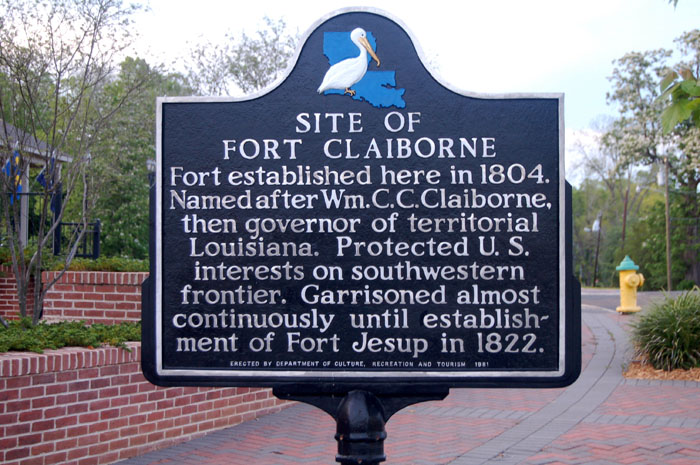
Fort Claiborne Marker, Louisiana site.
Fort Claiborne, a U.S. Army fort in Natchitoches, Louisiana, was established on August 4, 1804, by Captain Edward D. Turner, 2nd U.S. Infantry, under orders from General James Wilkinson. It was named after Louisiana Territorial Governor William C.C. Claiborne. The fort was also known as Post at Natchitoches or Post on Cane River.
It was built in 1804 after the Louisiana Purchase of 1803, which necessitated that the Americans protect their newly acquired property, much to the chagrin of the French and Spanish Creoles in northern Louisiana, who saw these “depraved Americans” as a threat to their way of life. The conflict between the American newcomers and the “old inhabitants” along the Red River became apparent with the establishment of the post.
Established a short distance from the old French Fort Saint Jean Baptiste, about 300 yards west of the river, the post occupied about two acres with a palisaded rectangular enclosure parallel to the river. The enclosure had two free-standing barracks buildings on the south end and a two-story free-standing blockhouse inside the north end. The second story of the blockhouse was canted 90 degrees from the first story.
The Creole (French/Spanish) parishioners of Natchitoches sued the American government to remove the fort, as they believed it was built on communal property overseen by the church, located at the fort’s southeastern corner. The suspicion that the Creole community had against the Americans was evidenced by the abandonment of the original cemetery at the location of Fort St. Jean Baptiste. The Catholic Creoles removed their dead from the cemetery once protestants began burying their own at the newly renamed “American Cemetery.”
A government Indian Factory of the Caddo Indian Agency was also established here in October 1805.
The fort became a substantial locale as it continued to be occupied for close to 15 years. Here, the Indian Agent Dr. John Sibley signed treaties with Caddoan, Coushatta, and other tribes – including the famous Caddo Chief, Dehahuit – to begin the process of westward removal.
The Red River Expedition of 1806 by Peter Custis, Thomas Freeman, and Captain Sparks was launched from Fort Claiborne.
In 1818, the Indian Factory of the Caddo Indian Agency relocated to the Sulphur Fork of the Red River in present-day Arkansas.
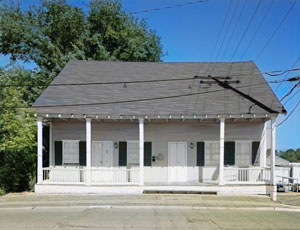
Fort Claiborne Guest House, 801 Second Street, Natchitoches, Louisiana, by the Historic American Building Survey.
Fort Claiborne was garrisoned almost continuously by various companies of the U.S. 2nd, 1st, and 7th Infantry Regiments, and the Rifle Regiment, as well as one or two companies of artillery. It was ordered to evacuate to Fort Selden on Bayou Pierre in June 1819. The old post was demolished in July 1819. There is a state marker located at 2nd and Lafayette Streets.
After the signing of the Adams-Onis Treaty of 1819, which legally named the border between New Spain and the Louisiana Territory, the Mexican Revolution of 1821, and the American push into North Texas, the U.S. government established Fort Jesup along the Spanish Road Camino de Real)northwest of Natchitoches.
Today, the old location of Fort Claiborne has been reclaimed by the Natchitoches citizens. The convention and visitor’s bureau, the Louisiana museum and hall of fame, the events center, the Main Street office, and other city service buildings now occupy the site. The only reminder of the old fort is its guest house, which sits at the corner of Second and Lafayette Streets. The house, built in about 1810, was once located just outside the former stockade, but was perhaps not originally a military structure.