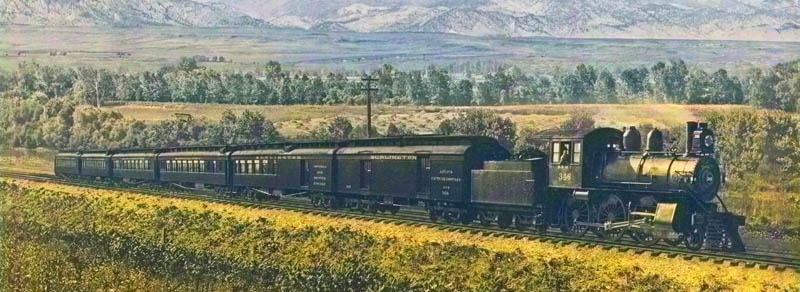
Chicago Special, Burlington Route, Colorado by William Henry Jackson, 1900.
The Chicago, Burlington & Quincy Railroad (reporting mark CBQ) was a railroad that operated in the Midwestern United States. Commonly referred to as the Burlington Route, the railroad operated extensive trackage in Colorado, Illinois, Iowa, Missouri, Nebraska, Wisconsin, Wyoming, and Texas through its subsidiaries, the Colorado and Southern Railway, Fort Worth and Denver Railway, and the Burlington-Rock Island Railroad. Its primary connections included Chicago, Minneapolis-Saint Paul, St. Louis, Kansas City, and Denver.
The earliest predecessor of the Chicago, Burlington & Quincy, the Aurora Branch Railroad, was chartered by an act of the Illinois General Assembly on October 2, 1848. The charter was obtained by Aurora and Batavia, Illinois citizens, who were concerned that the Galena and Chicago Union Railroad would bypass their towns in favor of West Chicago on its route, the only line running west from Chicago. The line from Aurora to Chicago was built through the fledgling towns of Naperville, Lisle, Downers Grove, Hinsdale, Berwyn, and the west side of Chicago.
The railroad started on February 12, 1849, in Aurora, Illinois. The Aurora Branch Railroad was laid with secondhand strap iron spiked to 12 miles of wooden rails. On September 2, 1850, the first train made its way over six miles from Batavia, Illinois, north to Turner Junction, and eastward to Chicago over the Galena and Chicago Union Railroad tracks. The locomotive and cars were borrowed from the Galena line as their equipment had not yet arrived. This allowed the Aurora Branch to be the second railroad to serve Chicago.
The Burlington and Missouri River Railroad across Iowa was incorporated in Burlington in 1852.
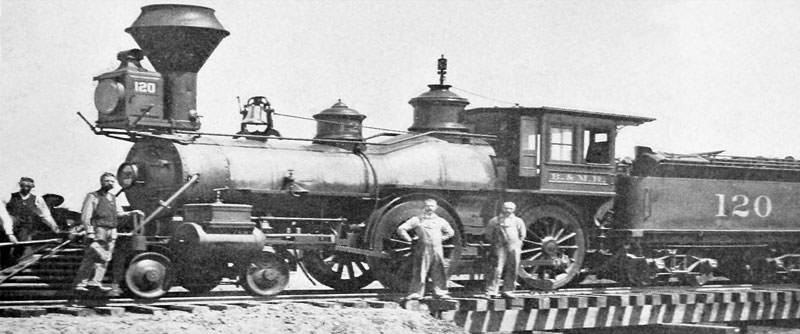
Burlington and Missouri River Railroad locomotive, 1886.
On June 22, 1852, the company was renamed Chicago and Aurora Railroad and given expanded powers to extend from Aurora to a point north of LaSalle; this extension to Mendota was completed on October 20, 1853.
Another amendment, passed February 28, 1854, authorized the company to build east from Aurora to Chicago via Naperville and changed its name to Chicago and Southwestern Railroad.
Chicago, Burlington, and Quincy Railroad representatives worked closely with farmers and ranchers as early as 1854. Throughout the years, products from farms and ranches were essential to the railroad, known as the “Granger Railroad.” The railroad advised prospective settlers on what crops could be successfully raised. It aggressively promoted crop and stock improvement, irrigation, and soil conservation.
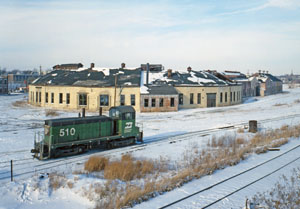
Chicago, Burlington & Quincy Railroad, Roundhouse & Shops in Aurora, Illinois, by the Historic American Building Survey.
Early repair shops for rolling stock were built by the Aurora Branch Railroad in Chicago, but the first true shop site was established in Aurora, Illinois, in 1855. These could repair and build locomotives, freight cars, and passenger cars. As the system grew, other shop sites were established or inherited from predecessor lines.
Operations began over the first few miles of track on New Year’s Day, 1856. The company was renamed the Chicago, Burlington, and Quincy Railroad that year. It soon reached its other namesake cities: Burlington, Iowa, and Quincy, Illinois.
In 1859, John Murray Forbes officially founded the Chicago, Burlington & Quincy Railroad Company, which combined several smaller Midwestern railroads. It grew until it extended from the Great Lakes to the Rocky Mountains. The road reached Ottumwa by September 1, 1859, where track-building stalled until after the Civil War.
In 1860, the Hannibal & St Joseph Railroad in Missouri carried the mail to the Pony Express upon reaching the Missouri River at St. Joseph, Missouri.
The first railway post office was inaugurated on July 28, 1862, using converted baggage cars on the Hannibal & St. Joseph Railroad.
Burlington’s rapid expansion after the Civil War was based upon sound financial management, dominated by John Murray Forbes of Boston and assisted by Charles Elliott Perkins. Perkins was a powerful administrator who eventually forged a system out of previously loosely held affiliates, virtually tripling Burlington’s size during his presidency.
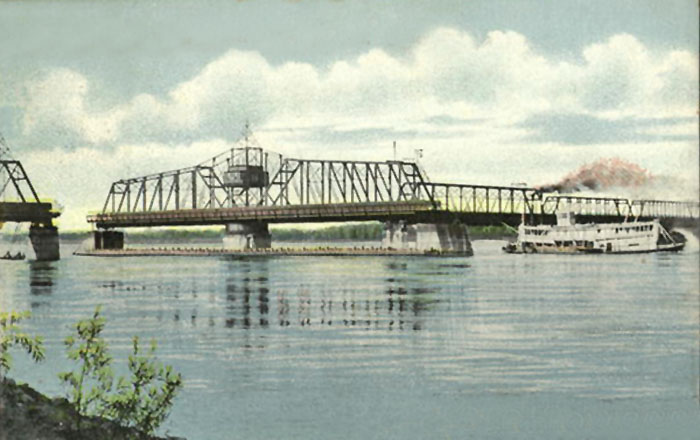
Chicago, Burlington & Quincy Railroad bridge over the Mississippi River in Quincy, Illinois.
In 1868, the Chicago, Burlington & Quincy Railroad completed bridges over the Mississippi River at both Burlington and Quincy, connecting the railroad with the Burlington and Missouri River Railroad in Iowa and the Hannibal & St. Joseph Railroad in Missouri.
The Burlington and Missouri River Railroad continued building west into Nebraska as a separate company, the Burlington and Missouri River Railroad, founded in 1869.
During the summer of 1870, it reached Lincoln, the newly designated capital of Nebraska, and by 1872, it reached Kearney, Nebraska. That same year, the Burlington and Missouri River Railroad across Iowa was absorbed by the Chicago, Burlington & Quincy Railroad. By the time the Missouri River bridge at Plattsmouth, Nebraska, was completed, the Burlington and Missouri River Railroad in Nebraska was well on its way to Denver. That same year, the Nebraska, Burlington, & Missouri River Railroad was purchased by the Chicago, Burlington & Quincy Railroad, which completed the line to Denver by 1882.
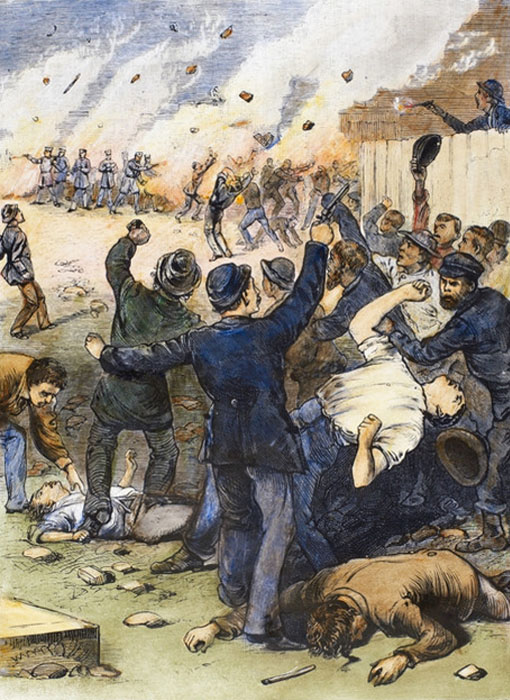
Chicago, Burlington & Quincy Railroad strike in 1888.
The only major strike in the line’s history occurred in 1888. Unlike most strikes, which were based on unskilled workers, this one was based on highly skilled, well-paid engineers and firemen, a challenge to management. A settlement would have been cheaper, but President Perkins was determined to assert ownership rights and destroy the union threat. The fight dragged on for ten months before the financially and emotionally exhausted strikers finally gave up, and Perkins declared a total victory. However, he had spent heavily on strikebreakers, lawsuits, and police protection, hurting the balance sheets and putting the railroad in a poor position to face the nationwide depression of the Panic of 1893.
Ultimately, Perkins believed the Burlington Railroad must be included in a powerful transcontinental system. Though the railroad stretched as far west as Denver and Billings, Montana, it had failed to reach the Pacific Coast during the 1880s and 1890s, when construction was less expensive. Though approached by E.H. Harriman of the Union Pacific Railroad, Perkins felt his railroad was a more natural fit with James J. Hill’s Great Northern Railway. With its river line to the Twin Cities, the Burlington Route formed a natural connection between Hill’s headquarters in St. Paul, Minnesota, and the railroad hub of Chicago. Moreover, Hill was willing to meet Perkins’ $200-a-share asking price for Burlington’s stock.
By 1899, the company had rostered 1,205 locomotives, 936 passenger cars, and 40,720 freight cars.
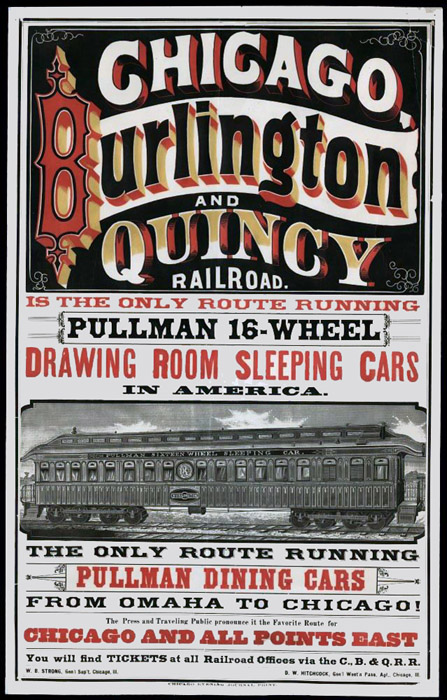
Chicago, Burlington & Quincy Railroad Poster.
In 1901, a rebuffed Harriman tried to gain an indirect influence over the Burlington by launching a stock raid on the Northern Pacific. Though Hill managed to fend off this attack on his nascent system, it led to the creation of the Northern Securities Company and, later, the Northern Securities Co. v. United States ruling by the U.S. Supreme Court.
At the turn of the century, railroad “Empire Builder,” James J. Hill, founder of the Great Northern Railroad, purchased 97.2% of the Chicago, Burlington & Quincy Railroad, paying $200 per share. He sought to combine it with his Great Northern Railway and with J.P. Morgan’s Northern Pacific Railway, but in 1904, the U.S. Supreme Court, in the Northern Securities case, declared the scheme illegal under the Sherman Antitrust Act.
By the early 1900s, the shops at Aurora served the Chicago Division, the shops in Galesburg, Illinois, the shops in Hannibal, Missouri, the shops in St. Louis, the shops in West Burlington, Iowa, and Creston, Iowa, the shops in Iowa, and the shops in Denver, Colorado, the shops in McCook and Red Cloud Divisions.
Always anxious to employ the latest technology, Burlington operated the first printing telegraph in 1910, was the first railroad to use train radio in 1915, and was among the first to utilize centralized traffic control in 1927.
Perhaps Burlington’s best-known achievement occurred in 1934 with the introduction of the Pioneer Zephyr — America’s first diesel-powered streamlined passenger train. Its high-speed diesel-electric propulsion system was the forerunner of thousands of diesels that replaced steam locomotives on virtually every railroad a few short years after World War II. On May 26, 1934, the Burlington staged one of the greatest transportation events of the 1930s — a 1,000-mile record-breaking, non-stop run from Denver, Colorado, to the World’s Fair on Chicago’s lakefront, where the Pioneer Zephyr climaxed the “Wings of a Century” transportation pageant. News bulletins had been broadcast throughout the day as the train streaked through villages and cities. The highest speed attained was 112.5 miles per hour, and the total fuel cost for the trip was $14.64.
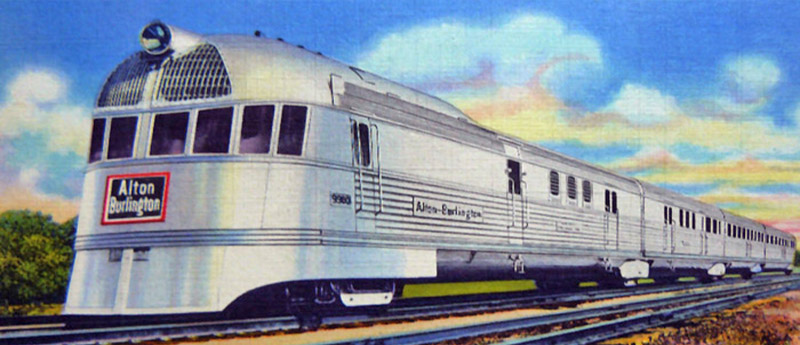
Chicago, Burlington & Quincy Railroad Zephyr.
Because of this extensive trackage in the Midwest and mountain states, the railroad used the advertising slogans “Everywhere West,” “Way of the Zephyrs,” and “The Way West.”
Burlington’s first freight diesels were purchased in 1944, and 95% of its trains were dieselized by 1953.
In 1945, Burlington created America’s first vista-dome passenger car, and in 1950, it ushered in the age of modern commuting, bringing to Chicago America’s first double-deck, stainless steel suburban equipment.
Beginning in the summer of 1955, the Chicago, Burlington, and Quincy Railroad hosted a series of occasional steam excursion trains at the request of railfan clubs, such as the Illinois Railroad Club. Harry C. Murphy, a steam fan who recognized the popularity of steam locomotives, authorized additional steam excursion trains on the railroad throughout the late 1950s and early 1960s. During this time, 21 steam locomotives of varying classes participated in Chicago, Burlington, and Quincy’s new steam excursion program.
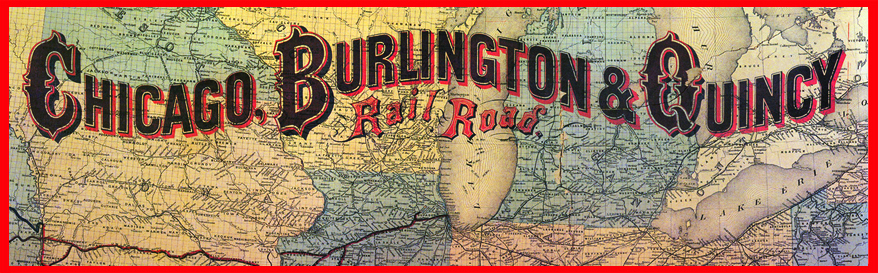
Chicago, Burlington & Quincy Railroad Map.
In 1964, steam excursion operations on the railroad had dwindled due to rising operational and maintenance costs, as well as a loss of experienced steam locomotive mechanics. Public demand and Harry Murphy’s passion for steam kept the Chicago, Burlington & Quincy’s steam program going. In reducing operating costs for the railroad, Harry Murphy’s successor, Louis Menk, ordered the Chicago, Burlington & Quincy’s steam excursion program to be shut down by August 1, 1966. Despite a subsequent public outcry and protest over the program’s cancellation, the railroad’s final excursion train ran on July 17.
On March 2, 1970, the Chicago, Burlington, and Quincy Railroad became part of the Burlington Northern Railroad, which merged the Chicago, Burlington, and Quincy with its owners, the Great Northern and the Northern Pacific. The Burlington Northern painted Burlington’s bright Chinese Red locomotives Cascade Green, and they continued pulling freight trains of all kinds. The most frequent trains of the modern age were unit trains of coal, grain, and intermodal containers.
Shortly after that, America’s passenger trains were nationalized with the creation of Amtrak. The silver, stainless steel Zephyrs gave way to a rainbow of equipment from railroads nationwide.
The new system merged with the St. Louis and San Francisco Railroad in 1980. The latter had lines extending from Chicago and Minneapolis, Minnesota, to Denver, Colorado, and the Pacific Northwest, and through Denver to Houston and Galveston, Texas.
On September 22, 1995, another merger, combining the Burlington Northern with the Atchison, Topeka & Santa Fe Railroad, created the current Burlington Northern Santa Fe Railroad.
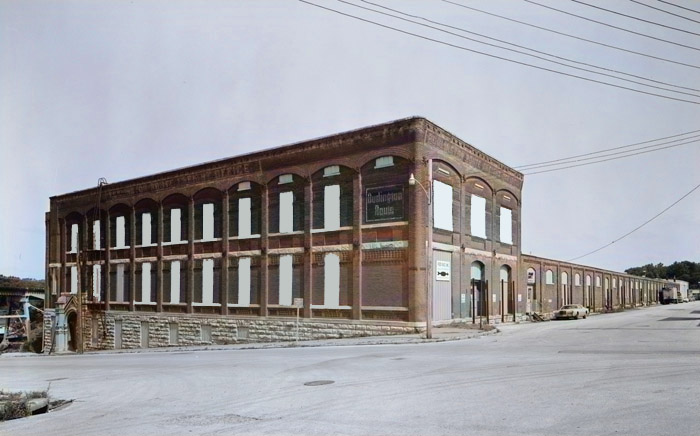
Chicago, Burlington & Quincy Railroad Freight Office in Quincy, Illinois.
©Kathy Alexander/Legends of America, updated July 2025.
Also See:
A Century of Railroad Building
Linking the Oceans By Railroad
Vintage Photographs of Railroads & Depots
Sources:
Encyclopedia Britannica
Denvers Railroads
Burlington Route
Wikipedia