
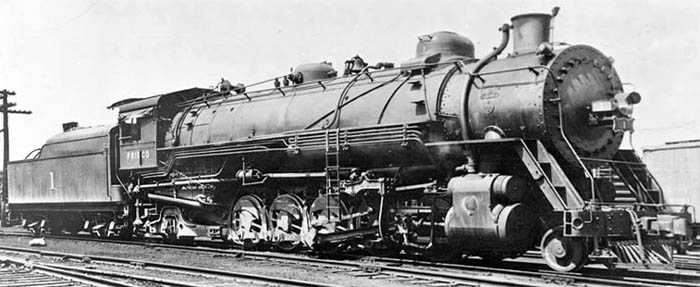
St. Louis-San Francisco Railway.
Frisco Railroad Logo
The St. Louis-San Francisco Railway, more familiarly known as the “Frisco,” was a dominant railroad line throughout the south-central United States, primarily in Missouri, Arkansas, Oklahoma, and Kansas.
Incorporated in Missouri on September 7, 1876, the St. Louis and San Francisco Railroad was formed from the Missouri Division and Central Division of the Atlantic and Pacific Railroad, which had gone bankrupt. The Pacific Railroad of Missouri created many of these original tracks as early as 1855. However, construction was dramatically cut back during the Civil War.
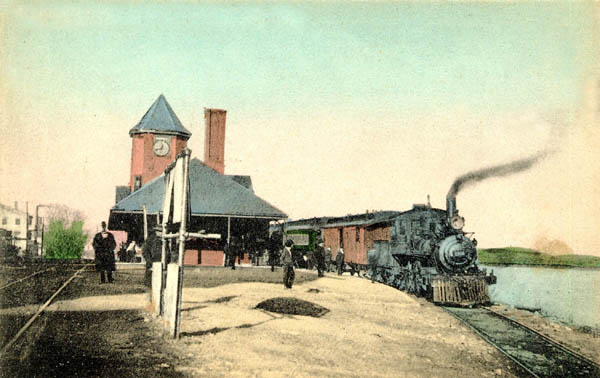
St. Louis & San Francisco Railway in Cape Girardeau, Missouri.
The Frisco acquired rights-of-way through much of the region and was interested in developing the land, eventually bringing people to an area. This development often led to westward expansion in the second half of the 19th century and the development of several towns.
The tracks were aggressively expanded into Oklahoma and Kansas and, by the 1880s, were completed through Tulsa to Sapulpa, Oklahoma. After the turn of the century, Frisco completed the line through Kansas, Oklahoma, and Texas. In 1901, the Railway expanded to the Southeast and, by the 1920s, had reached the Gulf of Mexico at Pensacola, Florida.
However, Frisco’s rapid expansion and acquisitions also caused financial difficulties for the line by 1912. That year, levees along the Mississippi River gave way, flooding the mainline for more than a month and a half, further hurting its revenue. Beginning in 1913, the railroad went into receivership for three years, and in August 1916, it was reorganized as the St. Louis-San Francisco Railway.
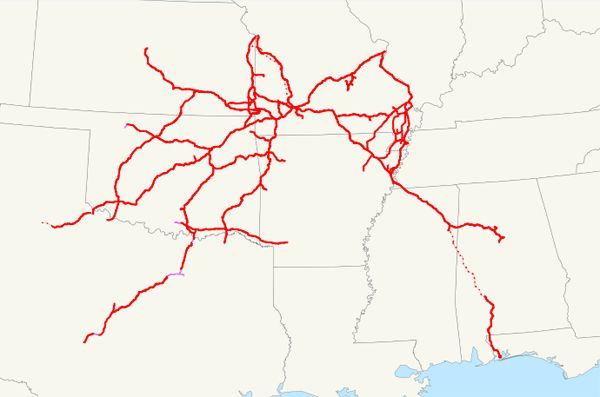
Frisco system in 1918.
From March 1917 through January 1959, the Frisco operated the Texas Special in a joint venture with the Missouri-Kansas-Texas Railroad. This luxurious streamliner ran from St. Louis, Missouri, to Dallas, Ft. Worth, and San Antonio, Texas.
After World War I, the Frisco struggled through the 1920s and 1930s, falling into receivership again in 1932 and abandoning many branch lines. However, it continued, and after World War II, it became a much leaner company, emphasizing its profitable freight lines.
With the rise of automobile use and the interstate system, passenger service declined on all rail lines during the 1950s, and Frisco began to terminate its passenger services. In 1978, Frisco became part of the Burlington Northern Railroad system, which joined with the Santa Fe Railroad to become the Burlington Northern Santa Fe (BNSF) in 1995.
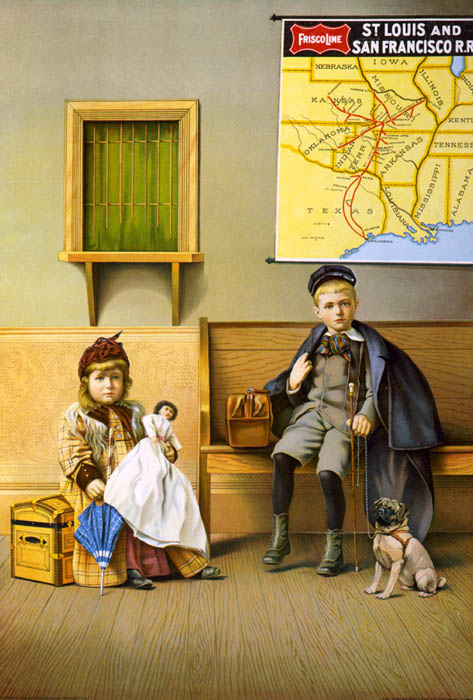
St. Louis & San Francisco Railway Station by Strobridge Litho, 1899.
Despite its name, the railroad never went west of Texas.