
Trail of Blood on Ice.
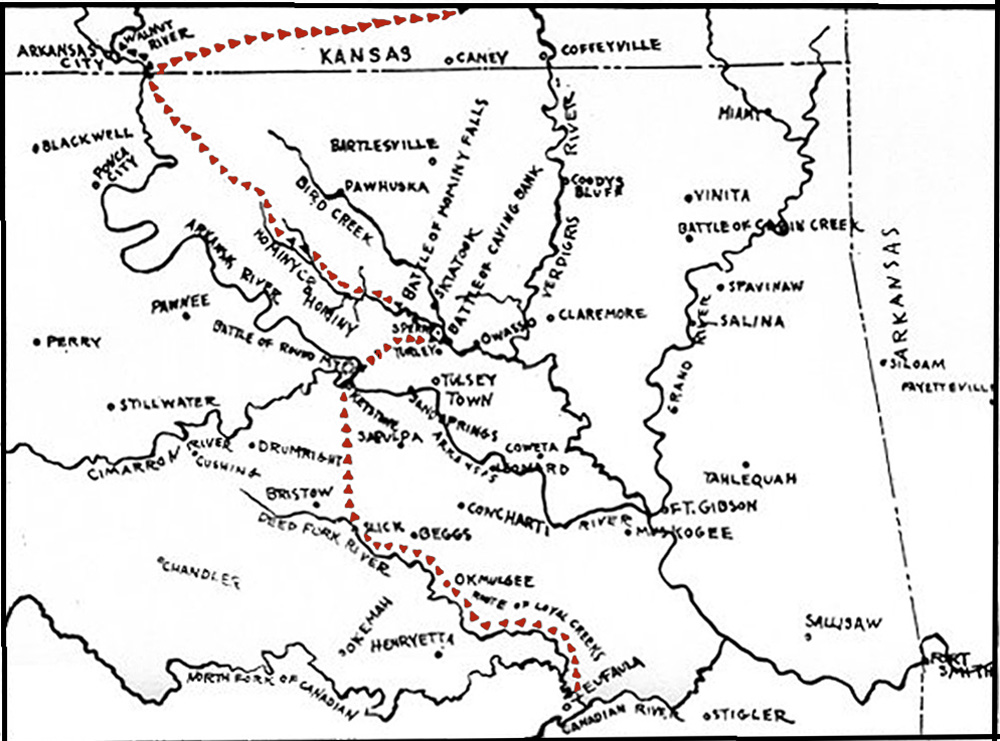
The Trail of Blood on Ice was a Civil War Campaign in December 1861 in which pro-Union Native Americans were led by Upper Creek Indian Chief Opothle Yahola to Fort Row in Kansas.
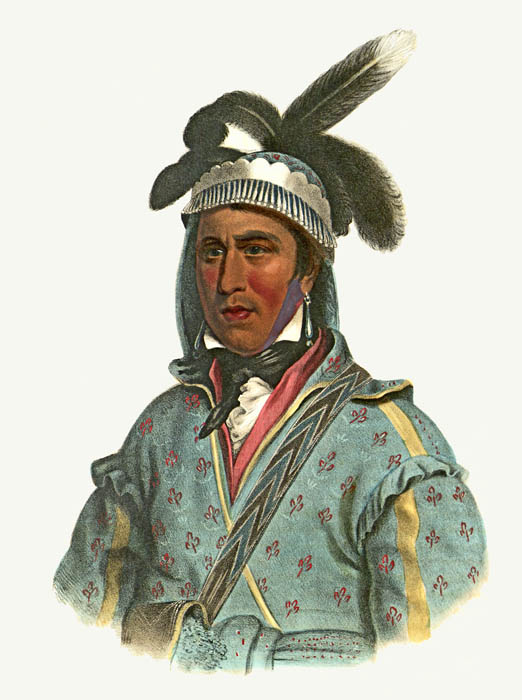
Muskogee Creek leader Opothle Yoholo.
With the secession of eleven Southern states in 1861, the Union and the Confederate States of America vied for control of the Indian Territory (Oklahoma.) Most of the tribes initially leaned toward supporting the Union. However, that changed with Fort Sumter, South Carolina’s fall, and the subsequent Confederate victory at the First Battle of Manassas. Leaders of the Cherokee, then the largest of the Indian nations in Indian Territory, lobbied for the territory to align itself with the Confederacy. Old tribal rivalries were renewed, with some aligning with the North and others with the South.
When a Confederate force under Colonel Douglas H. Cooper attacked Unionist tribes in Indian Territory, Upper Creek Chief Opothle Yahola resisted and led Unionist Creek and Seminole Indians from McIntosh County, Oklahoma, north to Fort Row, in Wilson County, Kansas. Along the way, the fleeing Indians faced continuing attacks from Confederate forces under Colonel Cooper. Their bitterly harsh trek is known as the “Trail of Blood on Ice.”
Battle of Round Mountain
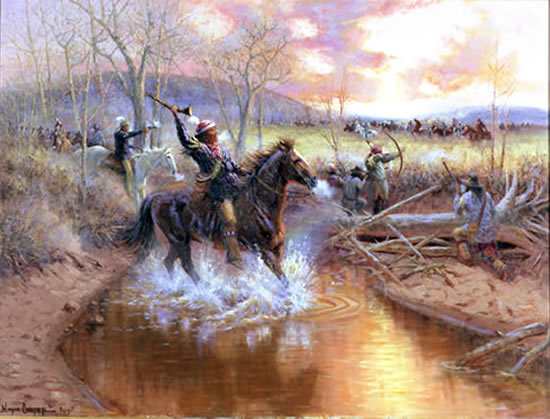
Battle of Round Mountain, Oklahoma, by Wayne Cooper.
The first engagement, the Battle of Round Mountain, occurred on November 19, 1861, near the Red Fork of the Arkansas River. The actual location is in dispute as some historians believe it to be near Keystone, while others believe it to be near Yale, Oklahoma. The evidence slightly favors the site near Yale, known as Twin Mounds.
Cooper’s men arrived there around 4:00 p.m., where the cavalry discovered that Opothle Yahola’s followers had recently abandoned their camp. The Confederates located and followed stragglers; the 4th Texas blundered into Opothle Yahola’s warriors on the tree line at the foot of the Round Mountains. The Federal response chased the Confederate cavalry back to Cooper’s main force. Darkness prevented Cooper’s counterattack until the main enemy force was within 60 yards. After a short fight, Opothle Yahola’s men set fire to the prairie grass and retreated.
Battle of Chusto-Talasah
The second engagement, the Battle of Chusto-Talasah, also known as “Caving Banks,” was fought on December 9, 1861, near Sperry, Oklahoma. Cooper attacked and attempted to outflank the Federals for almost four hours, finally driving them east across Bird Creek just before dark. Cooper camped there overnight but did not pursue the Federals because he was short of ammunition. The Confederates claimed victory. Chief Opothle Yahola and his band moved off in search of security elsewhere. Cooper estimated their loss to be 500. Confederate casualties were 15 killed and 37 wounded.
Battle of Chustenahlah
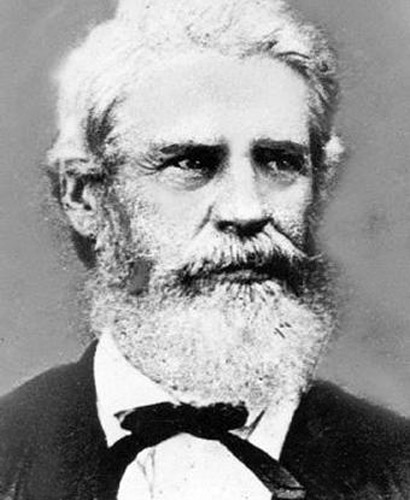
Colonel Douglas H. Cooper
The third and final engagement, the Battle of Chustenahlah, occurred on December 26, 1861, near Skiatook, Oklahoma. Colonels James M. McIntosh and Douglas H. Cooper planned a combined attack, with each column moving on the camp from different directions. McIntosh left Fort Gibson on December 22 with 1,380 men. On December 25, he was informed that Cooper’s force could not join him for a while, but he decided to attack the next day despite being outnumbered and severe cold weather conditions. McIntosh assaulted the camp at noon. The 1,700 pro-Union defenders were secluded in the underbrush along the slope of a rugged hill.
McIntosh devised a plan to converge on the crest, with the South Kansas-Texas Cavalry (also known as the 3rd Texas) ordered to charge directly up the steep bluff on foot. The 11th Texas advanced to their left using a defile for concealment, while the 6th Texas circled to the right. As the Confederate attack progressed, the Native Americans began to fall back, taking cover for a while and then moving further back. The retreat became a rout as the Federals reached their camp. The Indians attempted to make a stand there but were forced away again by 4:00 p.m.
The survivors fled; many went to Kansas, where they found loyal Unionists. Three hundred Cherokees under Colonel Stand Watie intercepted the fleeing Creek and Seminole, killing 15 of them. Sonuk Mikko’s band of Seminole Indians covered the rear after the battle against Cherokee chief Stand Watie.
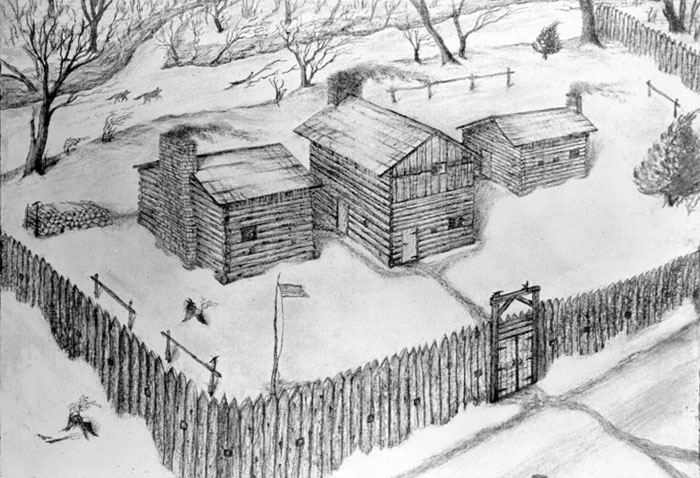
Fort Row in Wilson County, Kansas.
Chief Opothle Yahola’s band resisted no further and continued their trek to Fort Row, Kansas. Upon their arrival at the fort, the soldiers could not get extra supplies and lacked adequate medical support for the refugees. The Creek were forced to move to Fort Belmont, in Woodson County, but conditions were still deplorable. Nearly 2,000 of them died on the way to Kansas or shortly after, primarily due to starvation, exposure, and disease. One of these was Opothle Yahola’s daughter.
Many made their way to other parts of eastern Kansas, such as LeRoy’s post, and formed the First Indian Home Guard. The tri-racial Union regiment comprised Creek and Seminole Indians, African-Creek, and African-Seminole, with white officers commanding the unit.
The Leavenworth Times newspaper, on December 25, 1862, reported that about 900 Indian women and children had left Fort Scott, Kansas, to find their husbands and fathers serving in General James Blunt’s Army in Missouri. Destitute and helpless, this entourage of camp followers impeded the movements of Blunt’s forces. Consequently, Blunt established a refugee camp near his headquarters at Neosho, Kansas. They agreed to remain in the camp through at least through March 1863. The newspaper predicted that the Indians in Blunt’s command would do “excellent scouting service this winter in cleaning out the bushwhackers who have always infested that locality.”
Opothle Yahola died in the Creek refugee camp near the Sac and Fox Agency at Quenemo in Osage County, Kansas, on March 22, 1863. He was buried beside his daughter near Fort Belmont in Woodson County, Kansas.
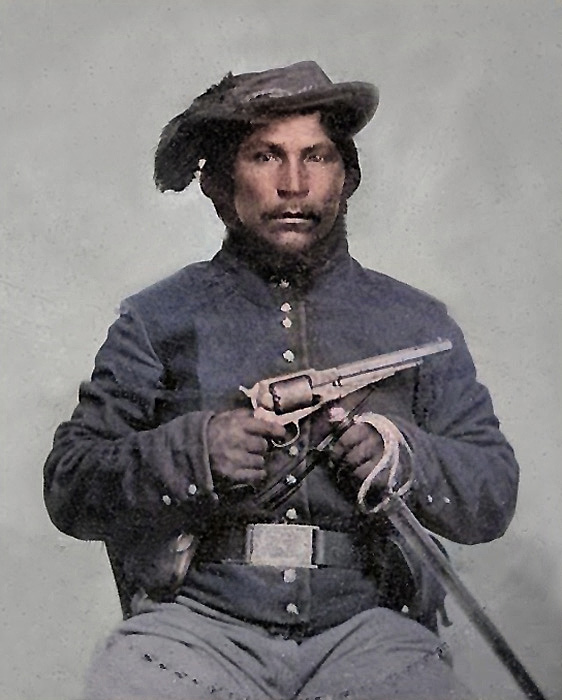
Indian Home Guard.
In 1995, the Kansas Legislature designated certain areas of the Verdigris, Neosho, Fall Rivers, and the Big and Little Sandy Creek valleys as the Opothle Yahola Historic Trail. The trail is marked on U.S. Highway 75 from the Oklahoma-Kansas state line north to Osage County, Kansas.
©Kathy Alexander/Legends of Kansas, December 2024.
Also See:
Sources:
History Collection
Kansas Genweb
Missouri Life
Revitalize Yates Center
Wikipedia