
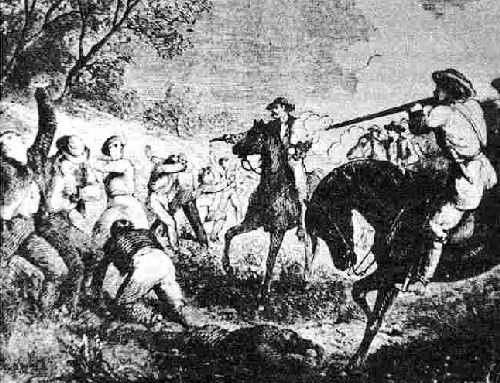
Jayhawkers and Bushwackers fight it out over Kansas becoming a free state or a pro-slavery state.
Fort Belmont, in southern Woodson County, was built in about 1860 near the town of Belmont. Its purpose was to protect the settlers from both Indians and Missouri Bushwhackers during the strife of the Kansas-Missouri Border War.
Located in a wooded area on Sandy Creek, the fort was built near the Belmont Trading Post, established in 1856. It was centered near the crossroads of trail lines leading from Humboldt to Eureka and Neosho Falls to Coyville/Fort Row.
The post included Officers’ quarters in 3-4 small officer cabins south of the fort and a rectangular earth embankment measuring 150 feet by 60 feet with logs as a roof about a quarter of a mile to the north. A parade ground was located east of the officers’ quarters.
For a brief period, an Indian Agency was located at the post to service the Osage and Creek Indians of the area. Companies from the Kansas 16th Regiment and local militiamen led by Captain Joseph Gumby manned the post. Likely, few, if any, people ever stayed there very long, as militiamen had homes nearby.
The post never saw any military action during the Civil War. However, Creek Indian leader Opothle Yahola led about 10,000 of his followers to Kansas to escape the pursuit of Confederate soldiers and sympathetic Indians in present-day Oklahoma. More than 240 refugees died during the winter of 1861-1862 when the Union Army was unable to provide adequate food and shelter. Those who died, including Opothle Yahola and his daughter, are buried near here in unmarked graves. The escape from Oklahoma was called the Trail of Blood on Ice, as it was in the middle of winter, with many of those being pursued barefoot and starving.

Muskogee Creek leader Opothle Yoholo.
The Indian agency was discontinued in October 1864. By the end of the month, Kansas Governor Thomas Carney had relieved the militia from duty and permanently closed Fort Belmont. The nearby town of Belmont was abandoned soon afterward.
Though the fort continued to stand until about 1871, it quickly deteriorated, and there are no remains today.
Fort Belmont was located two miles west of present-day Buffalo, Kansas, at the corner of Kanza Road and 70th Road southwest of Yates Center near the reservoir.
©Kathy Alexander/Legends of America, updated December 2024.
Also See:
Haunted Forts & Battle Grounds
Sources:
Pollard, William C., Jr.; Kansas Forts During the Civil War
Revitalize Yates Center
Wikipedia