
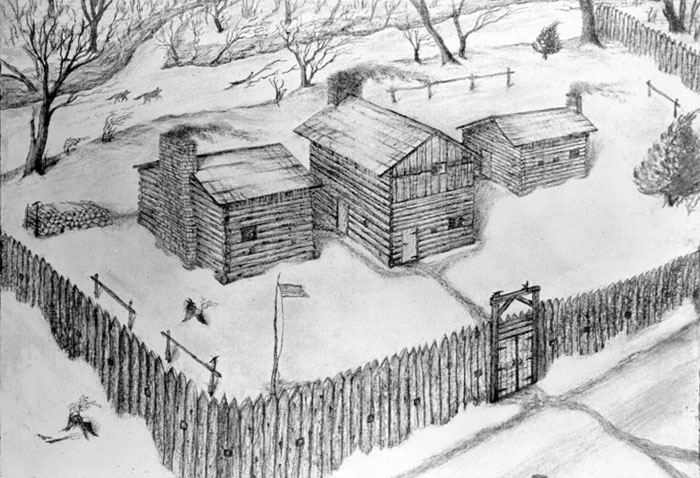
Fort Row in Wilson County, Kansas.
Fort Row, Kansas, was a small headquarters of the Union Army’s local volunteer-mounted militia in Wilson County. Under the leadership of Captain John Row, the militia was formed in the summer of 1861 to defend the area against raids by Confederate guerrillas operating in eastern Kansas. It was comprised of 70-80 men.
Located on the south bank of the Verdigris River east of the present-day Coyville, on land owned by John Shaffer, the fort was built in the fall of 1861. It included three blockhouses, constructed of heavy logs measuring 16 by 24 feet, surrounded by a six-foot tall log stockade on three sides. The steep riverbank on the other side provided a sound barrier. An earthwork embankment was built around the stockade, and rifle portholes were cut into the walls. Built on the prairie, it allowed a good view of the surrounding land. That winter, about 80 militia troops and their horses occupied the fort.
At that time, Creek Indian leader Opothle Yoholo had a following of 12,000 to 13,000 in Indian Territory (Oklahoma.) Confederate leaders hoped he would join them, but he sought to keep his people neutral and avoid the conflict of the Civil War. His neutrality plan failed, and in late 1861, the Creek and at least 2,600 Indians of other tribes headed for Fort Row.
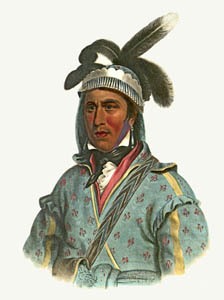
Muskogee Creek leader Opothle Yoholo.
Years earlier, Opothle Yoholo and his people were forced out of Alabama and Georgia after the Lower Creek sold their lands to the government. In 1837, Opothle Yoholo led 8,000 people from Alabama to lands north of the Canadian River in the Indian Territory. Before the Civil War began, they had settled in and prospered.
When the war began, many tribes joined ranks with the Confederates. However, Opothle Yoholo and his people refused and remained loyal to the federal government.
On August 15, 1861, Opothle Yoholo and Chief Micco Hutko contacted President Abraham Lincoln to request help for the loyalists. On September 10, the Union assured them they would receive help and freedom in Kansas. The letter directed Opothle Yoholo to move his people to Fort Row in Wilson County, where they would receive asylum and aid.
On November 15, Confederate Colonel Douglas H. Cooper, a former U.S. Indian Agent, led 1,400 men, including pro-Confederate Indians, northward, intending to convince Opothle Yoholo and his followers to support the Confederacy or to “drive him and his party from the country.”
Believing Federal promises of assistance, Opothle Yoholo led about some 9,000 Creek, Seminole, and mixed Blacks and Indians, seeking refuge in Kansas from Confederate soldiers.
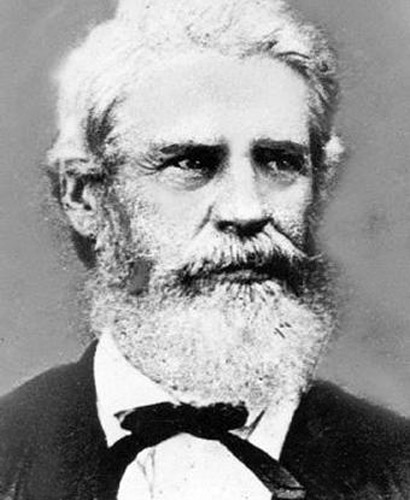
Colonel Douglas H. Cooper.
Opposing Indian bands and Confederate Forces followed them, leading to the Battle of Round Mountain on November 19, Chusto-Talasah on December 9, and, finally, Chustenahlah on December 26.
After a devastating defeat at Chustenahlah, Oklahoma, the out-matched Indians abandoned their livestock and wagons and fled with nearly nothing. Many were shoeless, with little clothing. Without food, they marched 100 to 150 miles through snow and bitter cold before reaching Fort Row. The Creek lost 2,000 to 3,000 people on the way, and more would have died had they not eaten some of their dogs and ponies.
In the middle of January 1862, the first groups of Indians, more than 2,000, arrived at the fort, overwhelming the small group of volunteers. Afterward, 20 to 60 Indians arrived daily until approximately 10,000 had arrived. In late January or early February, William G. Coffin, the regional superintendent for Indian affairs, arrived to help. He spent $10,000 on supplies, which quickly ran out. He managed to use credit to get more supplies, and he and his son Oliver, who was assisting him, used their own funds to buy more goods. Physicians had to amputate many frostbitten limbs. The Indians attempted to hunt game, which was quickly depleted.
Many were forced to move to Fort Belmont in Woodson County, but conditions were still deplorable.
At least 1,000 Indians died, including Opothle Yoholo’s daughter, who died at Fort Belmont, Kansas.
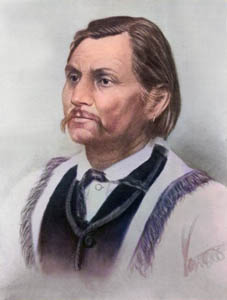
Creek Musgogee Chief Micco Hutko.
Eventually, many of the survivors continued on their trek to LeRoy in Coffey County. From LeRoy, 1,000 Indian braves were marched to Camp Hunter in Humboldt, Kansas, where, along with Seminole, African-Creek, and African-Seminole, they were inducted into the Union Army as the First Indian Regiment. They would first see action at the Battle of Prairie Grove, Arkansas, on December 7, 1862. This battle re-established Union control of northwest Arkansas. They also saw action on the battlefields of Missouri and the Indian Territory.
The militia company at Fort Row disbanded in the Spring of 1862, and most joined the Ninth Kansas volunteers. By that time, all the Indians had been moved elsewhere. Fort Row was never again used, and eventually, the buildings were destroyed by floods. For many years, human and animal bones littered the surrounding countryside.
Conditions for the Creek in Kansas continued to be very harsh. Opothle Yoholo died in the Creek refugee camp near the Sac and Fox Agency at Quenemo in Osage County, Kansas, on March 22, 1863. He was buried beside his daughter near Fort Belmont in Woodson County, Kansas.
After the Civil War, the reconstruction treaty of 1866 required the cession of 3.2 million acres – approximately half of the Muscogee Creek domain.
The fort’s exact location is unknown, but it was near where the Big Sandy Creek enters the Verdigris River north of Fredonia and east of Coyville in Wilson County, Kansas.
©Kathy Alexander/Legends of Kansas, December 2024.
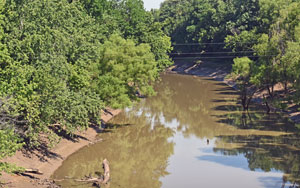
Verdigris River in Wilson County, Kansas by Kathy Alexander.
Also See:
Sources:
Abandoned Kansas
Fredonia Chamber
Kansas Memory
Wilson County Historical Society
Wikipedia – Fort Row
Wikipedia – Opothle Yoholo