
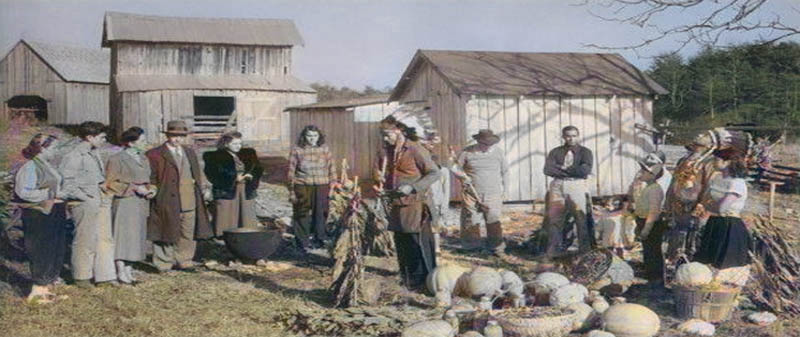
Lumbee People.
The Lumbee Tribe originally lived in North Carolina, primarily Robeson County, where they continue to live today. The Lumbee Tribe is the largest in North Carolina, the largest tribe east of the Mississippi River, and the ninth largest in the nation. They are a mixed-race community that claims to be descended from several Indigenous tribes who once inhabited the region. They take their name from the Lumber River, originally known as the Lumbee, which winds through Robeson County.
Archaeological evidence reveals that the Robeson County area has been continuously occupied for at least 14,000 years. Lumbee occupation areas contain numerous archaeological sites dating back to the Late Woodland period (mid-1700s), and oral traditions about the history of some Lumbee families extend back as far as the mid-1700s. The Lumbee ancestors were mainly Cheraw and related Siouan-speaking Indians, who were first observed in 1724 on the Lumbee River in present-day Robeson County.
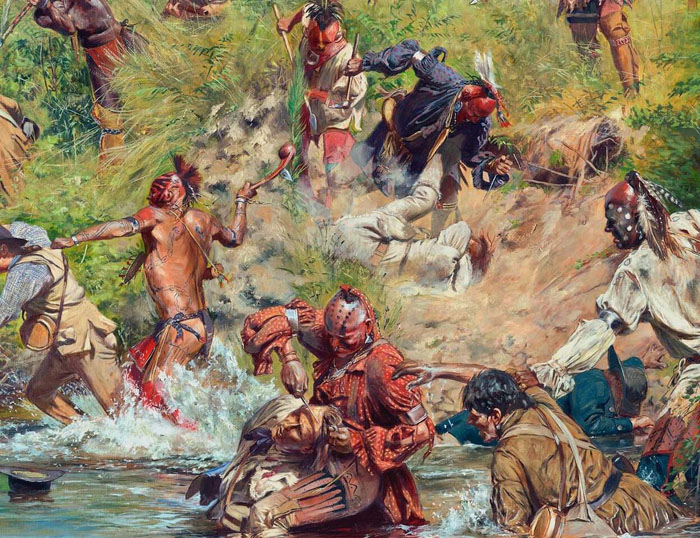
Tuscarora War By Don Troiani.
In 1711-1712, the Cheraw participated in an alliance of tribes engaged in intertribal warfare against Tuscarora in the war in northeastern North Carolina. The Tuscarora were defeated mainly through Indian allies of European colonists, with thousands being killed or enslaved.
A few years later, in 1715, the Cheraw participated in the Cofitachiqui Indian alliance in the Yamasee War, which was targeted against traders and colonists around Charleston, South Carolina. The Cofitachiquo alliance was defeated by an alliance of European colonists and their Indian allies. The earliest European document referring to Indian communities in the Lumber River area is a map prepared in 1725 by John Herbert, the English commissioner of Indian trade for the Wineau Factory on the Black River. Herbert identified the Saraw, Pee Dee, Scavano, and Wacoma as the four Siouan-speaking communities. Modern-day Lumbee claims a connection to those settlements, but none of the four tribes is located within the boundaries of present-day Robeson County.
Genetic research has shown the community to be overwhelmingly of African and European descent, with a minority of Native American genetic ancestry. However, historical records show that many of the Lumbee’s ancestors were recorded as Native Americans. Free people of color in the American South were primarily African, Native American, or South Asian.
By 1730, English settlers were surprised at the presence of a large English-speaking Native American tribe. Linguists speculate that the Lumbee ancestors were native peoples who initially spoke the Cheraw dialect of the Eastern Siouan language before adopting English sometime before the early 1700s. Lumbee ancestors encountered English-speaking European settlers and adopted their language much earlier than other Native American groups. It was later determined that no separate Lumbee language existed.
Land records show that in the second half of the 18th century, the ancestral Lumbee began to take titles to land near the Lumber River and prominent swamps such as Ashpole, Long, and Back.
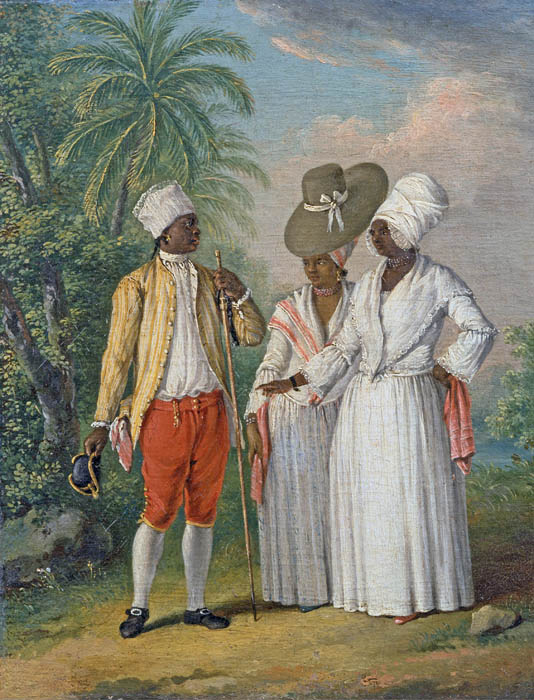
Free People of Color.
In the first federal census, pension records for veterans of the American Revolution in Robeson County listed men with surnames later associated with Lumbee families, all listed as “Free Persons of Color.”
Following Nat Turner’s Rebellion in 1831, the state legislature passed amendments to its original 1776 constitution, abolishing suffrage for free people of color. This was one of a series of laws passed by North Carolina whites from 1826 to the 1850s, creating restrictions on that class. Free people of color were stripped of various civil and political rights which they had enjoyed for almost two generations. They could no longer vote or serve on juries, bear arms without a license from the state, or serve in the state militia. As these were obligations traditionally associated with citizenship, they were made second-class citizens.
In 1853, the North Carolina Supreme Court upheld the constitutionality of the state’s actions to prevent free people of color from bearing arms without a license. Noel Locklear, identified as a free man of color in State v. Locklear, was convicted of being in illegal possession of firearms. In 1857, William Chavers from Robeson County was arrested and charged as a free person of color for carrying a shotgun without a license. Chavers, like Locklear, was convicted. Chavers promptly appealed, arguing that the law restricted only “free “negroes,” not “persons” s of color from Indian blood.” The “appeals court reversed the lower court, finding that “free “persons of color may be, then, for all we can see, persons colored by Indian blood.”
When “the Civil War began in 1861, North Carolina used forced labor to construct her defenses. Several Lowry cousins had been conscripted as laborers to help build Fort Fisher near Wilmington. In response, Henry Berry Lowry and several of his relatives took to the swamps and resorted to “lying out” to avoid being rounded up by the Home Guard and forced to work as impressed laborers. The Lowry Gang, as it became known, resorted to crime and conducting personal feuds, committing robberies and murders against white Robeson County residents and skirmishing with the Confederate Home Guard.
Despite the widespread sympathies among the Indian community for the plight of the participants in this guerilla warfare, nearly 150 Lumbee ancestors voluntarily enlisted in the Confederate Infantry, including the nephew-in-law of Henry Berry Lowry.
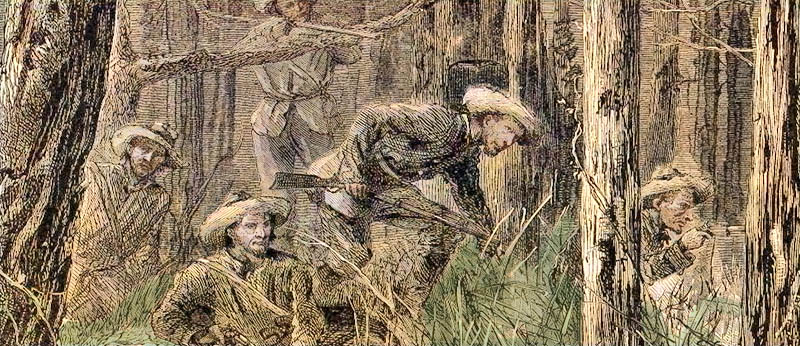
Lowry Swamp War in North Carolina by Harper’s Weekly newspaper.
A yellow fever epidemic from 1862 to 1863 killed many slaves working on the construction of Fort Fisher near Wilmington. As the state’s owners resisted sending more slaves to Fort Fisher, the Confederate Home Guard intensified efforts to conscript able-bodied free persons of color as laborers.
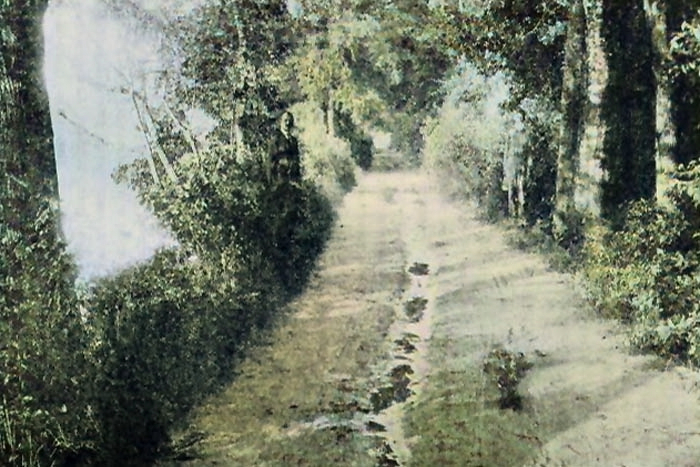
James Barnes Murder Site.
The Lowry Gang grew bolder as the war turned against the Confederacy. In December 1864, they killed James P. Barnes after he had drafted workers, including the Lowrys, for work on local defenses. Next, the gang killed James Brantley Harris, a Confederate conscription officer who had killed a Lowry relative.
A surprise search by the Home Guard of Allen Lowry’s home in March 1865 uncovered a stash of forbidden firearms. The Home Guard convened a summary court-martial, convicted Allen Lowry and his son William of illegally possessing firearms as men of color, and executed them.
After the Civil War, the Lowry Gang continued their insurgency into the Reconstruction Era, and the authorities’ attempts to capture gang members became known as the Lowry War.
Republican governor William Woods Holden declared Lowry and his men outlaws in 1869 and offered a $12,000 reward for their capture — dead or alive. Lowry responded with more revenge killings. The Lowry Gang gained the sympathy of local Indian families and even some poor whites, who refused to cooperate with efforts to stop them. Records of the pursuit of the Lowry gang provide the first documentation of the local people of mixed Indian ancestry.
Eluding capture, the Lowry Gang persisted after Reconstruction ended, and conservative white Democrats gained control of the North Carolina government, imposing segregation and white supremacy.
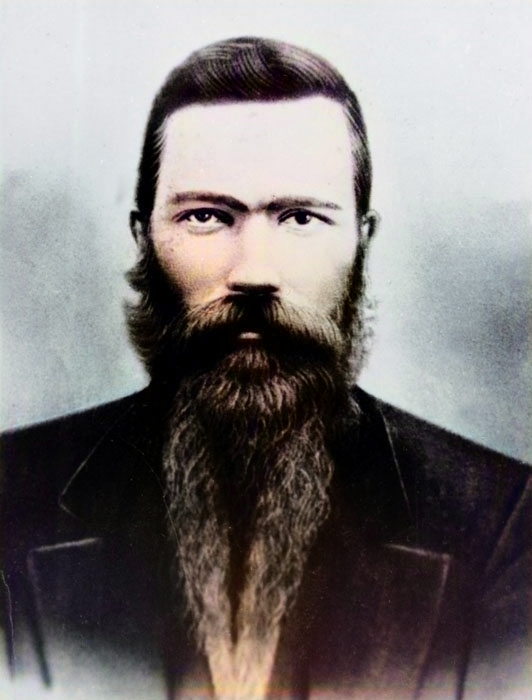
Henry Berry Lowry.
In February 1872, shortly after a raid in which he robbed the local sheriff of more than $28,000, Henry Berry Lowry disappeared. It is claimed he accidentally shot himself while cleaning his double-barrel shotgun. As with many folk heroes, the death of Lowry was disputed. He was reportedly seen at a funeral several years later. Without his leadership, all but two members of the Lowry gang were subsequently hunted down and either captured or killed.
During Reconstruction, the legislature established public education for the first time, providing for white and black schools. All children of color were assigned to black schools, which the children of freed slaves dominated. The Indian people of Robeson County had always been free and did not socially associate or interact with Blacks. They refused to send their children to school with the free Blacks and demanded separate Indian schools.
In the 1880s, Democratic state representative Hamilton MacMillan proposed to have the state recognize these Indian people of Robeson County as the “Croatan Indians” and to create a separate system of Croatan Indian schools.
In 1885, North Carolina recognized the Lumbee as a tribe and provided educational assistance and other services.
In 1887, the Indians of Robeson County petitioned the state legislature to establish a normal school to train Indian teachers for the county’s schools. They raised the requisite funds and some state assistance with state permission, which proved inadequate. Several tribal leaders donated money and privately held land for schools. Robeson County’s Normal School eventually developed into Pembroke State University and subsequently became the University of North Carolina at Pembroke.
The Lumbee first petitioned the federal government for recognition in 1888 but was rejected due to the Bureau of Indian Affairs’ lack of funding.
In 1899, North Carolina Congressional representatives introduced the first bill in Congress to appropriate federal funds to educate the Indian children of Robeson County. They introduced another bill a decade later and yet another in 1911.
By the end of the 19th century, the Indians of Robeson County established schools in eleven of their principal settlements.
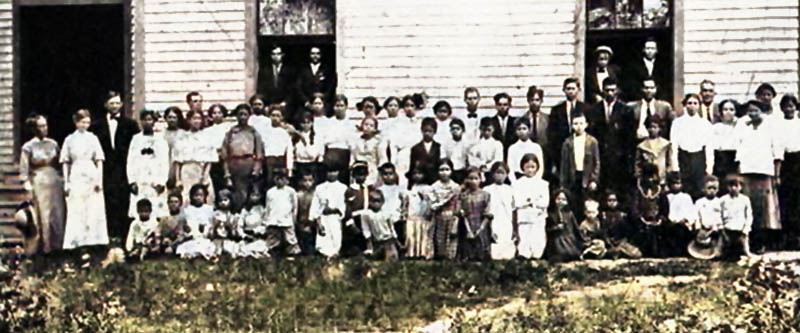
Croatan Normal School at Pembroke, North Carolina, 1916.
In 1911, the North Carolina General Assembly passed legislation changing the tribe’s name to “Indians of Robeson County.”
The Federal Indian Reorganization Act in 1934 was chiefly directed at Native American tribes on reservations. It encouraged them to re-establish self-government, which had been diminished since the founding of reservations and the supervision by the Federal Bureau of Indian Affairs. At this time, the Indians of Robeson County renewed their petition for federal recognition as a tribe. The Bureau of Indian Affairs sent John R. Swanton, an anthropologist from the Bureau of American Ethnology, and the Indian Agent Fred Baker to evaluate the Indians of Robeson County to historical continuity as an identified Indian community.
In 1936, D’Arcy McNickle, from the Bureau of Indian Affairs, came to Robeson County to collect affidavits and other data from people registering as Indian under the Indian Reorganization Act of 1934. McNickle stated, “There are reasons for believing that until comparatively recently, some remnant of language persisted among these people.”
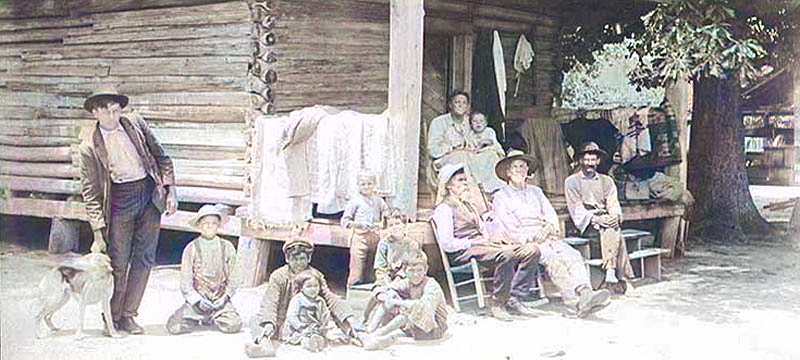
Lumbee Family.
As it did for many other minority groups in the United States, World War II marked the beginning of a significant transitional era for the Robeson Native Americans. Hundreds of local Indians served alongside whites in integrated units during the war (unlike African Americans, who were still segregated in the military). After the war, Indian veterans returned to Robeson more worldly and ready to fight for social and political change.
In 1952, under the leadership of D.F. Lowry, the tribe voted to adopt the name “Lumbee.” The North Carolina legislature recognized the name change in 1953. The tribe petitioned again for federal recognition.
The Lumbee Act, passed by Congress in late May 1956 as a concession to political lobbying and signed by President Dwight D. Eisenhower, designated the Lumbee as an Indian people. It withheld full recognition as a “Tribe” as had been agreed to by the Lumbee leaders. The Lumbee Act designated the Indians of Robeson, Hoke, Scotland, and Cumberland counties as the “Lumbee” Indians of North Carolina.” It further stipulated that “nothing in this Act shall make such Indians eligible for any services performed by the United States for Indians because of their status as Indians.”
In 1956, James W. “Catfish” Cole,” a Ku Klux Klan member from South Carolina, established the North Carolina Knights, a Klan organization aimed at defending racial segregation. He soon began a campaign of harassment against the Lumbee, claiming they were “mongrels and half-breeds” whose “race mixing” threatened to upset the established order of the segregated Jim Crow South. After giving a series of speeches denouncing the “loose” morals” of Lumbee women, Cole burned a cross in the front yard of a Lumbee woman in St. Pauls, North Carolina, as a warning against “race mixing.”
Emboldened, Cole called for a Klan rally near Maxton on January 18, 1958. The Lumbee, led by veterans of World War II, disrupted the rally, resulting in the “Battle of Hayes Pond.” Also known as “the Klan Rout,” it made national news. Cole had predicted more than 5,000 Klansmen would show up for the rally, but fewer than 100 and possibly as few as three dozen attended. In contrast, about 500 Lumbee, armed with guns and sticks, gathered in a nearby swamp and attacked the Klansmen, opening fire and wounding four Klansmen in the first volley. The remaining Klansmen panicked and fled. Cole was found in the swamps, arrested, and tried for inciting a riot. The Lumbee celebrated the victory by burning Klan regalia and dancing around the flames.
“The Klan was trying to put a damper on the Lumbee. They were not going to come here and run the Lumbees away from their home. It could have been a lot worse. No one was hurt. It turned out to be a beautiful situation, and the Klan moved on.”
— James Jones
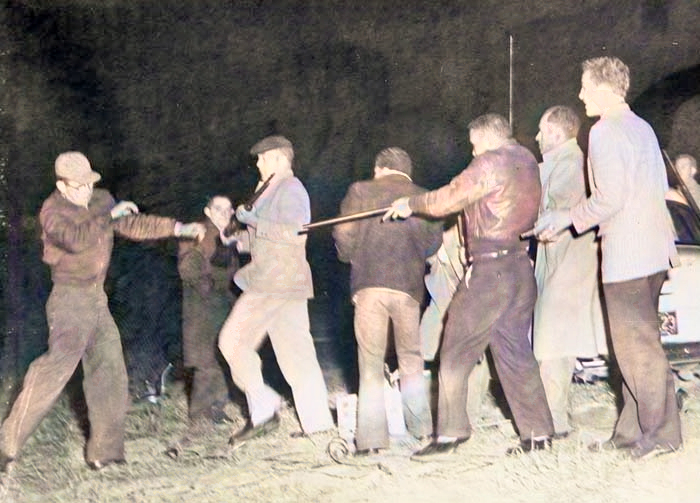
Battle of Hayes Pond, North Carolina.
In 1960, Smithsonian ethnologists William Sturtevant and Samuel Stanley described the Lumbee as larger than any other Indian group in the United States except the Navajo. They estimated their population to be 31,380 Lumbee from North and South Carolina.
In 1987, the Lumbee petitioned the United States Department of the Interior for full federal recognition. The petition was denied because of the Lumbee Act.
The Lumbee resumed lobbying Congress to gain full federal recognition through congressional action. However, the Department of the Interior opposed these attempts. In the following decades, the tribe renewed its bids for full recognition, including financial benefits.
According to its constitution, adopted in 2000, the Lumbee tribal government is organized into three branches: the tribal chairperson (executive), the 21-member Tribal Council (legislative), and the Supreme Court (judicial). The tribal chairperson and the Tribal Council are elected to three-year terms.
On April 22, 2021, U.S. Representative G. K. Butterfield introduced legislation to grant the Lumbee full federal recognition, and the bill passed the House of Representatives on November 1, 2021. However, the Senate never acted. Another attempt at federal recognition passed the House but not the Senate in December 2024. Then, on January 23, 2025, the newly appointed Secretary of the Interior Deb Haaland, acting on wishes from President Trump, said in a memoradum:
“In 2024, the United States House of Representatives passed, by a vote of 311-96, the Lumbee Fairness Act (H.R. 1101), which would grant the Lumbee Tribe full Federal recognition, but this legislation was not considered by the United States Senate before the end of the 118th Congress. Similar legislation has passed the House of Representatives several times.
Considering the Lumbee Tribe’s historical and modern significance, it is the policy of the United States to support the full Federal recognition, including the authority to receive full Federal benefits, of the Lumbee Tribe of North Carolina.
Within 90 days of the date of this memorandum, the Secretary of the Interior shall review all applicable authorities regarding the recognition or acknowledgement of Indian tribes and, in consultation with the leadership of the Lumbee Tribe of North Carolina, shall submit to the President a plan to assist the Lumbee Tribe in obtaining full Federal recognition through legislation or other available mechanisms, including the right to receive full Federal benefits.”
Secretary Haaland also happens to be the first Native American to serve as a cabinet secretary. As a 35th-generation New Mexican, she is a member of the Pueblo of Laguna.
The Lumbee Tribe of North Carolina is one of eight state-recognized Native American tribes in North Carolina.
Various enterprises contribute to the economy, including industrial parks, farms, small businesses, and universities.
Today, more than 55,000 members of the Lumbee Tribe reside primarily in Robeson, Hoke, Cumberland, and Scotland Counties. Pembroke is the tribe’s cultural and political center.
©Kathy Alexander/Legends of America, January 2025.
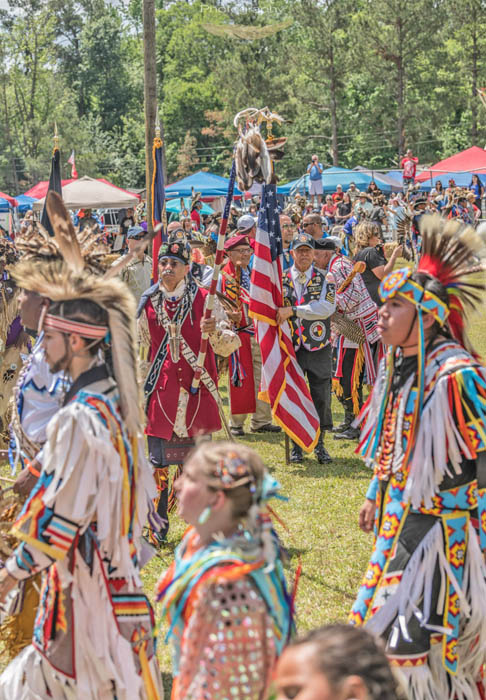
Lumbee Celebration.
Also See:
Native American Heroes and Legends
Native American Photo Galleries
Sources:
Lumbee Tribe of North Carolina
Lumbee Tribe – Facebook
North Carolina Department of Administration
Public Broadcasting Service
Southern Cultures
Wikipedia