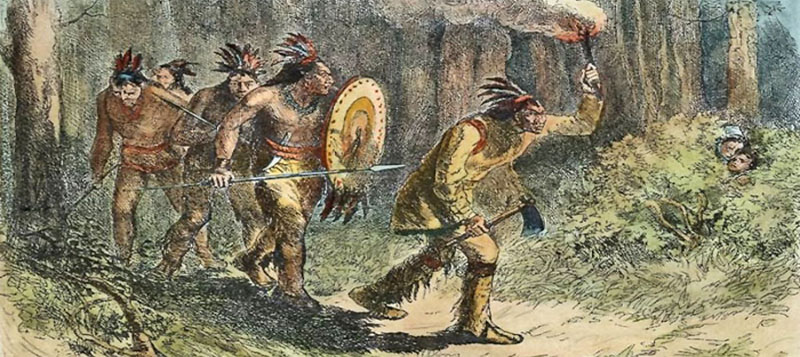
Tuscarora Warriors.
The Tuscarora tribe is an Indigenous People of the Northeastern Woodlands in Canada and the United States. They are an Iroquoian Native American and First Nations people. The Tuscarora Nation, a federally recognized tribe, is based in Lewiston, New York, and the Tuscarora First Nation is one of the Six Nations of the Grand River in Ontario, Canada. Some Tuscarora descendants are part of the Seneca-Cayuga Nation headquartered in Oklahoma.
Some records indicate that the Tuscarora originally lived in the Great Lakes region. However, by the time of the initial European encounter, they resided in present-day North Carolina and Virginia by the late 16th century. They resembled the Algonquian tribe in their habits and lifestyle, but the Tuscarora spoke a different version of the Iroquoian language called Skarure, which translates to “hemp gatherers.” They were a confederacy of three tribes, including the Katenuaka, Kawenteaka, and the Skaruren. The members of these three tribes belonged to approximately seven matrilineal clans: Bear, Beaver, Deer, Eel, Snipe, Turtle, and Wolf; however, clans may have had different subclans.
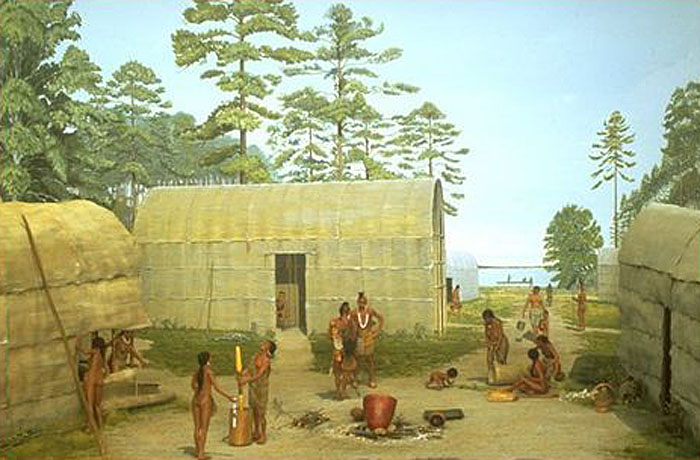
Tuscarora Village.
They established their primary towns on or near the Pamlico, Neuse, Roanoke, and Tar Rivers. Each village had a chief and was organized into a plantation system with several houses located relatively near one another. These houses were organized into confederacies, the most prominent of which were the Upper Town and Lower Town confederacies.
Known for migrating with the seasons, the Tuscarora lived in squat, round houses with circular floors and domed roofs made of bark and cyprus/cedar wood during the summer months. The thick bark protected them from the rain and sun. As winter approached, the Tuscarora migrated to camping spots, where they built houses close to each other with pits for small fires to stay warm.
The tribe ate various foods, including fish, large game such as deer and bears, and plantation crops. They wore animal furs and copper accessories such as bracelets and necklaces. Often, tribe members used the bloodroot plant to dye their hair a deep red color to distinguish themselves from other neighboring tribes.
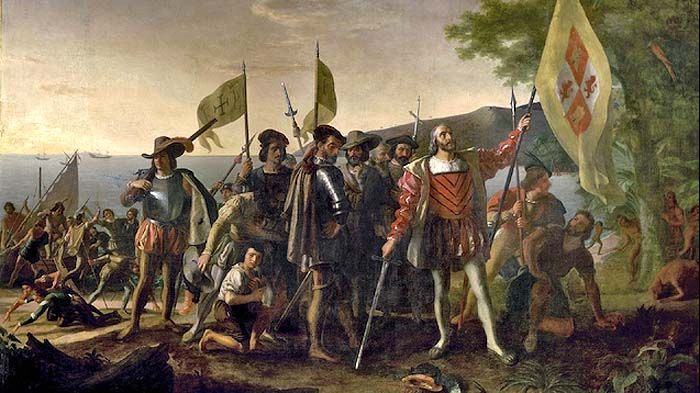
Spanish Explorers.
From the 1520s, the Tuscarora were in contact with the Spanish, who eventually permitted them to establish an outpost in Tuscarora territory.
In the middle of the 17th century, the Tuscarora and northern Virginian settlers started a fur trade.
In 1660, the Welsh clergyman Morgan Jones was captured in Tuscarora territory by the Doegs. This Tuscarora band spoke Welsh, learning the language from Welsh explorers and travelers. The day after his capture, the Doegs held council and condemned Jones and his five companions to death. When an interpreter informed the Welshmen of their fate, Jones dejectedly remarked, in Welsh, “I have escaped so many dangers of the wilderness, and must I now be knocked in the head like a dog?” Upon hearing the remark, the Doeg War Chief took Jones by the waist and told him in Welsh that he should not die. Jones and his companions remained among the Tuscarora for four months.
On July 14, 1670, John Lederera, a German explorer, visited the village of Kateras in present-day Raleigh, North Carolina, and described it as “a place of great Indian trade and commerce.”
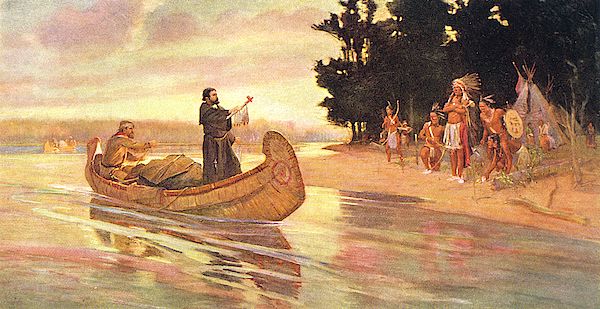
Father Jacques Marquette.
In 1672, French explorer Jacques Marquette met a party of Indians on the upper Mississippi River, believed to be Tuscarora, based on their language and clothing. The Indians informed Marquette that they obtained their guns and other European wares from white men in the east, who “had rosaries and pictures,” a possible reference to the Spanish who frequented Tuscarora territory.
The first successful English settlement of North Carolina began in 1653. The Tuscarora lived in peace with the settlers for almost 50 years, while nearly every other colony in America was involved in some conflict with Native Americans.
In early 18th century North Carolina, European colonists reported two primary branches of the Tuscarora: a northern group led by Chief Tom Blount and a southern group led by Chief Hancock. Chief Blount occupied the area around present-day Bertie County, North Carolina, on the Roanoke River. Chief Hancock lived closer to present-day New Bern, occupying the area south of the Pamlico River.
Varying accounts from about 1710 estimated the number of Tuscarora warriors from 1,200 to 2,000, with their total population three to four times that number.
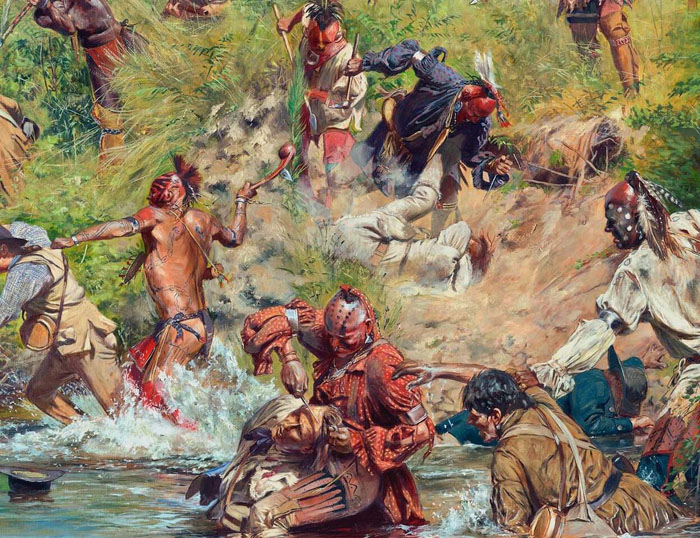
Tucarora War by Don Troiani.
As the English settlers moved closer to the Tuscarora and the two began interacting more frequently, conflict arose over competition for resources, shared hunting grounds, and cultural differences. These conflicts with British colonists led to the outbreak of the Tuscarora War, which lasted from 1711 to 1713.
After suffering defeat, about 1,500 Tuscarora fled north to New York and Pennsylvania.
However, nearly 650 Tuscarora families continued to live in North Carolina and parts of Virginia and South Carolina. Many of these people are believed to have returned to North Carolina.
In 1715, some 70 warriors of the southern Tuscarora went to South Carolina to assist colonists against the Yamasee Tribe. Those 70 warriors later asked permission to have their wives and children join them and settled near Port Royal, South Carolina.
In June 1718, under the leadership of Tom Blount, the Tuscarora, who remained in North Carolina, signed a treaty with the colony. It granted them a 56,000-acre tract of land on the Roanoke River in Bertie County. The remaining Southern Tuscarora were forced to remove from their villages on the Pamlico River and relocate to the villages of Ooneroy and Resootskeh in Bertie County. In 1722, the Bertie County Reservation, which would officially become known as “Indian Woods,” was chartered by the colony. At that time, there were 300 fighting men, their wives, children, and the elderly.
The Tuscarora, who had fled north, became the sixth member of the Iroquois Confederacy in 1722 because of their ancestral linguistic and cultural connections.
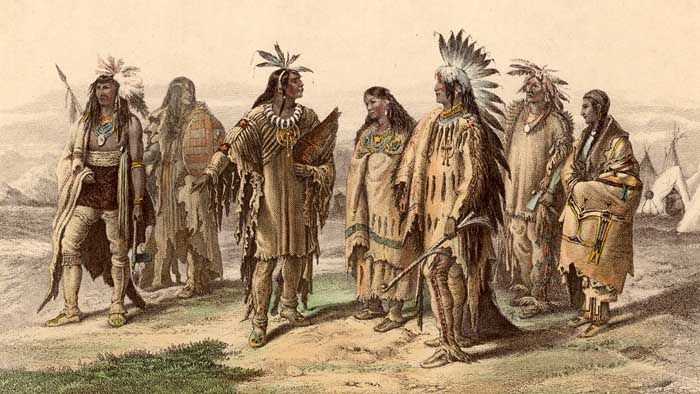
Iroquois People.
As colonial settlement surrounded the Indian Woods Reservation, the Tuscarora suffered discrimination and other acts: they were overcharged or denied the use of ferries, restricted in hunting, and cheated in trade; their timber was illegally logged, and their lands were continuously encroached upon by herders and squatters. Over the next several decades, the colonial government continually reduced the Tuscarora tract, forcing cessions of land to the encroaching settlers. They sold off portions of the land in deals often designed to take advantage of the Tuscarora. Many Tuscarora were not satisfied with the leadership of Tom Blount and decided to leave the reservation. In 1828, the Tuscarora, remaining in North Carolina, gave up their title and rights to Indian Woods, and the land was sold. Around 645 Tuscarora families remained and moved to other parts of North Carolina, Virginia, and South Carolina.
In 1744, a treaty was signed in Lancaster, Pennsylvania, where the Six Nations relinquished their lands south of New York to the Americans.
When Moravian missionaries visited the reservation area in 1752, they noted that “many had gone north to live on the Susquehanna” and that “others were scattered as the wind scatters smoke.” In 1752, the southern Tuscarora was said to number 300 men; in 1754, there were 100 men and 200 women and children, and these figures were repeated in 1761.
In 1763 and 1766, additional Tuscarora migrated north to settle with other Iroquoian peoples in northern and western Pennsylvania and New York. In 1766, there were said to be about 225 Tuscarora in the South. By the following year, 155 southern Tuscarora had been removed, and only 105 remained on or near the reservation in Bertie County.
American Indians and the Continental Army.
Most Tuscarora and Oneida nations in New York allied with the rebel colonists during the American Revolution. Most of the warriors of the other Iroquois nations supported Great Britain, and many participated in battles throughout New York. Consequently, the Tuscarora and Oneida were attacked by Indians in the British interest, including even some of their Iroquois brethren; their houses were burned, their crops and other property destroyed, and they scattered. Late in the war, the pro-British Tuscarora followed Chief Joseph Brant of the Mohawk, other British-allied tribes, and Loyalists north to Ontario. They established the Six Nations reserve of the Grand River First Nation in Ontario, Canada. However, a large band settled at Oyonwayea, or Johnson’s Landing, on Lake Ontario, about four miles east of Niagara, New York.
In 1803, the last band to leave North Carolina went to New York. By then, only “10 to 20 Old families” remained at Indian Woods.
After that, the Tuscarora in New York no longer considered southern remnants as part of their nation.
The decline of Irriqouis’ influence began with the American Revolution. Although the Tuscarora and Oneida allied with the Americans, the fledgling country enacted punitive measures against the other members of the Six Nations at the revolution’s conclusion. As a result, small segments of the Seneca, Cayuga, and other Iroquois peoples, including some Tuscarora, migrated westward, forming new settlements or joining existing communities at Lewistown and Sandusky, Ohio.
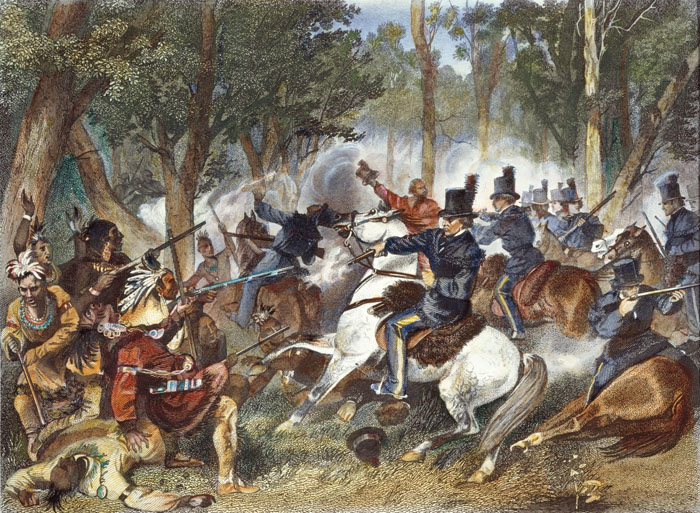
War of 1812.
During the War of 1812, in the British attack on Lewiston, New York, on December 19, 1813, a band of Tuscarora living in a village on an escarpment just above the town fought to save Americans fleeing the invasion force. Allied Mohawk and some American Tories accompanied the British disguised as Mohawk. The American militia fled, leaving only the Tuscarora—outnumbered 30 to one—to fight a delaying action that allowed some townspeople to escape. The Tuscarora sent a party of warriors to blow horns along the escarpment and suggest a more significant force. In contrast, another party attacked downhill with war whoops to give an exaggerated impression of their numbers. The British force burned Lewiston, as well as the Tuscarora village, then undefended.
The descendants of the Six Nations were among the first indigenous nations subjected to Indian Removal after signing their 1831 treaty with the United States. They received land in present-day Ottawa and Delaware Counties, Oklahoma. In 1838, the United States negotiated a treaty with another segment of New York Indians, including several Tuscarora. Initially bound for lands in Wisconsin, the small party was diverted to Indian Territory.
During the Civil War, in 1862 and 1863, a yellow fever outbreak killed the African slaves sent to build Fort Fisher in Wilmington, North Carolina. Slave owners across the state were reluctant to send more slaves, so the Confederate Home Guard intensified its efforts to conscript Indians and other free people to build the fort.
1864 Three Tuscarora who were conscripted to help build Fort Fisher were murdered by Brantley Harris of the Confederate Home Guard en route back to Robeson County.
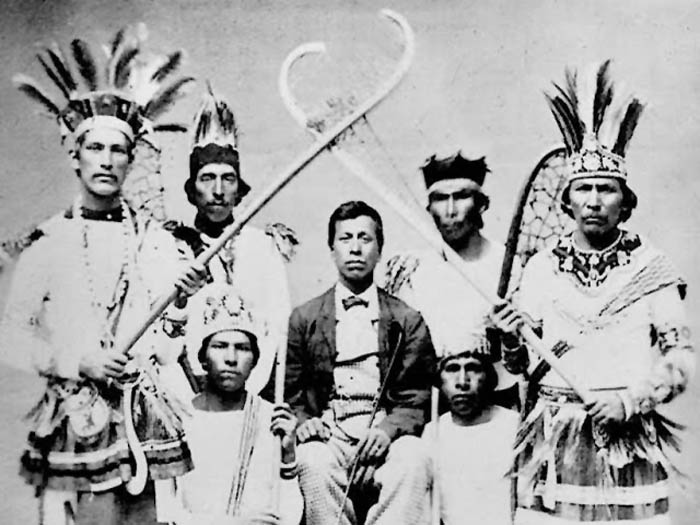
Tuscarora Men 1892.
In 1867, in the wake of the Civil War, the expansive Omnibus Treaty provided for the unification of all Iroquois peoples within Indian Territory onto a single Seneca reservation.
In 1885, there were 828 Tuscarora divided between New York and Canada.
In the following decades, the Tuscarora Nation continued to struggle to protect their land in New York.
Under the purview of the Oklahoma Indian Welfare Act of 1936, the comingled Irriquois incorporated the Seneca-Cayuga Tribe of Oklahoma. Since their arrival, they have maintained a longhouse where they continue to hold numerous ceremonies, festivals, and dances. The nation also offers youth programs and language courses to enrolled citizens. The Seneca-Cayuga Nation is headquartered in Grove, Oklahoma, and has a population of more than 5,000.
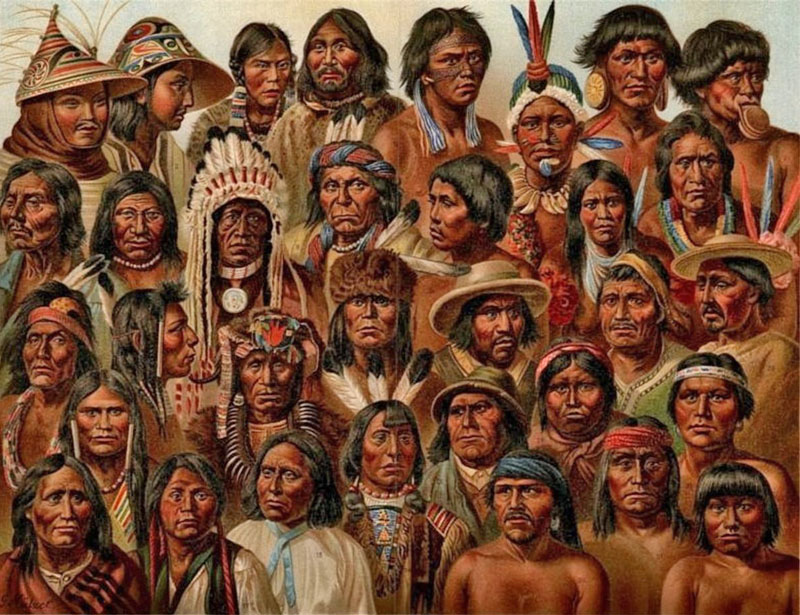
Tuscarora People.
In the mid-20th century, New York City commissioner Robert Moses generated controversy by negotiating with the Tuscarora Sachem council and purchasing 550 acres of the Tuscarora reservation for the reservoir of the new hydroelectric project along the Niagara River, downriver from Niagara Falls. Construction began on the Lewiston Reservoir and the hydroelectric Niagara Power Plant in 1957. The plant continues to generate electricity for households from the Niagara area to as far away as New York City.
In 1971, the Tuscarora in Robeson County, North Carolina, sought to get an accounting of their lands and rents due to them under the unratified treaty of 1803. At least three bands were organized in Robeson County. In 2010, they united as one group.
Tuscarora Nation officials in New York consider that any individuals remaining in North Carolina no longer have tribal status, although they might have some Tuscarora ancestry.
Today, only the tribes in New York and Ontario have been recognized government-to-government by the respective national governments.
The Tuscarora and Cherokee are the only Indian treaty nations in North Carolina.
Some Tuscarora descendants are part of the Seneca-Cayuga Nation headquartered in Oklahoma. They are primarily descendants of Tuscarora groups absorbed in the early decades of the 19th century in Ohio by relocated Iroquois Seneca and Cayuga bands from New York. They became known as Mingo while in the Midwest, coalescing as a group in Ohio. The Mingo were later forced into Indian Removals to Indian Territory in present-day Kansas and Oklahoma. In 1937, descendants reorganized and were federally recognized as the Seneca-Cayuga Tribe of Oklahoma. The nation occupies territory in the northeast corner of the former Indian Territory.
In 2022, a formal Tuscarora language course was offered after decades of various Tuscarora working to revive the language and teaching sporadic language mini-courses. Tuscarora graduates actively began teaching their children the language.
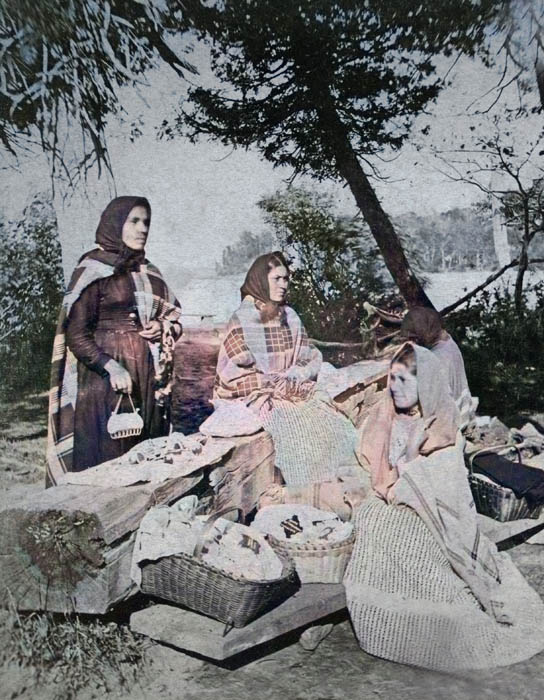
Tuscarora Women at Niagara Falls, 1875.
©Kathy Alexander/Legends of America, January 2025.
Also See:
Native American Photo Galleries
Native Americans – First Owners of America
Sources:
Encyclopedia of Oklahoma History and Culture
North Carolina History
Swanton, John R.; The Indian Tribes of North America. Bureau of American Ethnology, Bulletin 145. Washington DC: US Government Printing Office. 1953.
Tuscarora Nation
Wikipedia – Tuscarora People
Wikipedia – Tuscarora War