
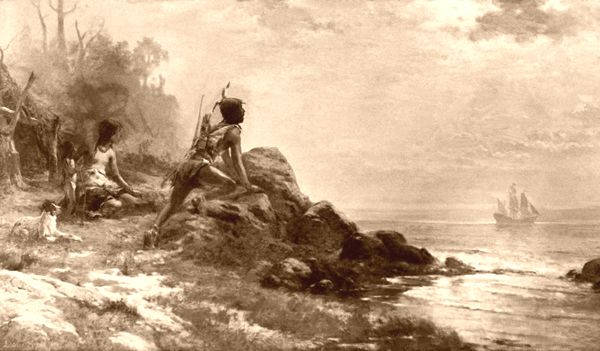
Native Americans watch as Sir Henry Hudson arrives in New York.
Before Europeans arrived in the 16th century, New York was inhabited by Algonquian and Iroquoian-speaking Native Americans. The Algonquian, including the Mohegan, Lenape, and Wappinger tribes, lived primarily in the Hudson Valley and Long Island. The Iroquois, residing in the central and western parts of the state, comprised the Cayuga, Mohawk, Oneida, Onondaga, and Seneca tribes, which united in approximately 1570 to form the Iroquois Confederacy.
The first European explorer to discover New York was Giovanni da Verrazzano, an Italian-born navigator employed by France, who came to New York Bay in 1524. Although he is credited with the first discovery, he did little further exploration. Henry Hudson, an English explorer working for the Dutch, reached New York Bay and sailed up the river, now bearing his name, in 1609.
The same year, Samuel de Champlain, a Frenchman from Canada, explored and claimed northern New York. The French, who had allied with the Huron tribe in Ontario, continued to push into northern and western New York from Canada but met with resistance from the Iroquois Confederacy, which dominated the western region of New York.
In 1614, Fort Nassau was built near the site of the present-day capital of Albany. The fortification, which served as a trading post and warehouse, was built on the site of an earlier French fortification from 1540. Early on, the Dutch claimed the Hudson River region, and the Dutch West India Company, established in 1623, founded the colony of New Netherland in 1624. The first permanent Dutch settlement was established at Fort Orange, which replaced Fort Nassau in present-day Albany, New York. Two years later, in 1626, Peter Minuit purchased Manhattan Island from the Canarsie tribe for goods valued at approximately 60 Dutch guilders and established the Dutch colony of New Amsterdam on the lower tip of present-day Manhattan Island, which would later become New York City.
The English captured the colony in 1664 during the Second Anglo-Dutch War and governed it as the Province of New York, with its boundaries roughly similar to those of the present-day state. The city of New York was recaptured by the Dutch in 1673 during the Third Anglo-Dutch War (1672–1674) and renamed New Orange. However, it was returned to the English under the terms of the Treaty of Westminster a year later. The threat from the French was continuous, and New York was involved in several of the French and Indian Wars from 1689 to 1763, which hindered the province’s growth. Much of western New York remained unsettled by colonists throughout the 18th century.
Slowly, the colony expanded, establishing its first college in 1754 in New York City. Initially known as King’s College, it is now Columbia University.
Beginning to establish its own identity separate from England, colonial self-assertiveness grew after the warfare with the French ended. Due to England’s restrictive commercial laws, the Navigation Acts were often flouted through smuggling. When the Stamp Act was passed, New York was a leader of the opposition. The Stamp Act Congress met in New York City in 1765, and the Sons of Liberty were organized. The policies of Lieutenant Governor Cadwallader Colden, who did not oppose the Stamp Act, led to numerous complaints, and unrest grew.
As troubles flared and escalated into the American Revolution, New Yorkers were divided in their loyalties. New York endorsed the Declaration of Independence on July 9, 1776, and the state constitution was framed by a convention assembled at White Plains the following day.
After independence was declared, the first major battle of the American Revolution was the Battle of Long Island in August 1776. The most significant battle of the entire war, the British victory, made New York City their military and political base of operations for the duration of the conflict and, consequently, the center of attention for General George Washington. Approximately one-third of all the military engagements of the American Revolution occurred in New York state. The British held New York City to the war’s end. The state, however, had declared independence and functioned with Kingston as its capital. In 1777, Brigadier General George Clinton was elected New York’s first governor. He would become the longest-serving Governor in the U.S., holding office until 1795, then again from 1801 to 1804, before becoming Vice President of the U.S. in 1805 until he died in 1812.
After the Treaty of Paris, which ended the war, was signed on September 3, 1783, New York was the 11th state to ratify the United States Constitution on July 26, 1788. New York City served briefly as the new nation’s capital from 1789 to 1790 and was also the state capital until 1797, when Albany succeeded it.
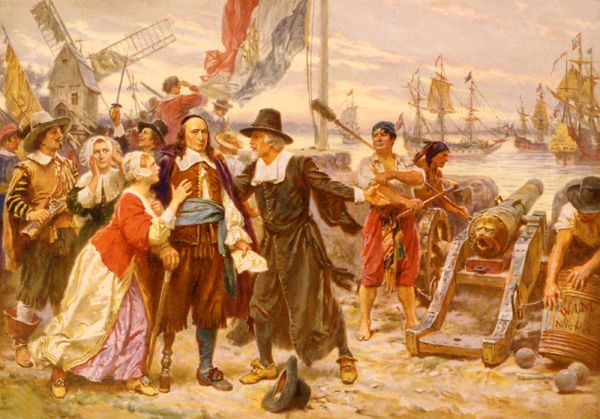
The Fall of New Amsterdam.
New York rose quickly, and in the 1780s, increased commerce and industry marked the turn away from the old, primarily agricultural order.
In 1807-1808, new concerns over a possible war with Great Britain prompted President Thomas Jefferson to renew fortification programs along the East Coast, which became known as the Second System of Fortifications. These forts in New York included Fort Columbus, Castle Williams, Fort Wood and Gibson, the Humbert Battery, and Castle Clinton. In the War of 1812, New York saw action in 1813–14, particularly with the British capture of Fort Niagara and the brilliant naval victory of Thomas Macdonough over the British on Lake Champlain at Plattsburgh.
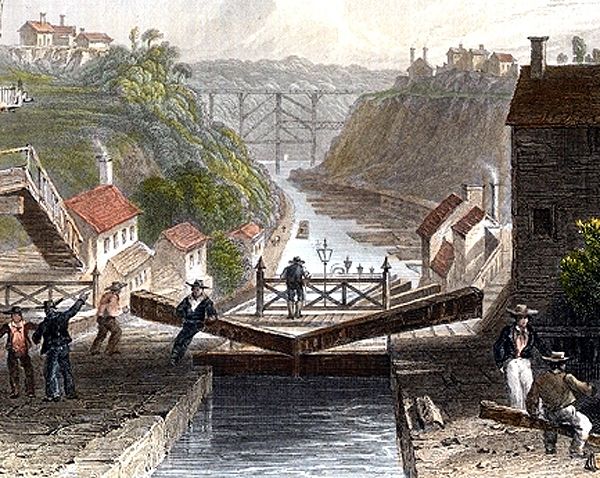
Erie Canal, Lockport, New York.
New York’s rapid commercial growth is partly attributed to Governor DeWitt Clinton, who pushed through the construction of the Erie Canal, which was completed in 1825. The canal and railroad lines built in 1831 made New York the major East-West commercial route in the 19th Century and helped account for the growth and prosperity of the port of New York.
Cities along the canal, including Buffalo, Syracuse, Rome, Utica, and Schenectady, prospered. Albany grew, and New York City, whose first bank had been established by Alexander Hamilton in 1784, became the nation’s financial capital. New York City also expanded into manufacturing, foreign trade, commerce, magazine publishing, and theatrical production, becoming the nation’s nerve center.
In the 1840s, famine and revolution in Europe led to a significant wave of Irish and German immigrants, whose first stop in America was typically New York City.
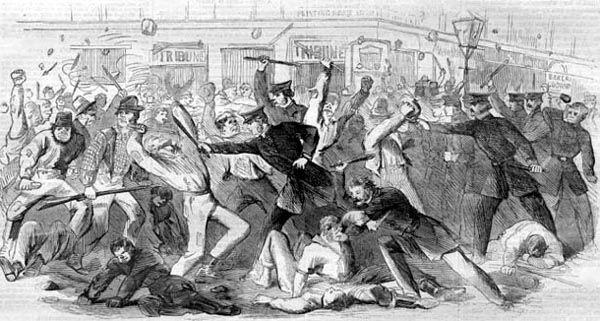
New York draft riots during the Civil War.
Slavery ended in New York State in 1827, yet this victory did not sever the state’s connections to enslaved labor. The conflict between the North and South spilled into the streets of New York. Local factories produced food, clothing, and other necessities for the army, and the state became a hotbed of slavery politics. In less than half a century, abolitionists convinced many Northerners that American slavery could not be reconciled with American freedom. The conflict between the two sides, one favoring slavery and the other opposing it, was all but inevitable. In 1863, these tensions came to a head in New York City during the 1863 draft riots, the worst civil unrest in the nation’s history. A measure of resolution came when black regiments from New York were allowed to join the effort to end slavery.
After the Civil War, New York underwent significant changes due to immigration, prosperity, and the legal freedoms granted to African Americans by the Thirteenth, Fourteenth, and Fifteenth Amendments. Nevertheless, deep-seated racial prejudice remained for years.
As economic growth accelerated, political corruption became rampant. After 1880, the influx of immigrants from Ireland, Italy, and Eastern Europe brought workers to the expanding old industries and the emerging new ones, including the electrical and chemical industries. Labor conditions worsened but were challenged by the growing labor movement, whose targets included sweatshops, which were particularly notorious in New York City.
By 1900, New York was the wealthiest and most populous state, and the boroughs of New York City had combined to make the nation’s largest metropolitan area. The state enjoyed a booming economy during the Roaring Twenties but, like everywhere else in the nation, would suffer during the Great Depression, facing over 25% unemployment.
When World War II began, as the largest state, New York supplied the most resources and suffered the most casualties, with 31,215 fatalities. This period constituted New York’s last significant industrial era. At its conclusion, the defense industry shrank, and the economy shifted towards producing services rather than goods. Returning soldiers disproportionately displaced female and minority workers who had entered the workforce when so many men were at war. Companies began to move to the south and west, seeking lower taxes and a less costly, non–union workforce, taking many New York workers with them.
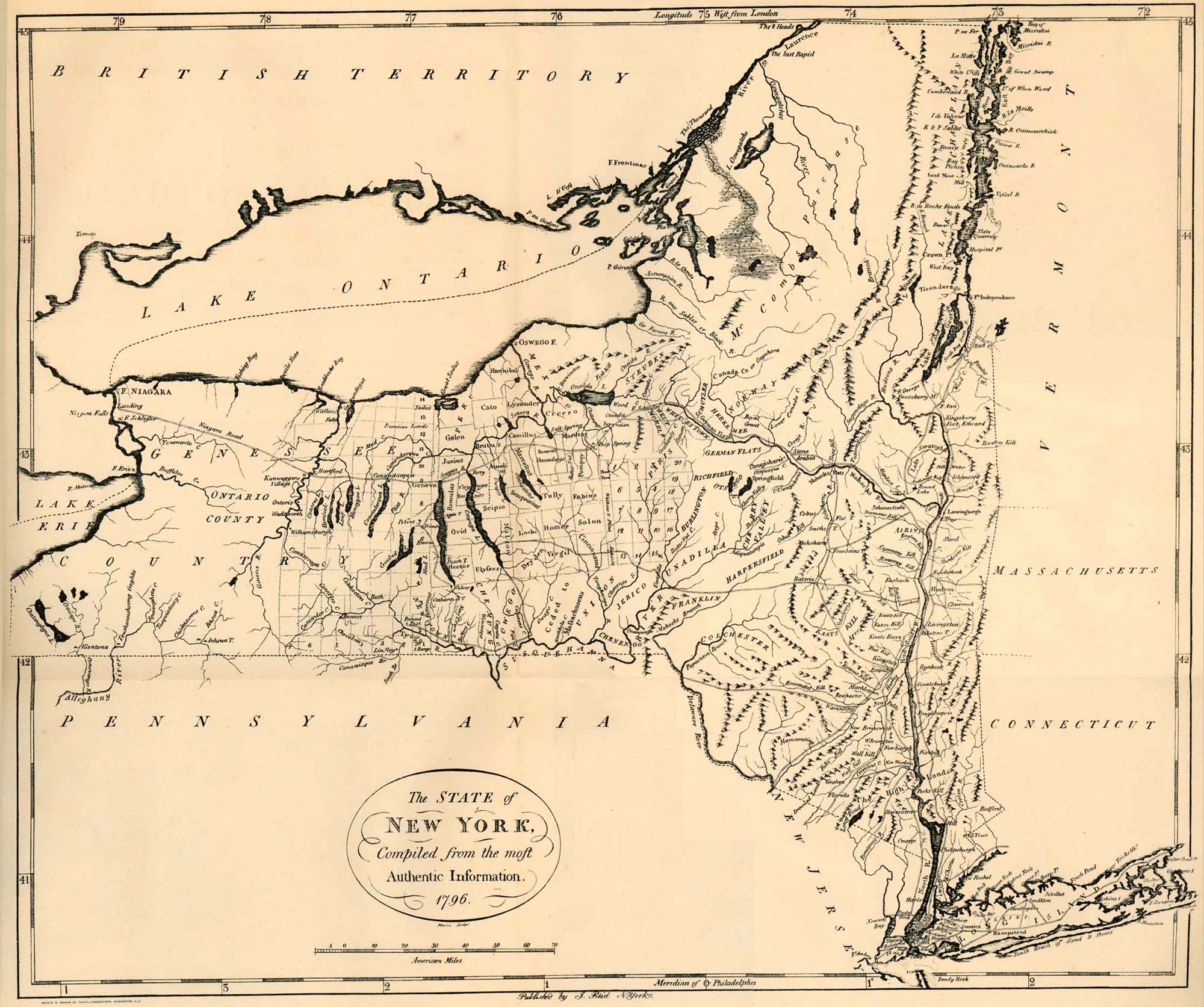
New York State Map, 1796.
Larger cities stopped growing around 1950. Buffalo’s population fell by half between 1950 and 2000. Reduced immigration and worker migration led New York State’s population to decline for the first time between 1970 and 1980. Growth resumed only in New York City in the 1980s, driven by the telecommunications and high-tech industries. Upstate did not fare as well as downstate, as the new major industries that began to reinvigorate New York City did not typically spread to other regions.
Today, New York State ranks seventh in the nation in manufacturing. Other principal industries include printing and publishing, industrial machinery and equipment, electronic equipment and instruments, and tourism. New York farms produce cattle and calves, corn, poultry, vegetables, and fruits, and the state is also a leading wine producer.
Significant points of interest in the Empire State are Castle Clinton, Fort Stanwix, Niagara Falls, the Statue of Liberty, and the U.S. Military Academy at West Point. National Historic Sites include the homes of Franklin D. Roosevelt at Hyde Park and Theodore Roosevelt in Oyster Bay and New York City; the Women’s Rights National Historical Park in Seneca Falls; National Memorials, including Grant’s Tomb, The National September 11 Memorial, and Federal Hall in New York City; Fort Ticonderoga; the Baseball Hall of Fame in Cooperstown; and the United Nations, skyscrapers, museums, theaters, and parks in New York City.
©Kathy Alexander/Legends of America, updated July 2025.
Also See:
Castle Clinton – Anticipating the War of 1812
Discovery, Description & Early Occupation of New York City
Liberty Island and the Statue of Liberty
New Amsterdam – The Beginnings of New York City
See Sources.