
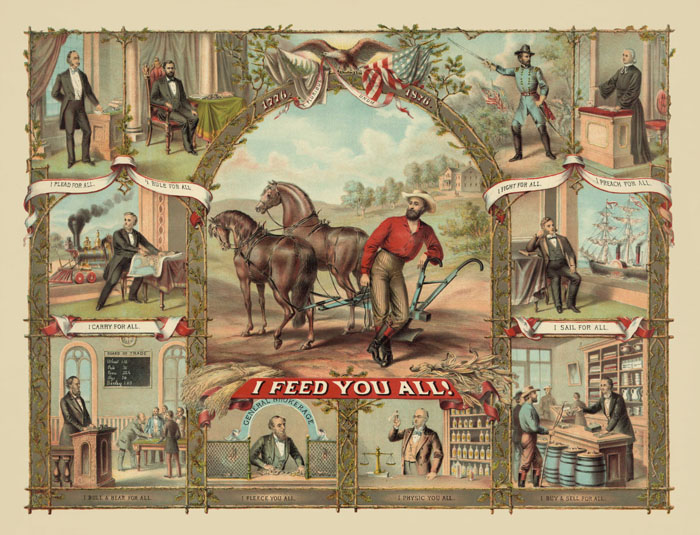
The Grange Movement by the American Oleograph Co., 1875.
The Grange, officially known as The National Grange of the Order of Patrons of Husbandry, is a social organization that encourages families to work together to promote the economic and political well-being of their communities and agriculture.
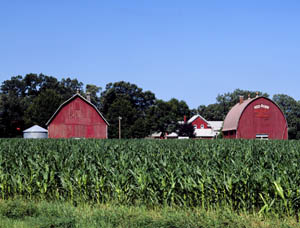
Minnesota Farm by Carol Highsmith, 2025.
Founded in 1867, shortly after the Civil War, the Grange is recognized as the oldest national agricultural advocacy group in the United States. Following a personal interview with President Andrew Johnson, the Commissioner of the Department of Agriculture commissioned Oliver H. Kelley, a farmer from Minnesota, to travel to the Southern states and gather data to improve agricultural conditions there in the mid-1860s. Many poor farmers who had endured the hardships of the Civil War were initially wary of Northerners like Kelley. However, as a member of a Masonic Lodge, Kelley was able to bridge these sectional differences. He toured the war-torn South and was appalled by the outdated farming practices he observed. Kelley noted the lack of “progressive agriculture” among the illiterate and “ignorant” farmers who relied on methods passed down through generations.

The war-torn South after the Civil War.
This experience inspired him to create an organization serving as a social and economic network for farmers and their families. Kelley began writing letters and consulting with experts, leading to the establishment of the Grange. On December 4, 1867, seven men and one woman co-founded the National Grange of the Patrons of Husbandry. Membership in the organization was open to both men and women, functioning as a fraternal group for rural communities. The Grange aimed to enhance the social lives of farm families, share information, and ease sectional tensions following the Civil War. The first Grange was established in 1868 in Fredonia, New York. From there, Granges expanded across the United States, offering classes and social events for farmers.
The Grange adopted rituals and symbols from Freemasonry, including oaths and secret meetings, to protect against railroad spies. It also took inspiration from Greek, Roman, and Biblical mythology.
In 1873, the National Grange was established in Washington, D.C., with paid agents helping to organize local branches. Membership surged from 200,000 in 1873 to 858,050 in 1875. The organization encouraged the participation of women and teens, requiring women to hold at least four elected positions.
As they gained influence, Grangers engaged in political efforts, particularly in response to the Panic of 1873, which brought historically low crop prices. This led to enacting “Granger laws” to assist farmers, who faced opposition primarily from railroad companies.
Throughout the 1870s, the Grange introduced several essential farming practices, such as pooling savings to form early credit unions, storing grain in community elevators, and collectively purchasing equipment for bulk pricing. These initiatives significantly strengthened American farmers and contributed to the development of the modern farming industry.
Rapid growth infused the national organization with money from dues, and many local granges established consumer cooperatives, initially supplied by wholesaler Aaron Montgomery Ward.
The Granger movement supported efforts by politicians to regulate rates charged by the railroads and grain warehouses. It claimed credit for the ideas of the Cooperative Extension Service, Rural Free Delivery, and the Farm Credit System. The Grange also endorsed the temperance cause to avoid alcohol, the direct election of Senators, and women’s suffrage.
The Grange was a unique organization at the time because it accepted female members. Mary Elizabeth Lease of Kansas was one of the nation’s first female attorneys and a Grange member. She traveled to grange halls across the U.S. and urged farmers to “raise less corn and more hell.” This was a plea to reduce their production, as overproduction was causing prices to drop.
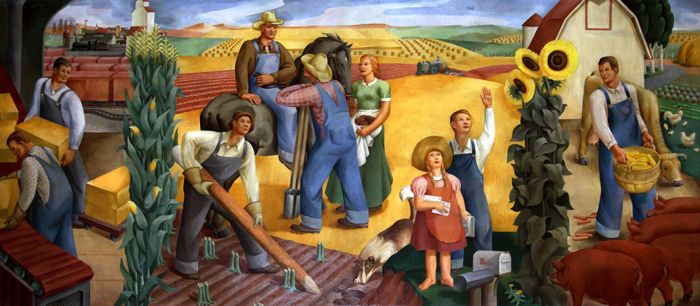
Kansas Farming Mural in the U.S. Courthouse, Wichita, Kansas, by Richard Haines, 1936.
While the Grange was not a political party, Grangers were involved in several political movements in the Midwestern United States in the late 19th century, such as the Reform Party of Wisconsin.
Over many decades, some of the local Grange chapters’ more popular service projects included building Grange Halls and Community Centers, organizing Rural Fire Departments, litter pick-up campaigns, construction and maintenance of roadside parks, installation of warning signals at railroad crossings, sponsorship of nursing homes, Red Cross and United Fund Drives, first aid classes, sponsorship of historical museums, and sponsorship of fairs and fairgrounds.
Poor fiscal management, combined with organizational difficulties resulting from rapid growth, led to a massive decline in membership. By the turn of the 20th century, the Grange rebounded, and membership stabilized.
The Grange in Kansas published a 100-year history of its organization in 1973, noting:
“Service to the membership and the community has always been one of the basic purposes of the Grange. One of the first services initiated by the Grange was joining together to purchase farm and family supplies statewide and locally. It also organized ‘help’ days for a sick or disabled neighbor in putting in or harvesting crops or caring for livestock.”
Grange membership has declined considerably, as the percentage of American farmers has fallen from a third of the population in the early 20th century to less than 2% today. Between 1992 and 2007, Grange members fell by 40%. Washington has the largest membership of any state, at approximately 13,000.
In 2019, the National Grange revised their Mission Statement:
“The Grange strengthens individuals, families, and communities through grassroots action, service, education, advocacy, and agriculture awareness.”
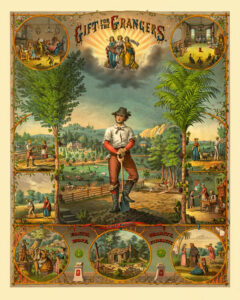
Grangers by Strobridge Co., 1873.
As a non-partisan organization, the Grange supports only policies, never political parties or candidates. Although the Grange was founded to serve the interests of farmers, because of the shrinking farm population, it has begun to broaden its range to include a wide variety of issues, and anyone is welcome to join the Grange.
©Kathy Alexander/Legends of America, January 2025.
Also See:
American Life in the Late 19th Century
Sources:
Kansas State Historical Society
National Register of Historic Places – Grange Hall
Wikipedia