
A look at the new book “All the President’s Men and Women: A Cabinet History by David White
The American presidential Cabinet seems a thing taken for granted these days, but it isn’t provided for anywhere in the Constitution and, as it stands now, is an evolution of an idea solidified by George Washington, the nation’s first President. A new book traces that evolution, detailing the successes and failures of every President and every member of every President’s Cabinet. The book is All the President’s Men and Women: A Cabinet History by David White.
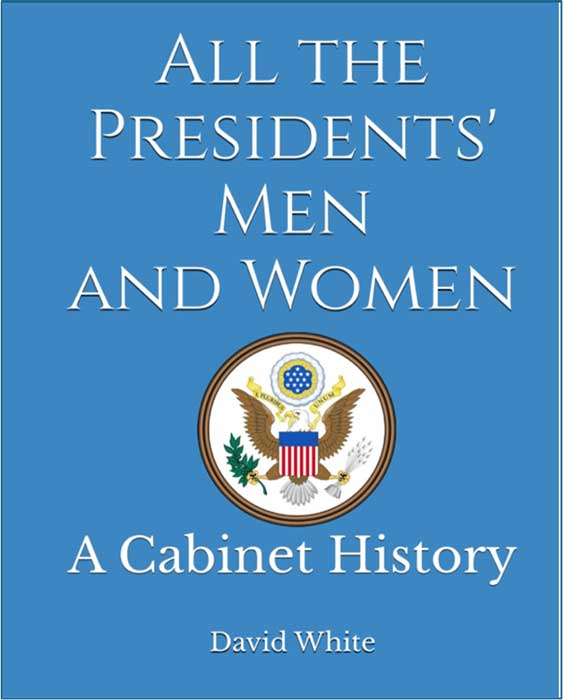
All the Presidents’ Men and Women: A Cabinet History, by David White
Washington, a precedent-setter in so many ways, decided that he needed a regular circle of advisors, as he had enjoyed as a military commander, and so developed the idea of a Cabinet. It wasn’t a new idea. As far back as Anglo-Saxon times in England, the king had relied on the counsel of a trusted few. In fact, for much of the time before the Norman Conquest, the witan, or king’s counsel, actually chose the ruler. That tradition of advisers carried on throughout English history and, in more modern times, took the form of the Privy Council. English Prime Ministers enjoyed the advice and consent of various members of the Privy Council, and this was the state of affairs when English settlers populated North America’s Eastern Seaboard, won a war against French and Native Americans, and then set about asking the American colonists to help pay the expenses of that war, after the fact. That, of course, led to protests, independence, war, and a new nation.
For the first American Cabinet, Washington chose his most trusted adviser, Alexander Hamilton, who had been a top aide during the Revolutionary War. Hamilton had a very strong financial acumen and was a natural choice as the new nation’s first Secretary of the Treasury. The primary author of the Declaration of Independence, Thomas Jefferson, had strong international experience and made a natural Secretary of State. A third member of the Cabinet, the Secretary of War, was Henry Knox, who had been Washington’s artillery commander during the war. The fourth and last Cabinet member was the Attorney General, Edmund Randolph, on whom Washington had depended as his personal lawyer for many years.
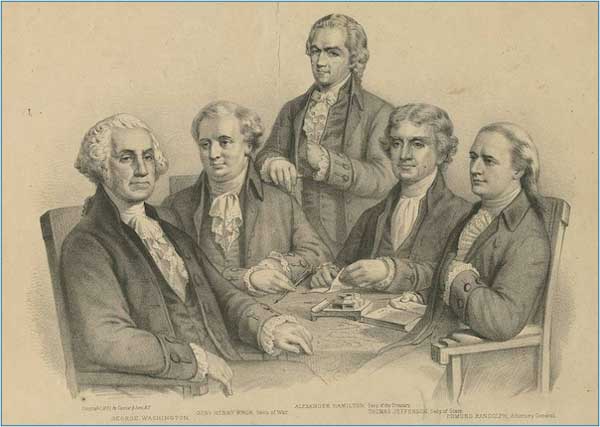
President George Washington’s Cabinet
Washington met with his Cabinet sporadically at first and then slightly more regularly. He also made it very clear that he, as the nation’s commander-in-chief, also had the final word in Cabinet matters. His successors would follow that model to varying degrees.
As the years went by, subsequent Presidents had more or less use for the Cabinet, as times and whims dictated. The growing nation had more and more needs, and the Cabinet did as well. The first new member of the Cabinet was the Secretary of the Navy. Others followed in later years. The current number of official government departments is 15. Other additions included, in order, the Departments of Interior, Agriculture, Housing and Urban Development, Transportation, Energy, Veterans Affairs, and Homeland Security. Along the way, the War Department became the Defense Department (and the last Secretary of War, James Forrestal, became the first Secretary of Defense in 1947). Some departments bifurcated, as in the case of the Department of Commerce and Labor, which became two separate departments after a few years, and with Health, Education & Welfare, which became Education and Health & Human Services. Another change came when the long-running Postmaster General, a member of the Cabinet since very early in the nation’s history, devolved into the head of a new, non-Cabinet entity in 1972. The book details the circumstances that created the need for each new department.
All of the heads of those departments were members of the Cabinet. So, too, were a handful of other government officials whom various Presidents elevated to Cabinet-level status and, in turn, attended varying numbers of Cabinet meetings. Among those other officials were the President’s Chief of Staff, Director of the Office of Management & Budget, National Security Adviser, Counselor to the President, U.S. Ambassador to the United Nations, U.S. Trade Representative, and Director of National Intelligence.
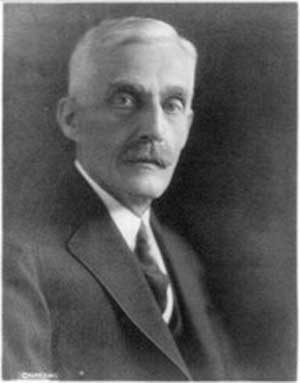
Andrew Mellon
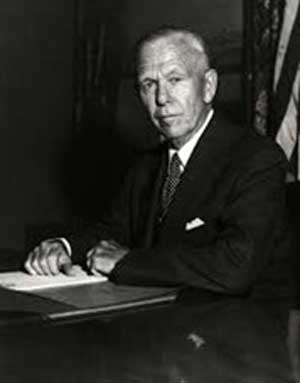
George Marshall
By and large, in any given Administration, the members of the Cabinet serve in their roles as heads of a government department, oversee staffs and budgets, report to the President, and attend Cabinet meetings. But rare is the Cabinet member whose name is a household one throughout America. Some Cabinet members have been very well known, depending on the circumstances. One of the most well-known men in the world in the Roaring Twenties was Secretary of the Treasury Andrew Mellon, who was the architect of so much of America’s prosperity. Mellon, a fan of tax cuts, served under three consecutive Presidents and left office with Herbert Hoover in 1932 after Republican policies were unable to lift the nation from the grip of the Great Depression. After World War II, Secretary of State George Marshall organized the European Recovery Program, which became known as the Marshall Plan. During the Vietnam War era, many in America would have known the name of Defense Secretary Robert McNamara, whose insistence on more and greater infusions of troops eventually created a large backlash against the war and the Government. The book details all of the accomplishments, all of the deeds, and all of the frustrations of every Cabinet member throughout the history of the nation.
Many Presidents worked their way up to the top, so to speak. By tracing the evolution of the Cabinet, the reader can, for example, experience the rise in experience, effectiveness, and popularity of Herbert Hoover, who had led a World War I relief commission and served as head of the U.S. Food Administration and Secretary of Commerce before succeeding Calvin Coolidge as President in 1928. Hoover continued to be one of the most famous names in America even as he and his party were voted out of office by Franklin D. Roosevelt and the New Deal. Another very experienced high-level official was John C. Calhoun, who served in the House and Senate and then as Secretary of War under James Monroe before winning the Vice-presidency in 1825; Calhoun served in that capacity under both John Quincy Adams and Andrew Jackson and then resigned, in order to protest what he saw as the Tariff of Abominations. He returned to the Cabinet a decade later as Secretary of State, under President John Tyler. Tracing his ascendancy, the reader gets a fresh perspective on the growing sectional conflict that devolved into Civil War.
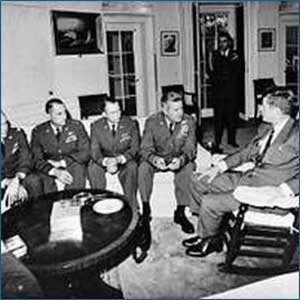 Historians have a wealth of resources in the study of the Cabinet, yet relatively few are wide enough in scope to cover the length and breadth of the history of it. That is what this book does: in its pages are found every American President and every Cabinet member, from Washington to Biden. It’s not just facts and figures, names and dates: anecdotes abound, such as the tense nature of the discussions in the wake of the Cuban Missile Crisis (left) and the goings-on known as the Petticoat Affair, a political-cultural scandal during the presidency of Andrew Jackson.
No discussion of American political history would be complete without mention of scandals. Those appear, too. Examining the events of the Teapot Dome affair from within the lens of the Cabinet gives that scandal a more well-rounded presentation, as does a Justice Department-area focus of the “Saturday Night Massacre” and other events that led to the resignation of President Richard Nixon.
This new book traces all of that, from earliest developments to modern times. Also included are tables listing every Department head, from beginnings to 2025.
Examining each member of a President’s Cabinet, in turn, paints a more detailed and nuanced picture of that President and, as well, the events and challenges of the nation as a whole and the world. Thus, this book tells the history of America in a novel, new way.
©David White, for Legends of America, submitted February 2025.

Author David White
About the Author: David White is a historian, author, and journalist of long standing. He is the author of a large handful of history books, including The People’s Choice: A Short History of America’s Presidential Elections, Slavery in America: 1619–1865, Titans of Antiquity: A Survey of Ancient Greece and Persia from Early Days to Alexander the Great, and Ferdinand Magellan and the First Voyage Round the World. White is the sole author and publisher of Social Studies for Kids, an award-winning research website for students of all ages and their parents and teachers. This website focuses on all aspects of what Americans term the Social Studies: history, geography, economics, civics and government, religions, languages, archaeology, and current events. White has published articles on this site for more than two decades. He began the website in order to fill a niche that he found lacking; that was the same focus for his most recent book, All the President’s Men & Women: A Cabinet History.
Also See:
Presidential Trivia, Fun Facts and Firsts