
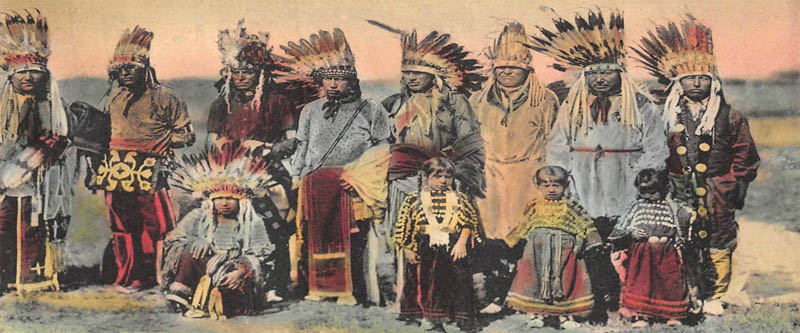
Ponca Indians.
The Ponca are a Siouan tribe of Nebraska, closely related to the Omaha, Osage, Kanza, and Quapaw.
Their traditions and historical accounts suggest that they originally lived east of the Mississippi River, in the Ohio River Valley, and migrated west in search of game after a war with the Iroquois.
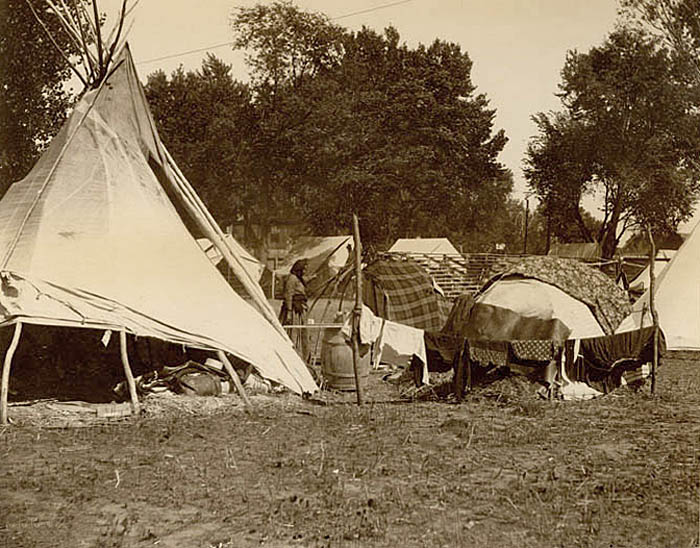
Ponca Camp..
The Ponca built their villages on both sides of the Niobrara River, spanning South Dakota and Nebraska. They sometimes lived with the Omaha, whose language is essentially the same. Their name, Ponca, means “Those Who Lead.” They grew maize and kept vegetable gardens in permanent villages, but in other respects, they lived like other Plains Indians, hunting buffalo.
Until the arrival of the Teton Sioux in about 1750, the Ponca territory stretched from the Missouri River to the Black Hills. Smallpox and other diseases in the 18th and 19th centuries reduced their numbers. Sioux warfare forced their withdrawal to an area near the mouth of the Niobrara River.
In 1789, fur trader Juan Baptiste Munier was given an exclusive license to trade with the Ponca at the mouth of the Niobrara River. He founded a trading post at its confluence with the Missouri River, estimating that approximately 800 Ponca people were residing there. Shortly after that, the tribe was hit by a devastating smallpox epidemic. In 1804, when they were visited by the Lewis and Clark Expedition, only about 200 Ponca remained.
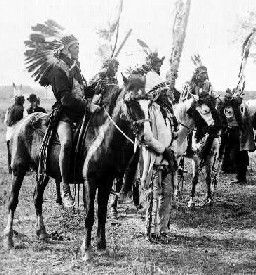
Sioux Warriors.
Although the Ponca never waged war with the United States, they did sign a peace treaty with the United States in 1817. Most of the leadership of the Ponca people was destroyed in 1824 when hostile Lakota attacked a delegation of 30 leaders of various ranks. Returning from a visit to a friendly Oglala Lakota camp, only 12 survived.
In 1825, the Ponca negotiated a second treaty, regulating trade and attempting to minimize intertribal clashes on the Northern Plains. In 1858, the Ponca signed another treaty, relinquishing parts of their land to the United States in exchange for protection from hostile tribes and a permanent reservation on the Niobrara River.
In 1865, the Ponca signed another land cession treaty in return for military protection and economic assistance. However, during the 1860s and 1870s, drought, failed bison hunts, and a continuous Sioux threat brought the Ponca to the brink of starvation.
In the 1868 Sioux Treaty of Fort Laramie, the U.S. mistakenly included all Ponca lands in the Great Sioux Reservation. As a result, conflict arose between the Ponca and the Lakota Sioux, who claimed the land as their own and forced the government to remove the Ponca from their ancestral lands.
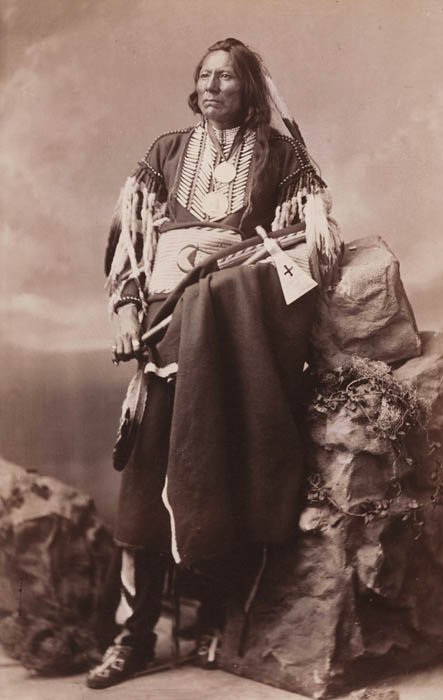
Ponca Chief White Eagle by John K. Hillers.
In 1876, the government decided to remove several northern tribes to the Quapaw Reservation in Oklahoma. However, after several Ponca chiefs inspected the land, they decided against a move because the area was unsuitable for agriculture. When governmental officials came in early 1877 to move the Ponca, the chiefs refused, citing an earlier treaty. Unfortunately, most of the tribe refused and were forcibly moved. The Ponca struggled with malaria, food shortages, inadequate facilities, and the hot climate in Oklahoma. According to some estimates, nearly 158, almost a third of the tribe, perished during the first years in Oklahoma. Under Principal Chief White Eagle, the southern Ponca settled on a 101,000-acre reservation near the confluence of the Salt Fork and Arkansas Rivers in Kay and Noble Counties. Establishing winter camps along the Arkansas River, they continued to practice their tribal customs.
In 1881, the U.S. returned 26,236 acres of land in Knox County, Nebraska, to the Ponca, and about half of the tribe moved back north from Indian Territory. However, the tribe continued to decline.
During the 1880s and 1890s, agents and missionaries sought to abolish the traditional dances, marriage practices, and religious customs of the tribe. During opposition by Ponca’s leadership, the U.S. government began dismantling the tribal government under the Curtis Act. They allotted reservation lands to individual members under the Dawes Act in 1887 and 1892 to encourage assimilation and facilitate Oklahoma’s admission as a state. Any land remaining after allotment was sold to non-natives. After Oklahoma achieved statehood, some remaining Ponca land was leased or sold to the Miller Brothers’ 101 Ranch Wild West Show. The ranch employed Many Ponca people, allowing them to reenact aspects of their traditional lifestyle.
Later in the 19th century, their number rose to about 700.
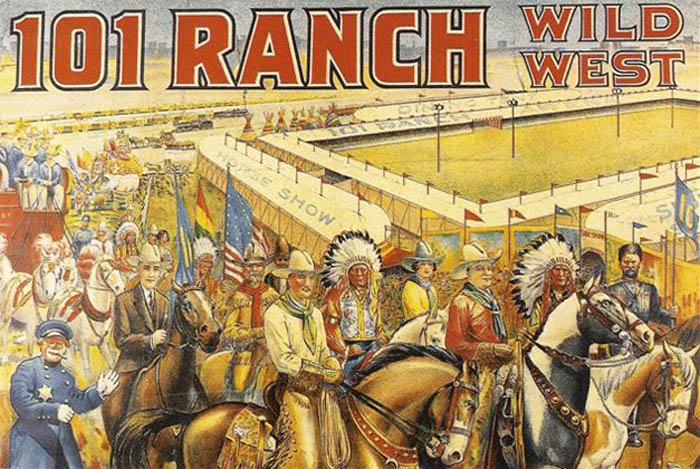
101 Ranch Show, Oklahoma.
The Ponca again came under pressure after oilman Ernest Whitworth Marland discovered oil on and near their reservation in 1911. The development of the Ponca and Tonkawa oil fields created environmental problems, prompting the Ponca to abandon their winter camps along the Arkansas River and relocate to individual allotments.
After World War II, the U.S. government began a policy of terminating its relationship with tribes. In 1966, the government terminated the Northern Ponca tribe in Nebraska, allotted its land to members, and sold off the rest of the property.
In 1950, the Oklahoma Ponca organized a new government under the Oklahoma Indian Welfare Act and adopted its tribal constitution. Today, the tribe is headquartered in White Eagle, Oklahoma, and conducts business from Ponca City. The Ponca Tribe of Oklahoma has over 4,200 members.
In the 1970s, the northern tribe began reorganizing politically and reviving its cultural identity. First, they sought state recognition, and then they allied with their congressional representatives to seek legislation for federal recognition. On October 31, 1990, the Ponca Restoration Act was signed into law, and the Ponca Tribe of Nebraska was recognized. As the only federally recognized tribe in Nebraska without a reservation, they are currently trying to rebuild a land base on their ancestral lands. Today, the Ponca Tribe of Nebraska has over 2,783 enrolled members and is headquartered in Niobrara, Nebraska.
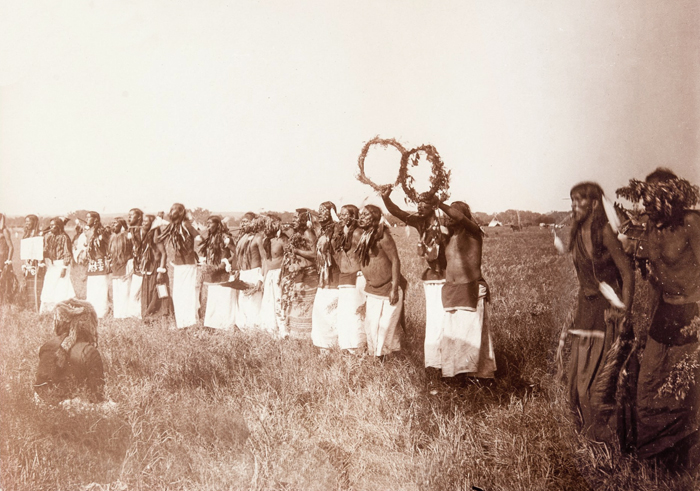
Ponca Sundance.
Relations between the Ponca of Oklahoma and the Ponca of Nebraska improved after the U.S. government restored recognition. Since then, both groups have cooperated on numerous issues, including retaining their language and cultural traditions.
Today, the Ponca Tribe of Nebraska and the Ponca Tribe of Indians of Oklahoma are federally recognized.
©Kathy Alexander/Legends of America, updated July 2025.
Also See:
Native American Mythology and Legends
Native Americans – The First Owners of America
Sources:
Hodge, Frederick Webb, The Handbook of American Indians North of Mexico, Bureau of American Ethnology, Government Printing Office. 1906
Oklahoma History
Ponca Tribe of Nebraska
Wikipedia