
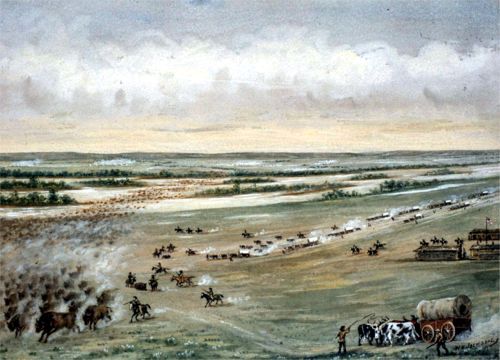
Fort Kearny, Nebraska.
The first Fort Kearny was built in 1847 in Nebraska City, Nebraska. It consisted of a single log blockhouse atop a hill over the Missouri River. Soldiers returning from the Mexican-American War wintered there. However, just a year later, the military decided that the site was ill-chosen, and a new fort was built some 200 miles west on the south bank of the Platte River, about halfway between Fort Leavenworth, Kansas, and Fort Laramie, Wyoming.
This new fort was first called Fort Childs, but then it took the name of the original fort in Nebraska City. The post, established along the Oregon-California Trail, soon protected thousands of westward-bound pioneers who camped around the broad Platte Valley. Reports estimate that over 500 ox teams passed the fort on some days. The post also served as an ammunition depot and protected peaceable Indians in the area from hostiles and outlaws.
Fort Kearny rapidly developed into one of the most important stops on the Oregon-California Trail, and on June 2, 1849, Lieutenant Woodbury wrote:
“Four thousand four hundred wagons have already passed by this post — nearly all destined for California. There are four men and ten draft animals to each wagon-very nearly. Many, not included above, have traveled on the other side of the Platte, and many more are still coming. The post is at present very poorly prepared to give the emigrants the assistance which many have required even at this point so near the beginning of their journey.”
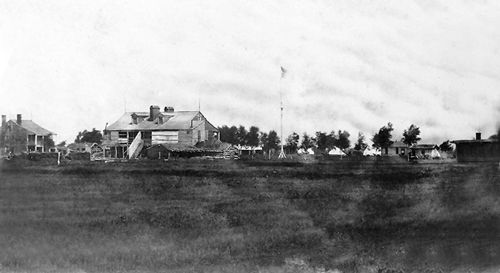
Vintage Fort Kearny.
In 1850, stagecoach services began to run between Independence, Missouri, and Salt Lake City, Utah. These provided Fort Kearny with regular mail and passenger service once a month. For the first time, the emigrants could trust that their letters would arrive at their intended destinations. Later, the post would also serve as an important stop on the Pony Express route in 1860-61.
One traveler, a member of the Utah Expedition, wrote a detailed description of the frontier post when he passed through in 1857:
“Fort Kearny, like most of the forts in the West, has no fortifications but is merely a station for troops. It stands on a slight elevation a few miles from the Platte River. The fort consists of five unpainted wooden houses, two dozen long, low mud [sod or adobe] buildings. The houses are built around a large open square or parade ground, while the mud buildings extend in every direction out from the roads along the sides of this square. Trees have been set out along the borders of the parade ground, and they are the only bushes that can be seen in any direction except a few straggling ones on the banks of the Platte a few miles distant. Intermixed between these immature trees on the sides of the square are 16 blockhouse guns, two field pieces, two mountain howitzers, and one prairie piece. These constitute the artillery defenses of the post against the Indians.”
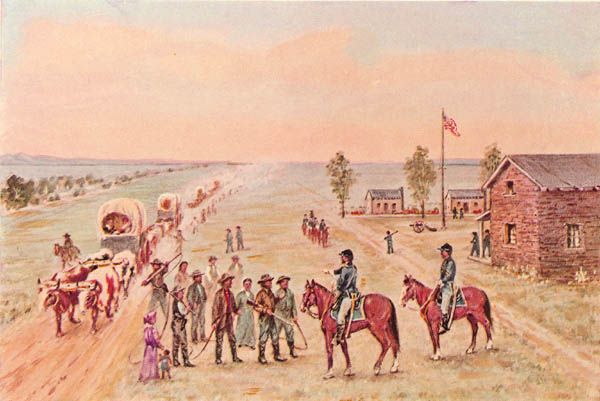
Fort Kearny, Nebraska by William Henry Jackson.
The commanding officer’s house is on the west side of the parade ground. It is a large, ill-shaped, unpainted structure, two stories high, with piazzas along its entire front on both floors. However, the building is much more respectable: commodious, comfortable, well-finished, and neatly finished. Directly opposite the commanding officer’s house, on the other side of the square, is the soldier’s barracks, 70 feet by 30 feet and two stories high. The barracks were never finished and are now in bad order. It can accommodate 84 men very well. There are now between 90 and 100 men in it. The other wooden buildings are the officers’ quarters, the hospital, and the sutler’s store. These structures do not present a very inviting appearance to the eye, but they are charming places compared to the spectacle of 24 long, winding, broken-backed, falling-down mud buildings. These are of all sizes, the largest being about 140 feet long, 40 feet wide, and 12 feet high.”
A small settlement called Dobytown was established around 1859, just west of Fort Kearny. Like many other early settlements, it was a wild and rough frontier town that was called home to several lawless elements. Gambling, liquor, and disreputable men and women were its principal attractions, though it also served as an outfitting point west of the Missouri River. General William Tecumseh Sherman, one of the town’s most famous visitors, described the horrible whiskey he was served here as “tanglefoot.” Despite its bad reputation, the town served as a transportation hub from 1860 to 1866 and was the first county seat of Kearney County.
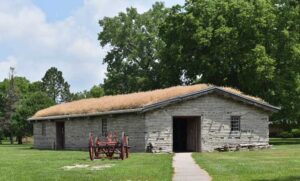
Fort Kearny, NE – Blacksmith Shop. Photo by Kathy Alexander.
During these years, hostilities among the Plains tribes, particularly the Cheyenne and Sioux, gradually mounted and became more widespread until it became an all-out war in 1864. Violence erupted all along the Platte and Little Blue Rivers in Nebraska as wagon trains were attacked, members of the trains killed and scalped, and the wagons plundered and burned. During this time, Fort Kearny became one of the central points for the army and the home of the First Nebraska Cavalry and the Seventh Iowa Cavalry. During these dangerous times, westward-bound wagon trains were not allowed to proceed until there were fifty wagons or more, and soldier guards were sent along with the wagon trains and stagecoaches. Earthwork fortifications were built at the fort in anticipation of an attempted attack on the post.
Completing the Union Pacific Railroad in 1869 reduced the flow of wagons on the Oregon-California Trail, spelling Dobytown’s demise. On May 17, 1871, the last soldiers departed from Fort Kearny.
For 23 years, it served as a military post, symbolizing westward expansion and development. After it was abandoned, the buildings were torn down, and the land opened for homesteading. Only the earthworks of the fortifications and the large cottonwoods around the parade grounds remained. In 1929, the State of Nebraska acquired title to the land and designated it a state park in 1960.
Archeological exploration has located the building sites now marked with interpretive signs. Replicas of the palisade and blacksmith-carpenter shop were built. An interpretive center presents audiovisual programs and museum displays. Fort Kearny State Historical Park, which is 40 acres in size, also serves as a recreational area, providing hiking trails, camping, picnicking, and boating.
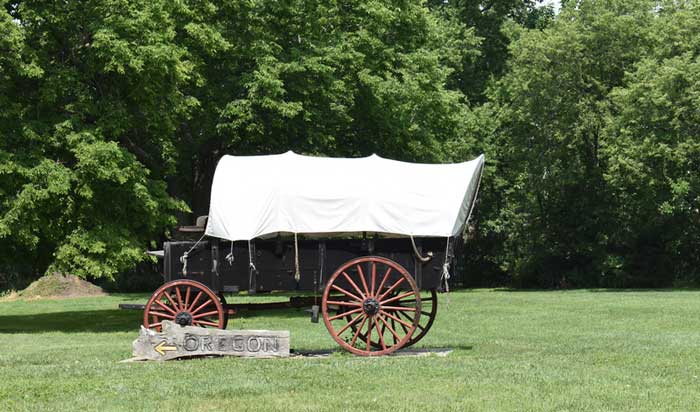
Fort Kearny, NE – Wagon
Fort Kearny State Historical Park is about seven miles southeast of Kearney, Nebraska.
Contact Information:
Fort Kearny State Historic Park
1020 V Road
Kearney, Nebraska 68847-9804
308-865-5305
©Kathy Alexander/Legends of America, updated January 2025.
Also See:
Forts & Presidios Across America