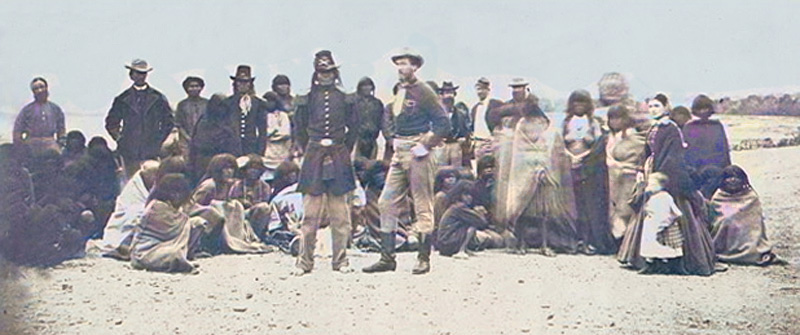
Mojave Indians at Fort Mojave, Arizona.
The Mojave or Mohave are a Native Americans indigenous to the Colorado River in the Mojave Desert. The Fort Mojave Indian Reservation includes territory within California, Arizona, and Nevada borders. The Colorado River Indian Reservation includes parts of California and Arizona and is shared by members of the Chemehuevi, Hopi, and Navajo peoples.
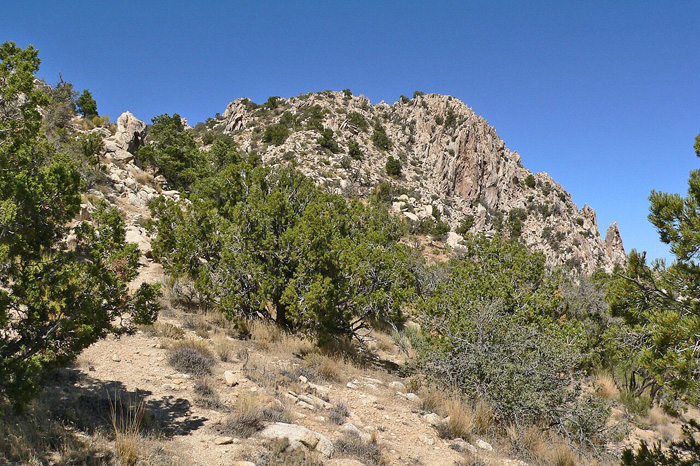
Spirit Mountain in Southern Nevada.
In their language, they were called the Pipa Aha Macav — “The People By The River.” Mojave culture traces its earthly origins to Spirit Mountain, the highest peak in the Newberry Mountains, located northwest of the present reservation inside the Lake Mead National Recreation Area. The Tribe’s spirit mentor, Mutavilya, created the Colorado River, its plants, and animals and instructed the people in the arts of civilization. Matevilya also gave the people their names and commandments.
The land of the Mojave, the most northern of the Yuman tribes, stretched from Black Canyon to the Picacho Mountains below today’s Parker Dam, straddling the Colorado River. The Mojave language belongs to the River Yuman branch of the Yuman language family.
Much of early Mojave history remains unrecorded in writing since the Mojave language was not written in precolonial times. They depended on oral communication to transmit their history and culture from one generation to the next. Disease, outside cultures, and encroachment on their territory disrupted their social organization, interrupting the Mojave transmission of their stories and songs to the following generations.
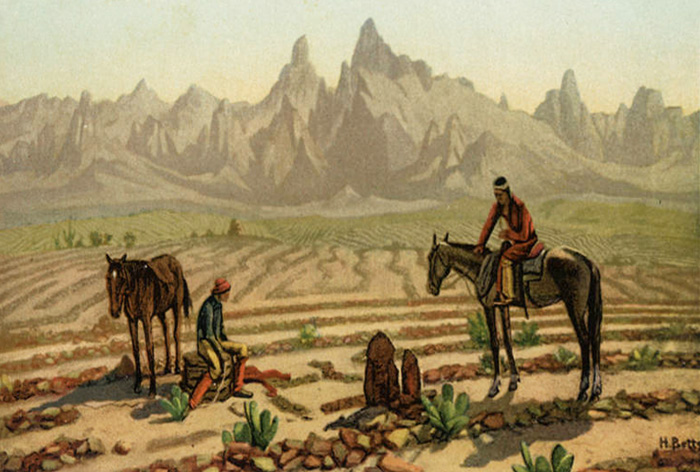
Mojave Indians near Needles, California.
They practiced a dry farming method, relying on the regular overflow of the Colorado River to irrigate crops planted along the banks. They supplemented this with wild seeds and roots, especially mesquite beans, game, and fish taken from the river with traps and nets.
The Mojave could be a fierce people willing to protect their land and venture far from it. They traveled to the Pacific Coast, becoming proficient traders. They exchanged surplus crops with coastal tribes for goods they desired and valued, such as shells.
They live within a clan system, and the children take the name of their father’s clan, though only women use the clan name.
A hereditary chief and leaders from the three regional groups of the Mojave governed the people, but only with their continued support and approval.
The Mojave were a people of dreams and visions. Dreams were viewed as the source of knowledge. Great dreams and visions, such as great tellings and songs, were related to the tribe. They shared the people’s history and legends, deeds of bravery and war, magic, and heroes.
They made pottery from sedimentary clay and crushed sandstone along the river’s banks. The material was coiled into shape, dried, painted, and fired in either open pits or rudimentary kilns. They created pots, bowls, ladles, and dishes decorated with geometric designs. The women took the crafts further by making unique pottery dolls for the children, dressing and decorating them like people, complete with human hair.
The Mojave valued the art of tattooing. They tattooed their faces with lines and dots, a cosmetic, fashionable practice.
They have traditionally used the indigenous plant Datura as a deliriant hallucinogen in a religious sacrament. A Mojave who is coming of age must consume the plant as a rite of passage to enter a new state of consciousness.
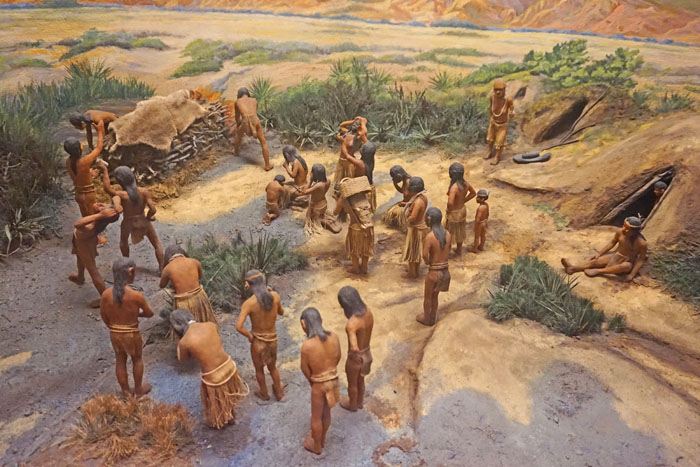
Mojave Indians cremating the dead in Southern California, by the Milwaukee Public Museum.
At death, the Mojave used cremation to enter the spirit world. The property and belongings of the deceased were placed on a pyre along with the body to accompany the spirits. Mourners often contributed their valuables as a showing of love. The names of the dead were never again spoken.
The search for fortune brought the white man to the land of the Mojave. A 1604 expedition searching for silver led New Mexico governor Don Juan Onate through Mojave territory.
However, it wasn’t until 1775 that Fray Francisco Garces became the first white man to meet the Mojave. His writings reveal the Mojave as friendly, most comely, healthy, and robust. He also mentioned that the men walked naked, and the women wore capes made of rabbit and beaver skin. He estimated their population at 3,000.
At that time, the Mojave were the largest concentration of people in the American Southwest. They lived in three groups: one from Black Canyon to the Mojave Valley, a second in the central Mojave Valley, and the third from the Mojave Valley to below Needles Peaks.
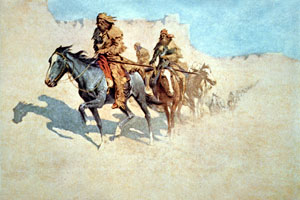
Jedediah Smith by Frederic Remington.
American mountain men led by Jedediah Smith appeared in Mojave territory in 1826, and though the Mojave welcomed the trappers, death, and hatred loomed in the future for the two groups.
In 1827, another party of trappers led by James Ohio Pattie marched through Mojave territory, ignoring Mojave’s demands for a horse in trade for the beaver taken from the river. Four days later, two white men and 16 Mojave lay dead. Late that year, Jedediah Smith returned and was attacked, losing nine men, and for the next 20 years, violence flared, reaching a peak when trappers from the Canadian Hudson Bay Company killed 26 Mojave.
In 1850, the United States annexed territory, including Arizona, and began encroachment by the U.S. Army.
The parade was led in 1851 by Captain L. Sitgreaves, a stern commander, and was followed in 1854 by Lieutenant Amie Weeks Whipple, an amiable man who gained the confidence of the Mojave. Whipple’s company surveyed and mapped a railroad route from Fort Smith, Arkansas, to the Pacific Ocean, which most Mojave favored because it meant an opportunity for trade.
From 1851 to 1856, the U.S. military was ever present, but it never found two white girls, Olive and Mary Ann Oatman, who lived with the Mojave. Captured by the Tonto Apache in 1851, their family was massacred, and the girls were traded to Mojave Chief Espaniol for two horses, some vegetables, several pounds of beans, and three blankets. The younger, frail Mary Ann died in 1854, probably from malnutrition. Olive, at 16, was returned to her relatives in 1856.
The story made national headlines and raised a furor among non-Indians. From the Mojave point of view, the girls were lucky to have fallen into their hands away from the Tonto Apache. Under the circumstances, they were fortunate. The chief attached them to his household, and they were afforded the best Mojave facilities, seeds for planting, love, and divergence from Mojave customs.
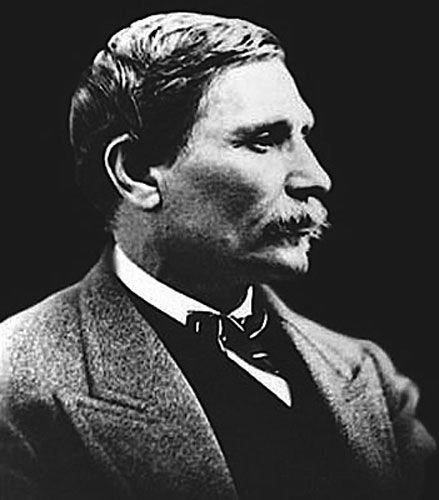
Edward F. Beale
In 1858, Lieutenant Edward Beale and 12 camels cleared and opened a wagon road along Whipple’s survey route, planting the seeds of Fort Mojave. He suggested a fort be built to guard the river crossing near present-day Needles. In August, a wagon train that lingered too long near the crossing was attacked.
Spurred by public clamor to “Wipe out the Mojave,” 700 Indian fighters led by Colonel William Hoffman were sent from San Francisco, California, in April 1859. The Expedition of the Colorado River moved into Mojave country with the well-publicized objective of establishing a military post on the east bank of the Colorado River to give safe passage to American immigrants traveling from east to west. By this time, white immigrants and settlers had begun encroaching on Mojave lands, and the post was intended to protect European-American emigrants from attack by the Mojave. Hoffman sent couriers among the tribes, warning that the post would be gained by force if they or their allies chose to resist. During this period, several members of the Rose-Baley Party were massacred by the Mojave.
The Mojave warriors withdrew as Hoffman’s armada approached, and the army, without conflict, occupied land where an outpost initially called Camp Colorado was built. Hoffman ordered the Mojave men to assemble at the armed stockade adjacent to his headquarters on April 23, 1859, to hear Hoffman’s peace terms. Hoffman gave them the choice of submission or extermination, and the Mojave chose submission. At that time, the Mojave population was estimated to be about 4,000, composed of 22 clans identified by totems.
Later, Camp Colorado was renamed Fort Mojave.
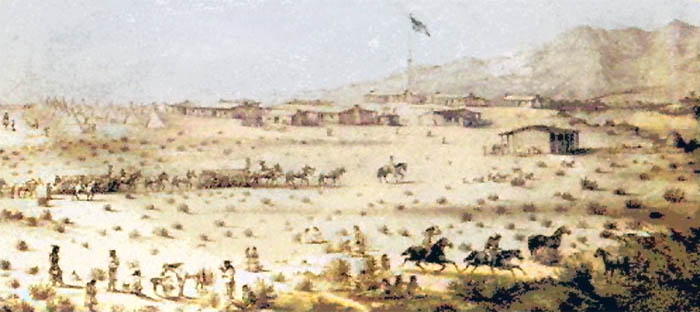
Fort Mojave, Arizona.
In 1861, the constraints of the Civil War forced the military to abandon Fort Mojave. Tribal leadership was in upheaval as the Great Chief Homoseh awahot relinquished his post to Yara tav, who favored peace with the Americans. He had seen their power, having traveled to Los Angeles, San Francisco, and Washington, D.C., to visit President Abraham Lincoln.
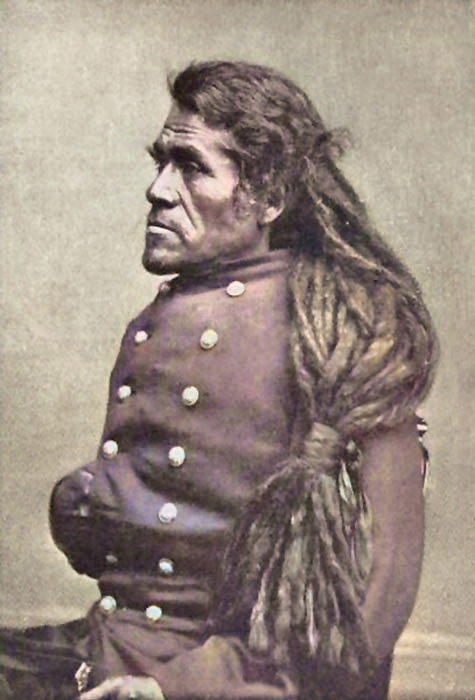
Mojave Chie fYara tav.
The original Colorado River reservation was established in March 1865. Under American law, the Mojave were to live on the reservation. Though disapproving of the poor farmland, Chief Yara tav led 500 to 800 Mojave to the new reservation in Parker Valley.
The Fort Mojave reservation was established in 1870. Both reservations include substantial senior water rights in the Colorado River, which is drawn for use in irrigated farming. However, many refused to leave their ancestral homes in the Mojave Valley. At this time, under the jurisdiction of the War Department, officials declined to try to force them onto the reservation, and the Mojave in the area were relatively free to follow their tribal ways.
After the Indian Wars ended in midsummer 1890, the War Department withdrew its troops, and the post was transferred to the Office of Indian Affairs within the Department of the Interior.
Beginning in August 1890, the Office of Indian Affairs began an intensive assimilation program. That year, a building and 14,000 acres were transferred from the War Department to the Interior Department. The fort became an industrial boarding school for the Fort Mojave and non-reservation Indians. The plan was to eradicate the native language and culture.
The Mojave and other native children living on reservations were forced into boarding schools, where they learned to speak, write, and read English.
This assimilation program, which was Federal policy, was based on the belief that this was the only way native peoples could survive. A compulsory education law was passed, and truant children forcibly returned to school were often whipped and locked in an attic for days and given water and a slice of bread for meals.
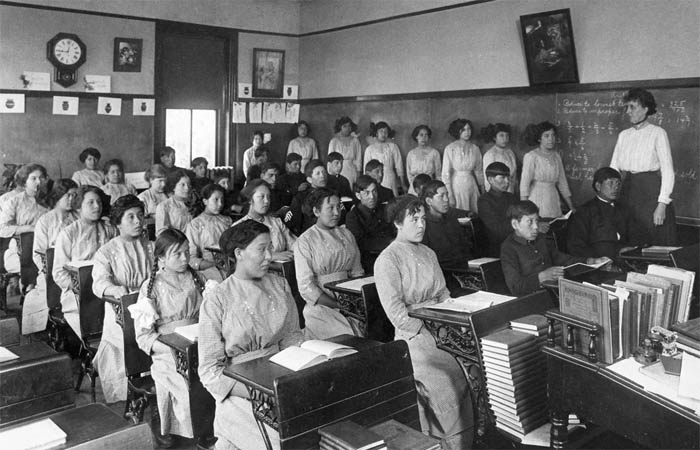
Native American Boarding School.
The assimilation helped to break up tribal cultures and governments. In addition to English, schools taught American culture and customs and insisted that the children follow them; students were required to adopt European-American hairstyles (which included haircutting), clothing, eating habits, sleeping, toiletry, manners, industry, and language. Using their own language or customs was a punishable offense; at Fort Mojave, five lashes of the whip were issued for the first offense. Such corporal punishment of children scandalized the Mojave, who did not discipline their children in that way.
As part of the assimilation, the administrators assigned English names to the children. They registered as members of one of two tribes, the Mojave Tribe on the Colorado River Reservation and the Fort Mojave Indian Tribe on the Fort Mojave Indian Reservation. These divisions did not reflect the traditional Mojave clan and kinship system.
The Indians were taught Anglo farming methods, but with no land, they looked elsewhere for work. Many turned to the Atlantic and Pacific Railroad (later the Santa Fe Railroad), which came to Needles in 1883. Others worked on river boats and in the mines; some sold beadwork and pottery dolls to train tourists. The Mojave became urban Indians living in Needles.
By 1910, the tribe’s population was estimated at 1,050.
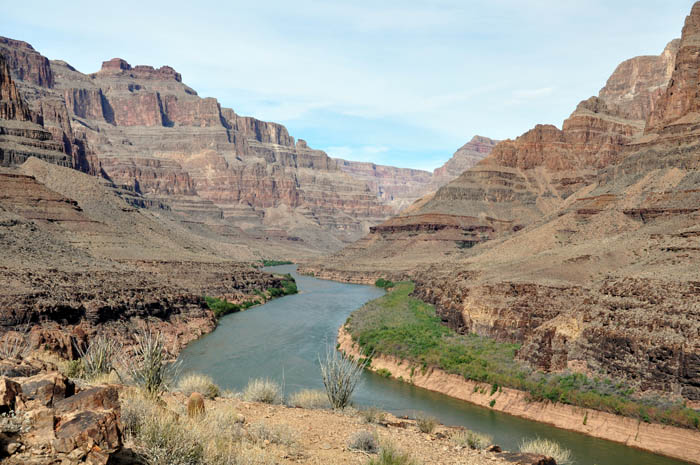
Mohave County, Arizona, courtesy of Wikipedia.
By executive order in 1911, Fort Mojave was granted a reservation consisting of the old military reserve on the California and Nevada sides of the Colorado River, a total of about 31,300 acres.
The boarding school closed in 1931, and children began attending school in Needles.
In the 1930s, George Devereux, a Hungarian-French anthropologist, did fieldwork and lived among the Mojave for an extended period. Afterward, he published extensively about their culture.
In 1936, a great flood washed out Mojave homes in Arizona and Needles, California. To replace these homes, a new village was built outside Needles in 1947 on land bought by the tribe and later declared part of the reservation.
Traditional tribal leadership forever changed in 1957 when the Fort Mojave Constitution was approved, creating a seven-member tribal council.
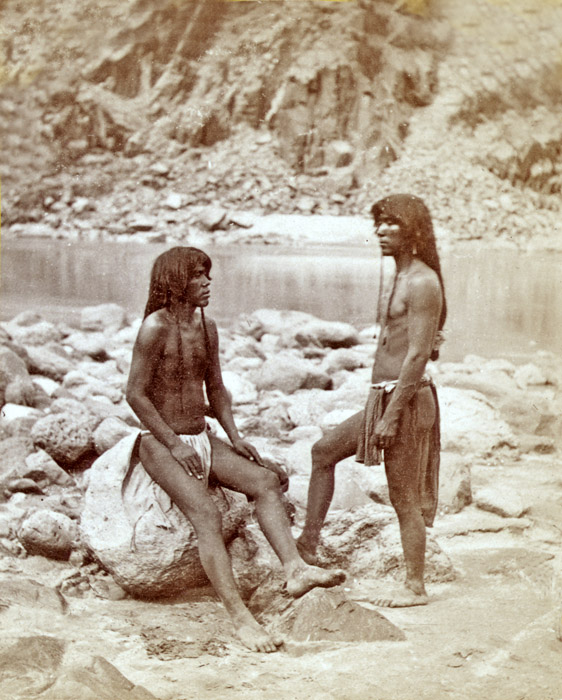
Mojave Indians, 1871.
By 1963, the tribe’s population had shrunk to approximately 988, with 438 at Fort Mojave and 550 at the Colorado River Reservation.
By the late 1960s, 30 years after the end of the assimilation program, 18 of the 22 traditional clans had survived.
In 1994, approximately 75 people on the Colorado River and Fort Mojave reservations spoke the language. The tribe has published language materials, and new efforts are being made to teach the language to children.
The ruins of Fort Mojave still exist today as a reminder of the once-troubled historical relationship between the Mojave and American civilization. The ruins are located on a bluff overlooking the Colorado River just south of the boundary of present-day Bullhead City.
Currently, the Mojave and the Chemehuevi, some Hopi, and some Navajo share the Colorado River Indian Reservation and function as one geopolitical unit known as the federally recognized Colorado River Indian Tribes. Each tribe also maintains and observes its traditions, distinct religions, and culturally unique identities.
The Colorado River Indian Tribes headquarters, library, and museum are in Parker, Arizona, about 40 miles north of I-10. The Colorado River Indian Tribes Native American Days Fair & Expo is held annually in Parker from Thursday through Sunday during the first week of October. The Megathrow Traditional Bird Singing & Dancing social event is also celebrated annually on the third weekend of March.
The Fort Mojave Indian Reservation is located along the Colorado River near Needles, California. It covers nearly 42,000 acres in the tri-state area of Arizona, California, and Nevada. The land is divided into three major segments: 23,669 acres in Mojave County, Arizona; 12,633 acres adjacent to Needles, California; and 5,582 acres in Clark County, Nevada. The tribal headquarters are located in Needles, California.
Recreation opportunities abound, whether it is gambling at one of the two Tribal casinos on the reservation, boating or fishing along the Colorado River, staying at the Avi Resort & Casino’s full-service hotel, hitting the links at the Mojave Resort PGA Championship Golf Course or enjoying the comforts of home away from home in the RV parks, located adjacent to either casino.
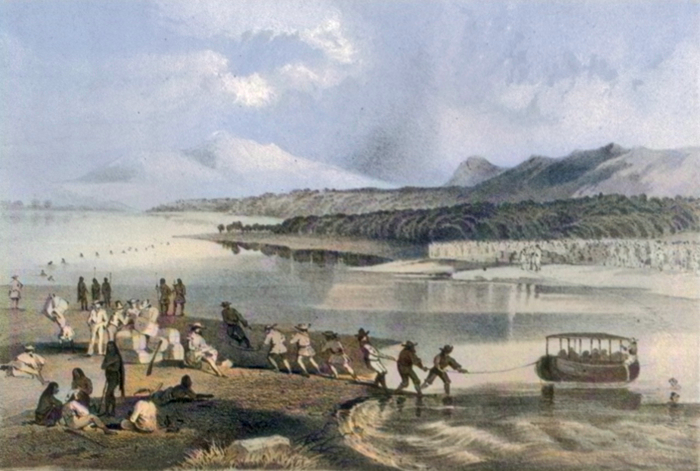
Mojave Villages on the Colorado River, by Sarony, Major & KnappLith, 1855.
An annual Pow Wow, held each February, brings Native Americans from tribes across the United States to a celebration that includes dance and music competitions and displays of many aspects of tribal culture.
More Information:
Fort Mojave Indian Tribe
500 Merriman Avenue, Needles, California 92363
760-629-4591
©Kathy Alexander/Legends of America, updated May 2025.
Also See:
List of Native American Tribes in the U.S.
Native American Photo Galleries
Also See: