
Hudson’s Bay Company Logo
Hudson’s Bay Company, chartered on May 2, 1670, is the oldest commercial corporation in North America and is one of the oldest in the world.
In its early days, it was headquartered in London, England, and controlled the fur trade throughout much of British-controlled North America for several centuries. Forging early relationships with several Native American tribes, the company’s trappers and traders were among the first European people to set eyes on many locations that would later become part of the United States and Canada.
The company established its first headquarters at Fort Nelson, located at the mouth of the Nelson River in present-day northeastern Manitoba, Canada. Other posts were quickly established around the southern edge of Hudson Bay, in Manitoba, as well as in present-day Ontario and Quebec.
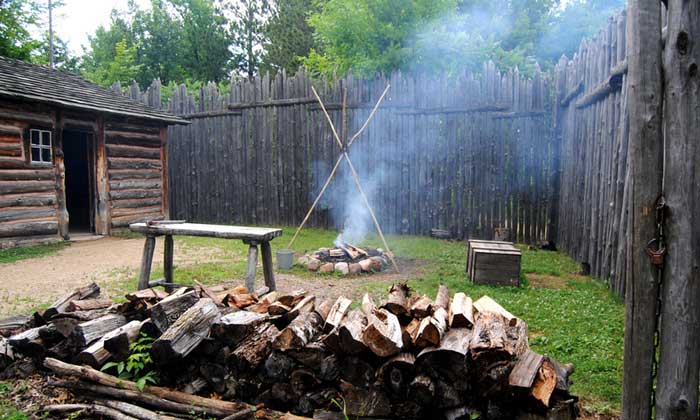
North West Trading Post Fire by Kathy Alexander.
In 1821, the Hudson’s Bay Company merged with the North West Company of Montreal, Canada, creating a combined territory that extended into the North-Western Territory, which reached the Arctic Ocean to the north and the Pacific Ocean to the west. Soon, the company controlled nearly all trading operations in the Pacific Northwest, based at its headquarters in Fort Vancouver, Washington. To stifle any competition, they discouraged any U.S. settlement of the territory.
During the 1820s and 1830s, their trappers were involved in the first explorations of Northern California as far south as the San Francisco Bay Area, one of the last regions of North America to remain unexplored by Europeans or Americans. The company’s network of trading posts functioned as the de facto government in many areas of the continent before the arrival of large-scale settlement. At one time, the company was the largest landowner in the world.
The company established Fort Boise, Idaho, in 1834 to compete with the American Fur Company’s Fort Hall, which they purchased in 1837. Situated along the Oregon Trail, they displayed abandoned wagons at the post to discourage pioneers from moving along the trail.

Hudson’s Bay Company Trading Post.
However, their monopoly of the region would be broken when the first successful large wagon train reached Oregon in 1843. Soon, thousands followed, and in 1846, the United States acquired the full authority of the most settled areas of the Oregon Country.
In 1849, the U.S. Army established a post known as Columbia Barracks, located up the hill from Fort Vancouver. By then, the fur trade was declining, and the Hudson’s Bay Company transferred its headquarters to Fort Victoria in British Columbia, Canada. However, several employees were left behind to work the farms and industries they had created in the area. The fur company then rented many of its buildings to the U.S. Army. They maintained a presence there for the next ten years, but in June 1860, the Hudson’s Bay Company abandoned Fort Vancouver and moved their entire presence north.
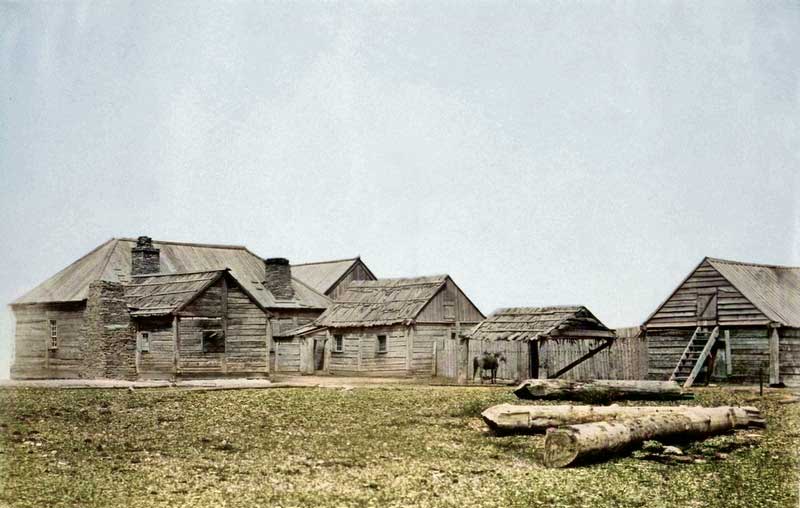
Officers’ house at the Hudson Bay Company’s Fort Colville, Washington, 1860.
The company evolved into a mercantile business selling vital goods to settlers in the Canadian West. In recent times, the Hudson’s Bay Company has struggled, undergoing several company restructures and division sell-offs, culminating in March 2025, when the company filed for bankruptcy. It was saved in May 2025 after the company sold its intellectual property to another iconic retailer, Canadian Tire.
©Kathy Alexander/Legends of America, updated July 2025.
Also See:
The Great Fur Trading Companies
Trading Posts of the Fur Trade
Trappers, Traders & Pathfinders
See Sources.