

Joseph H. Williams Tallgrass Prairie Preserve in Osage County, Oklahoma. Photo by Carol Highsmith, 2020.
In the late 19th century, the Osage Hills of northern Oklahoma and southern Kansas were said to have been plagued by a phantom who harassed, kidnapped, and murdered travelers in the area.
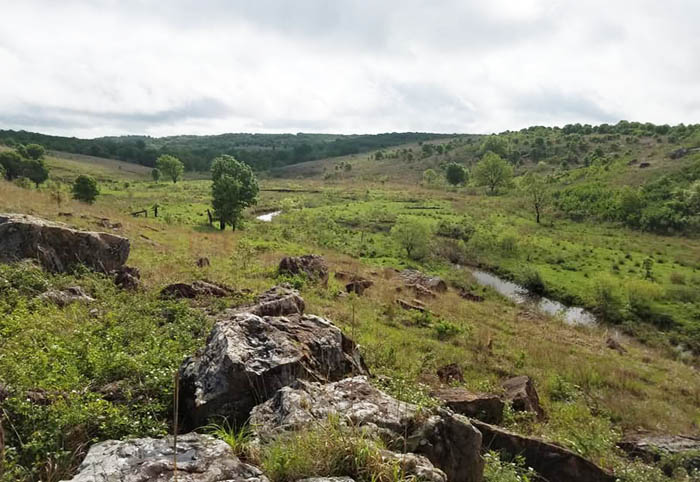
Osage County, Oklahoma Conservation District.
The Osage Hills are an extension of the Flint Hills in southern Kansas, one of the last remaining prairie areas in the nation. The Flint Hills were the world’s most excellent grassland, once stretching from Illinois to Texas. In Oklahoma, the terrain continues along broad rolling hills, with tallgrass prairie, and Cross Timbers encompassing Osage County and the surrounding area. This area once supported millions of buffalo; it’s a harsh, gritty, prickly, windy area with cattle ranches, oil fields, small towns, limestone bluffs, and remnants of the Old West.
Historically, most of this area was the last reserve of the Osage Indians, and its rugged environs hid outlaws and illicit activity well into the 20th century.
In July 1883, the Karl Fentwick family from New York was traveling through Kansas and into the Oklahoma area near the northwest corner of the Osage Reservation. They made camp at the end of the day, and they were in good spirits because they were celebrating the youngest of the family, Katie Fentwick’s birthday. After dinner, she received a beautiful gold locket and chain from her father. She then began running and playing around the camp, but unfortunately, she strayed too far and didn’t return. After the family organized a search party with experienced Indian trackers, she was never seen again. Hers was the first in a string of strange disappearances that would plague the area for several years.
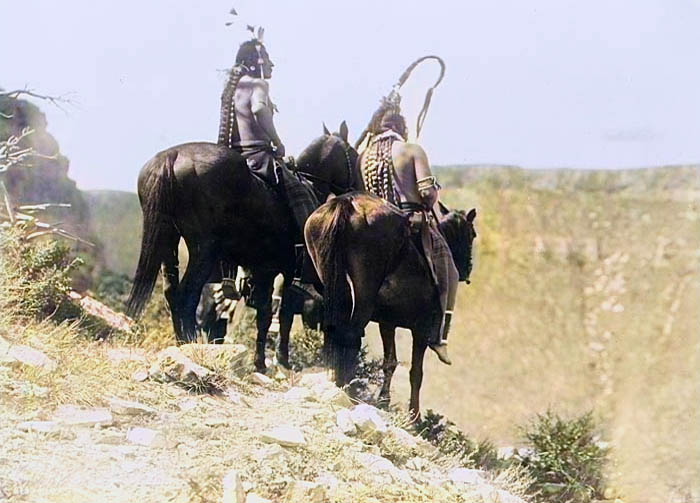
Indian Trackers by Edward S. Curtis.
Later, in December, George Bitters, a mail carrier from Sedan, Kansas, went missing during a regular weekly delivery to Peru, Kansas, in the Osage Nation. Never arriving at his destination, a search party went to look for him. Though they never found the mail carrier, his horse was discovered alive but stripped of its saddle and bridle. The following Spring, Elmer Johnson went hunting in the hills and disappeared. His rifle was found with the stock broken. His hat lay nearby, covered with blood.
In September 1885, a group of hunters discovered the skeletons of two horses and a weather-beaten wagon that had been abandoned for at least a year. The wagon contained the belongings of two men, but no trace of their bodies could be found. The following spring, a boy named Elmer Johnson went missing after he failed to return home from a hunting trip. Searchers found his gun, which had a broken stock, and recovered his hat, which was covered in blood.
On February 12, 1886, Oscar Beach went hunting along the northern border of the reservation and vanished as mysteriously as the others. By this time, there was much suspicion among the white settlers and the Indians. Though U.S. Marshals tried to find the culprit(s), they failed. Over the years, numerous individuals were reported missing, and their unusual disappearances went unexplained.
During this time, ranching in the Osage Reservation was producing large herds of cattle. The Atchison, Topeka & Santa Fe Railroad proposed to build a new railroad from Caney, Kansas, to Niotaze, then southwest through the Cascade Hills to the town of Chautauqua, and on to Elgin, Kansas, an ideal central shipping point. A team of Italian laborers was working on this job under the supervision of a powerfully built Irishman named Pat Durfee, who always wore a gold chain about his neck.

Building the railroad on the Great Plains by Alfred Waud, Harper’s Weekly, 1875.
On several nights, the crew members reported hearing strange noises and complained about a prowler lurking near their tents. The next morning, they discovered that some items were missing. As a result, the men began to sleep lightly and kept watch during the night. Despite their vigilance, the disturbances continued. Pat Durfee decided to stay up alone to catch the strange visitor. Around midnight, while he dozed, he was suddenly awakened by something tugging at the chain around his neck. In that moment, a shadowy figure dashed away into the moonlight.
Durfee grabbed his rifle and fired, shooting the plunderer in the leg. When he fell in the brush, thrashing and screaming like a wounded animal, Durfee approached for another shot. However, the thief roared like a beast and took off in complete disregard of the bleeding bullet wound. The workers rallied and made a chase into the hills, but the wildman got away with Durfee’s gold chain.
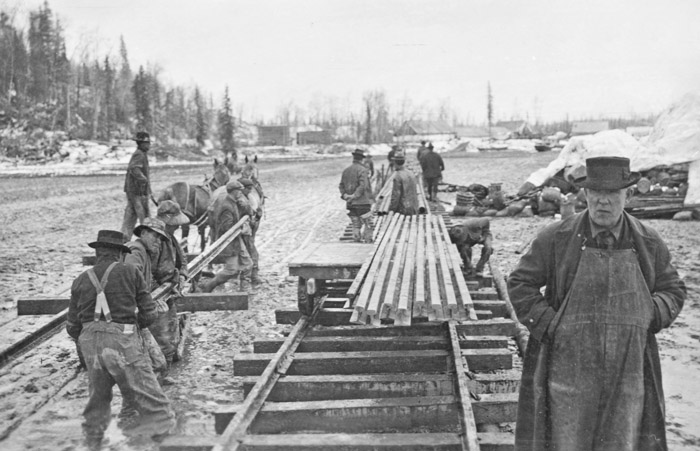
Railroad Construction.
Quickly, the foreman organized a posse and, with three Indians as guides, set out in pursuit. Following blood spots on the ground, they followed the trail all night and the next day. Late in the evening, they entered a ravine in a wild, broken section of hills that was so choked with undergrowth it was almost impenetrable. Continuing, the trail ended at the mouth of a cave.
Suddenly, their target launched an attack, hurling heavy stones with such precise aim that the posse suffered three casualties before they could retreat. Durfee fired until his rifle was empty, but failed to hit the creature. As he attempted to reload, the figure leaped from the rocks and charged at him, its screams echoing through the hills. Using his rifle as a club, Durfee struggled with the creature until some of his Italian workers drew knives and rushed to his aid. The fierce struggle finally ended when the monster collapsed on its wounded leg, lying on the ground and shrieking in a fit of rage.
The Italian laborers shuddered, and Durfee gasped as they gazed down at the wild man’s face, which was burned black and seamed with scars. The nose had been broken and had grown back horribly distorted. His upper lip had been torn away, displaying broken teeth jutting like fangs. Dressed in simple animal skins, his shaggy iron-gray hair was matted about his head and face, and around his wrists were heavy steel bands. From one, a link of chain still dangled. His lifeless body was then thrown to the bottom of a ravine and covered with rocks and dirt.
When the men entered the cave, they found a living area, a crude fireplace, some cooking utensils, and a grass bed. About 20 feet into the cave, a natural shelf in the rock wall contained at least 16 grinning skulls, and in the center of the cave lay a large pile of bones. There was also George Bitters’ saddle, bridle, and empty mail pouch, Elmer Johnson’s clothing, Oscar Beach’s gun, and many other items from anonymous and forgotten victims hanging from pegs driven into the wall. Little Katie Fentwick’s locket and the gold chain Pat Durfee had worn around his neck were stuffed in a crevice with several other pieces of jewelry.

Wild Man of the Osage Hills.
Upon report of the wild man’s demise and description, authorities recalled that some years earlier a chain shackled crazed half-breed Delaware Indian had broken out of his bondage and escaped into the Osage Hills. He was identified as Tangdhangtanke (the panther), who had been placed in irons for tribal crimes. He had escaped years before and was thought to have died from exposure.
©Kathy Alexander/Legends of Kansas, May 2025.
Also See:
Sources:
Lamb, Arthur H.; Tragedies of the Osage Hills, Raymond Red Corn; Second Print edition, January 1, 2001
“Osage Terror” by Glenn Shirley, True West Magazine, December 1962
Wikipedia