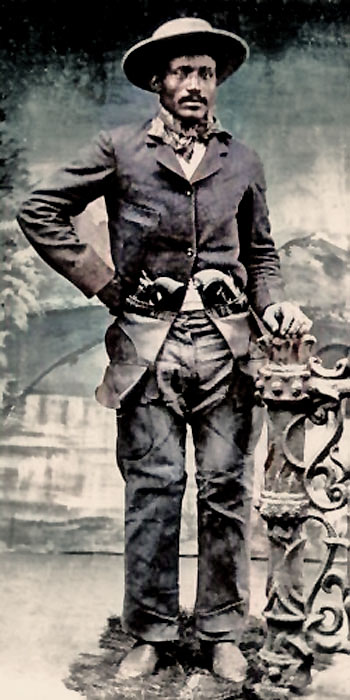
U.S. Deputy Marshall Grant Johnson.
Grant Johnson was one of the most noted peace officers in the history of the Indian Territory (Oklahoma). Born into slavery in June 1858 in northern Texas to Alex Johnson, a Black Chickasaw freedman from Missouri, and Miley Johnson, a Muskogee Creek freedwoman from Mississippi, he grew up to become a U.S. Deputy Marshal.
Indian freedmen were either former black slaves of Indians or descendants of Indian slaves of the Five Civilized Tribes – Cherokee, Choctaw, Chickasaw, Creek, and Seminole.
Johnson settled in the Creek Nation sometime after 1880. At that time, there was a history of intermarriage and tolerance between blacks, Creeks, and Seminoles.
Blacks, such as Johnson, who spoke Creek fluently and knew other Indian languages, were sought and hired to serve as U.S. Deputy Marshals. He began his career as a deputy Marshal in Indian Territory in about 1887. Serving under “Hanging Judge” Isaac Parker for at least 14 years, he was highly effective due to his knowledge of the customs and language of tribes living in Indian Territory.
Standing about 5-foot-8 and weighing 160 pounds, he was described as quiet and reserved but exuded confidence. He often wore a large, wide-brimmed white hat and a black bandanna around his neck. Carrying two revolvers on his hips, he kept a Winchester rifle in a saddle scabbard. Given a good education in English, his penmanship was excellent, and unlike many black and native marshals, he was able to use his skills to sign court documents.
Often working with Bass Reeves, the pair captured one of the most notorious outlaws in the territory, Abner Brasfield. Johnson is known for having captured Jake Stanley, noted counterfeiter Amos Hill, Choctaw outlaw Chahenegee, the murderers John Pierce and Bill Davis, the Cherokee outlaw Columbus Rose, train robber Wade Chamberlee, and dozens of others. Judge Isaac Parker considered Johnson one of his most effective deputies during his career.
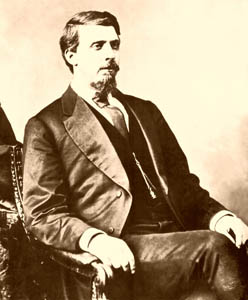
Judge Isaac Parker.
Newspapers in Indian Territory and Arkansas, Kansas, Texas, and the Midwest covered his exploits.
Grant Johnson received his last commission from Judge Parker in 1896.
He was transferred to the Northern District in 1898 and worked there for many years, patrolling around the town of Eufala, Oklahoma. During his time as a Deputy U.S. Marshall, he developed one of the most notable arrest records.
In 1902, a group of disgruntled Creek full bloods and Freedmen, led by Chitto Harjo, were creating disorder in the Creek Nation. Harjo felt that old treaties were being broken, including treaties that had previously allotted land to Indians and freedmen. Johnson and a group of other lawmen rounded up and arrested Harjo and his cohorts, putting them in the federal jail in Muskogee.
In 1906, Deputy Marshall Johnson became a policeman in Eufaula and largely patrolled the African American sector of the town.
“Grant Johnson, a mulatto, of Eufaula, was the best marshal they ever had.”
— James M. Calhoun, resident
Johnson died on April 9, 1929, in Eufaula, Oklahoma, at the age of 70.
Upon his death, the following words were spoken about Deputy Marshall Johnson:
“He was brave, yet he was kind to his prisoners. He was on the force in the day of Belle Starr. When Younger Bend was the suburbs of hell, Grant would go into the Bend and hunt for outlaws. Without a doubt, he was the best Negro that was ever on the force.”
©Kathy Alexander/Legends of America, updated August 2025.
Also See:
African American History in the United States
Old West Lawmen & Gunfighters Photo Gallery
U.S. Marshals – Two Centuries of Bravery
Sources:
African-Native-American.com (Dead Link)
Burton, Art T.; Black Red & Deadly, Eakin Press, August 1991
Find a Grave
Museum of Native American History
Oklahoma Historical Society