
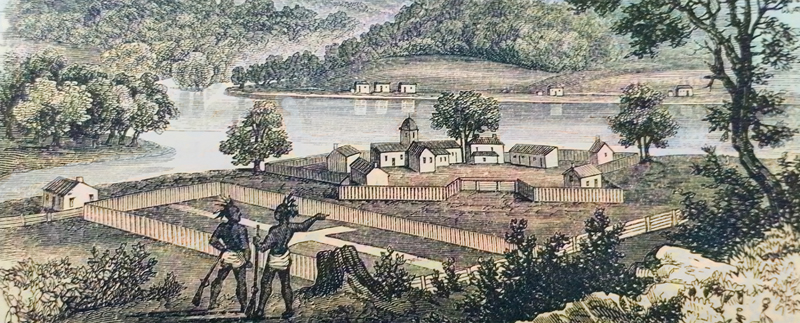
Fort Harmar, Ohio by Benson J. Lossing.
Fort Harmar, Ohio, was an early United States frontier military fort built at the Ohio and Muskingum Rivers confluence under Colonel Josiah Harmar, then commander of the United States Army, in 1875.
The first frontier fort built in Ohio Country, its objective was to prevent pioneer squatters from settling on Indian lands northwest of the Ohio River and to evict settlers already living there because they lacked government-issued land titles. Another purpose of the fort was to protect federal survey crews charged with gridding the Seven Ranges, a land tract in southeastern Ohio for sale at public auction.
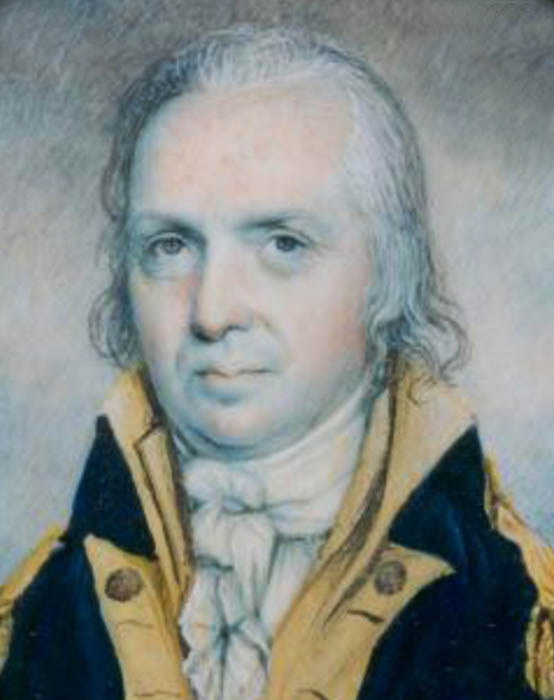
Colonel Josiah Harmar.
On October 25, 1785, Major John Doughty, his company, Captain Jonathan Heart, Lieutenant James Bradford, and Lieutenant Ebenezer Frothingham, and their commands left Fort McIntosh, Pennsylvania, for the Muskingum River. The 150 men arrived on November 5 and began constructing the pentagonal-shaped fort named for Colonel Josiah Harmar on elevated bottom land on the west side of the Muskingum River at its confluence with the Ohio River.
The position was judiciously chosen, as the pentagonal-shaped fort commanded not only the mouth of the Muskingum but also swept the waters of the Ohio River from a curve for a considerable distance above and below the fort. A 120-foot wall, built from timber placed horizontally 12-14 feet high, surrounded three-quarters of an acre. Log bastions were set upright in the ground at each of the five corners. Three of the bastions were mounted with cannons; the two facing the two rivers were not.
Officers’ quarters, made of hewn logs and one and a half or two stories high, were part of the bastions. They had kitchens in the back and stone chimneys. Barracks for the enlisted men extended along the main walls, with their roofs sloping inward, topped with a cupola that served as a sentinel post. A flagstaff was mounted atop the cupola, and a room beneath served as a guardhouse. The barracks were divided into rooms about 30 feet long and furnished with fireplaces.
A well near the center of the fort supplied water in case of a siege. Water for ordinary purposes was carried from the river. The main gate faced the river, and just outside the walls were extensive gardens to raise food for soldiers. In addition to vegetables, peach trees provided fruit. Three large log buildings served the blacksmith, carpenter, and mechanics between the fort and the Muskingum River. Although the first regular detachment moved into their new quarters on November 30, the fort was not completed until the spring of 1786. It then served as U.S. Army field headquarters for the entire western frontier from 1786 to 1789. Ultimate military command, however, rested with Secretary of War Henry Knox in New York City.
Fort Harmar was “very commodious and completely finished — the gates are all shut at night, and we rest secure. If no hostilities should commence, we shall have an agreeable tour in this part of the world.”
— Fort Harmer soldier, February 8, 1786
On March 3, 1786, Rufus Putnam, Benjamin Tupper, Samuel Holden Parsons, and Manasseh Cutler met in Boston, Massachusetts, to form the Ohio Company of Associates to purchase, settle, and sell land in present-day southeastern Ohio. The Ohio Company bought 1.5 million acres from Congress.
On July 23, 1786, 32-year-old Colonel Josiah Harmar and his wife arrived, and he assumed command of Fort Harmar.
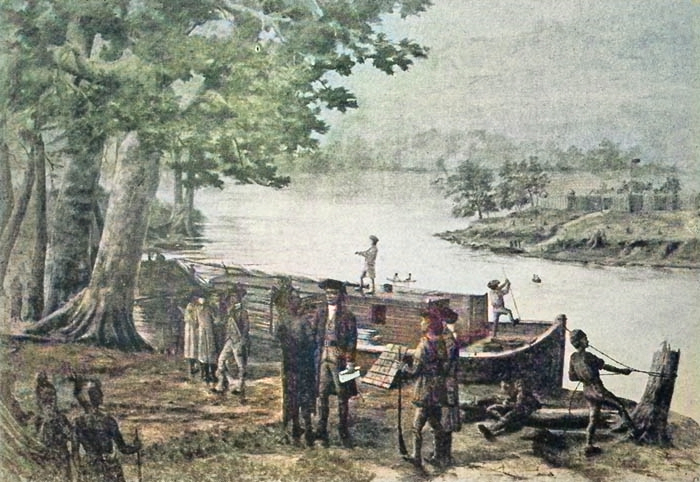
Rufus Putnam and the Ohio Company pioneers.
On July 13, 1787, Congress passed The Northwest Ordinance, creating the Northwest Territory — the region south of the Great Lakes, north of the Ohio River, west of Pennsylvania, and east of the Mississippi River – to create future states.
On April 7, 1788, Rufus Putnam and 47 other Ohio Company stockholders from New England landed at the mouth of the Muskingum River. They established Marietta, across the Muskingum River from the fort, one of the earliest settlements in the Northwest Territory. In July, Northwest Territorial Governor Arthur St. Clair and Territorial Secretary Winthrop Sargent arrived at Marietta to establish civil government and federal control of the territory.
In July 1788, Colonel Josiah Harmar charged Lewis Wetzel with the murder of George Washington, a Delaware Indian loyal to the United States. Wetzel shot Washington while he was hunting on the Muskingum River. Wetzel was arrested and jailed in Marietta but escaped before his trial. He eventually moved to New Orleans, Louisiana, and spent several years in prison for counterfeiting.
In January 1789, two Treaties of Fort Harmar were signed near the fort. One treaty was with representatives of the Wyandot, Delaware, Ottawa, Chippewa, Potawatomi, and Sac tribes; the other was with the Six Nations (except the Mohawk, who did not attend). Territorial Governor St. Clair signed both treaties. However, these treaties failed to prevent increasingly frequent raids by both whites and Indians along the Ohio frontier, especially to and from Kentucky. As immigrants flooded downriver in search of land, so did the location and intensity of violence.
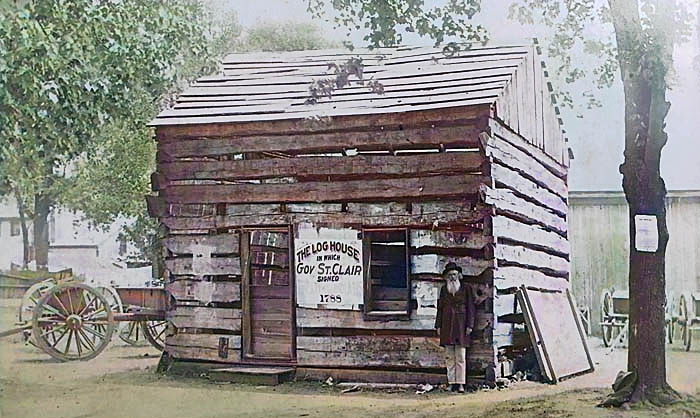
Fort Harmer Treaty Council House.
After signing the treaties, the government relocated its territorial capital and military headquarters from Marietta to Cincinnati.
In September, the U.S. Senate ratified the former treaty, which President George Washington proclaimed. However, the Senate refused to ratify the treaty with the Six Nations, and it was never passed. The treaties were ineffectual in bringing peace.
In December 1789, Governor St. Clair and Colonel Josiah Harmar, with 300 men, left Fort Harmar for the new headquarters at the newly constructed Fort Washington.
By January 1790, and throughout the year, only a few soldiers were stationed at Fort Harmar. In their stead, local militia defended Marietta and the Company’s developing perimeter settlements at Belpre and Waterford.
In October 1790, to end Indian raids into Kentucky, Secretary of War Henry Knox authorized Harmar to chastise Shawnee and outcast Cherokee bandits headquartered at Kekionga (present-day Fort Wayne.) Harmar marched from Fort Washington with 320 regular soldiers and 1,100 militia, mostly Kentuckians, to destroy the villages at Kekionga. By October 22, a confederated army of Indians, led by Miami Chief Little Turtle, routed Harmar’s forces in what became known as Harmar’s Defeat. During the battle, 183 men were killed or missing, and 31 were wounded.
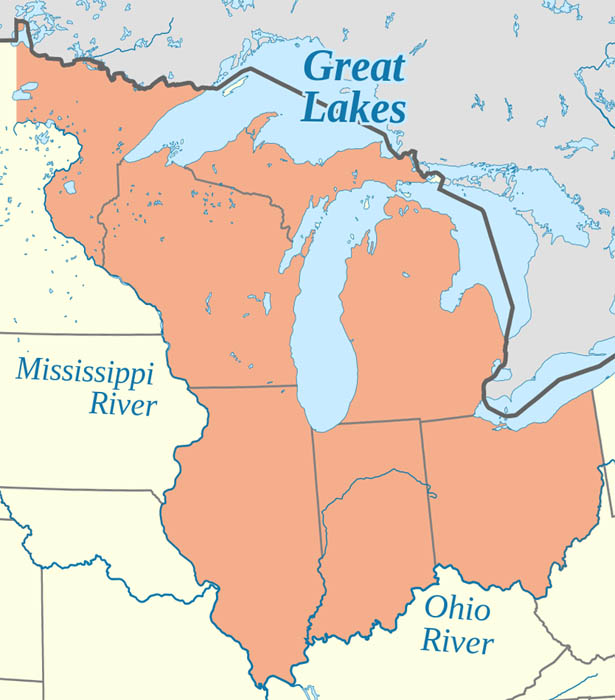
Old Northwest Territory, 1787.
By December 1790, Captain David Zeigler commanded sparsely manned dilapidated Fort Harmar. Virtually all of the 20 or so soldiers at the fort were wounded or ill, and there was no artillery and little equipment at the fort.
On May 1, 1791, Major General Arthur St. Clair wrote to the Secretary of War Henry Knox that Fort Harmar was in a “very ruinous situation. The pickets are very much decayed and the barracks very rotten…” He suggested to Knox that parts of the old fort be torn down and that locals inhabit other parts.
The neglected fort was finally demolished in the summer of 1791. The area had been redeveloped for other uses, and Marietta expanded to the west side of the river.
On October 13, 1791, Josiah Harmar, who served as senior officer of the army from 1784 to 1791, resigned from the army effective January 1, 1792. En route home to Philadelphia, Pennsylvania, he stopped at Marietta to visit friends, but an account of his visit has not been found. He later served as Adjutant General of Pennsylvania from 1793 to 1799. He died on August 20, 1813.
The Fort Harmar site eventually became a market and then was used to construct two different schools. This area of Marietta is still referred to as Harmar, and the neighborhood has been listed on the National Register of Historic Places as the Harmar Historic District.
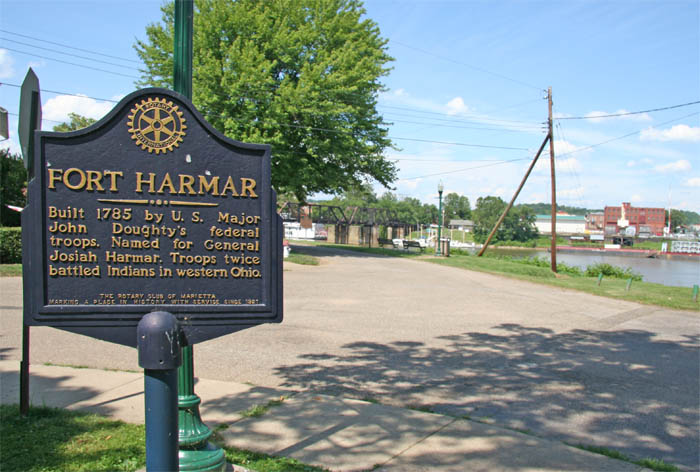
Fort Harmar, Ohio historic marker.
©Kathy Alexander/Legends of America, January 2025.
Also See:
Sources:
Historical Marker Database
Marietta Times
Ohio Society – Marietta Chapter
Wikipedia