
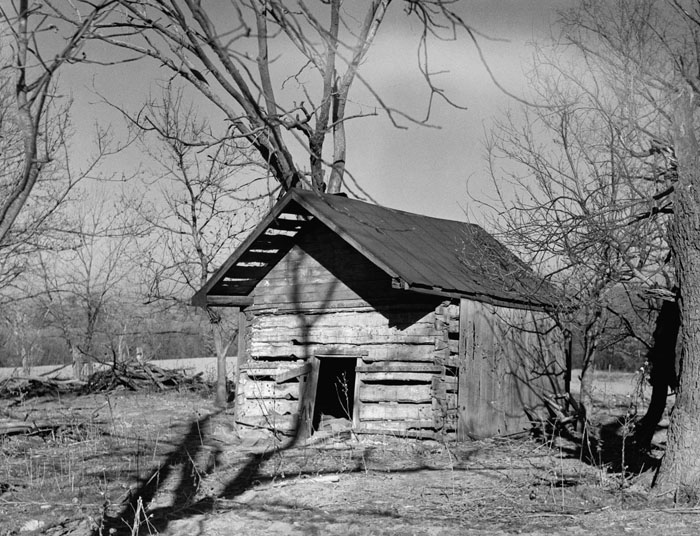
A slave cabin in Missouri.
Missouri was a slave state, and many of its leaders were Southern sympathizers who favored secession and joining the Confederacy when the Civil War began. However, there were relatively few enslaved people and slave owners in Missouri, and only a minority initially favored secession.
By early 1861, pro and anti-secession factions in Missouri organized military and paramilitary forces. Secessionists organized as “Minutemen” were often assisted by state officials. On February 13, Brigadier General Daniel M. Frost enrolled five companies of St. Louis-area Minutemen as the new 2nd Regiment of the Missouri Volunteer Militia. That same month, a new law banned militia activity outside the framework of this militia, forcing pro-Union activists to organize in secret. Later, the Missouri State Guard was established. While it was not a formation of the Confederate States Army, the Missouri State Guard fought alongside Confederate troops and, at various times, served under Confederate officers.
On February 28, Missouri elected a Constitutional Convention to amend the state constitution and decide the issue of secession. On March 21, the Convention voted 98 to 1 against secession but also voted not to supply weapons or men to either side if war broke out.
On April 20, several days after the Battle of Fort Sumter, South Carolina pro-Confederate mob seized the Liberty Arsenal in Liberty, Missouri, and expropriated about a thousand rifles and muskets. This sparked fears that Confederates would also seize the much larger St. Louis Arsenal, which had nearly 40,000 rifles and muskets — the largest stockpile in any slave state.
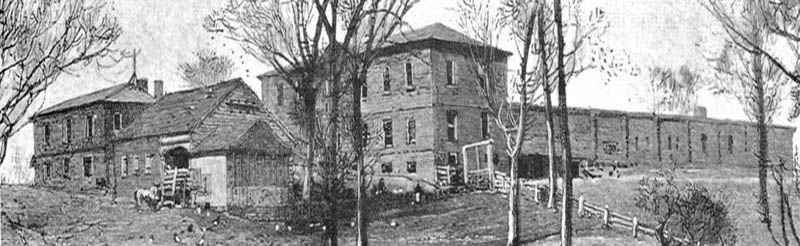
Liberty, Missouri Arsenal.
Initially, Kansas City, Missouri, was little more than a landing on the Missouri River, where travelers disembarked to travel to the town of Westport and the Santa Fe Trail a few miles to the South. Over the years, the settlement grew and was eventually called the “Town of Kansas. “By the time of the Kansas-Nebraska Act in 1854, the newly dubbed “City of Kansas” had 2,500 residents.
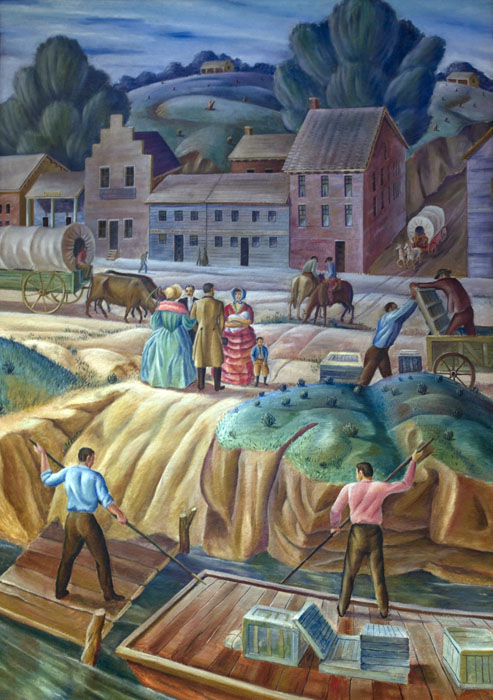
Town of Kansas by Frederick Emanuel Shane
Kansas City was the Union’s District of the Border headquarters during the Civil War. Just to the east in Independence, however, the Confederates won two significant victories in 1862 and 1864, and much of the countryside surrounding Kansas City harbored a militant pro-Southern population. Through the adversity, Kansas City remained under Union control.
In the fall of 1864, Confederate Major General Sterling Price’s Confederate Army of Missouri headed towards Kansas City, Missouri, and Fort Leavenworth, Kansas, hoping to capture Missouri for the South in the weeks before Abraham Lincoln’s reelection.
From October 21-23, 1864, the Battle of Westport, considered the “Gettysburg of the West,” was the largest and most decisive Civil War battle west of the Mississippi River. It occurred within the modern boundaries of Kansas City, Missouri, and was the last battle along the volatile Kansas and Missouri border. The Rebels could not break the Union lines during the battle and retreated south. Westport was the decisive battle of Price’s Missouri Expedition, and from then on, the Rebels were in retreat. The estimated casualties in the Union victory were 1,500 for both Union and Confederates.
The Confederates then went to Kansas, where they lost the Battles of Marais des Cygnes and Mine Creek before being forced to retreat to Missouri and, ultimately, Arkansas.
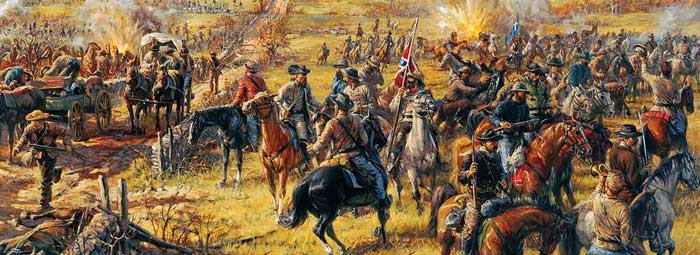
The Battle of Westport, Missouri by Andy Thomas.
Battle site identification markers are located at 61st Street and Manchester Trafficway, 63rd Street and The Paseo, the site of the heaviest fighting, and 52nd Street and Wornall, now a section of LoosePark, where the bloodiest segment of the engagement took place.
After the war, Kansas City expanded rapidly due to railroads and the cattle trade and annexed Westport.
©Kathy Alexander/Legends of America, February 2025.
Also See:
Sources:
American Battlefield Trust
Civil War on the Western Border
Wikipedia