
“Documentary photographers all have a common characteristic. They are curious yet objective. They search with inquisitive zeal for the essence of nature and events. They examine and scrutinize to reveal the truth.”
— Arthur Rothstein
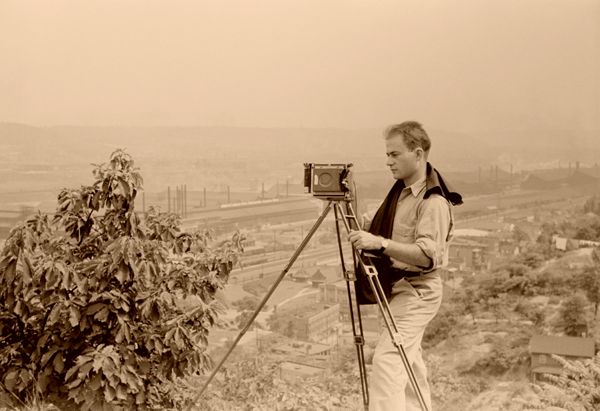
Arthur Rothstein, FSA photographer.
Arthur Rothstein, a photojournalist, is recognized for his five-decade career. His photographs provoked and entertained the American public with images of everything from hometown baseball games to war, struggling farmers, and U.S. Presidents. He was also a professor, authored numerous magazine articles, was a staff columnist for the New York Times, and wrote and published nine books on photography.
Rothstein, the son of Jewish immigrants, was born in Manhattan, New York City on July 17, 1915 to Isadore Rothstein and Nettie Perlstein Rothstein. He grew up in the Bronx and showed an early interest in photography.
Arthur Rothstein began photographing in college at Columbia University, where he founded the University Camera Club and was the photography editor of The Columbian, the undergraduate yearbook. While studying at Columbia University, he met economics instructor Roy Stryker. As a college senior in 1935, Rothstein prepared a set of copy photographs for a picture sourcebook on American agriculture that Roy Stryker and another professor, Rexford Tugwell, were assembling. Before the year was out, Stryker left Columbia to be part of President Franklin D. Roosevelt’s New Deal brain trust. Upon graduation, Roy Stryker hired Rothstein as the first photographer on the Farm Security Administration (FSA) staff in Washington, D.C.
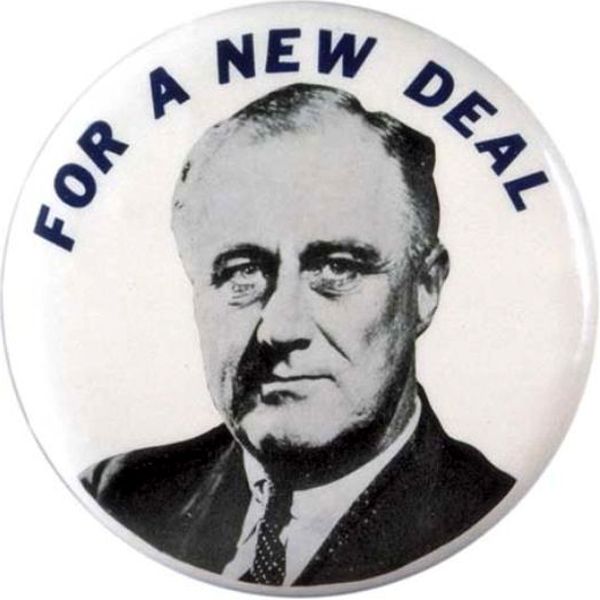
President Roosevelt’s New Deal.
During the next five years, Rothstein shot some of the most significant photographs of rural and small-town America. Praised for the directness and immediacy of his imagery, Rothstein became famous for his images of the Dust Bowl during the Great Depression. Rothstein’s work for the FSA earned him $1,620 a year, with an allowance of 2¢ per mile and $5 a day for food and lodging. While on the job, Rothstein carried with him only what he needed.
His first assignment working for the FSA was to document the people of the Blue Ridge Mountains in Virginia and their “relocation.” Rothstein spent a week with the people of the Blue Ridge Mountains, living as they did and getting to know them before he started shooting. When he finally picked up his camera and started working, he used a small, unobtrusive 35mm camera with no tripod. Having a relationship with his subjects before shooting them, Rothstein captured some of the most iconic images of the Great Depression that are still widely recognized today.
One widely-recognized photograph is Rothstein’s 1936 image entitled Fleeing a Dust Storm. Taken in April of 1936 to document the Dust Bowl, this image shows farmer Arthur Coble and his two sons in Cimarron County, Oklahoma, during a dust storm. Rothstein took this photo to show people in the eastern United States what was happening to fellow Americans, their farms, and others living in the Great Plains. Those in the East “had no contact and no sense of identity with this poor farmer walking across the dusty soil on his farm in Oklahoma, which gave him a sense of identity.”
He also used his work to help establish soil conservation practices and convince Washington to send government aid to the Great Plains. His documentary photographs also helped promote photography as a respected art form.
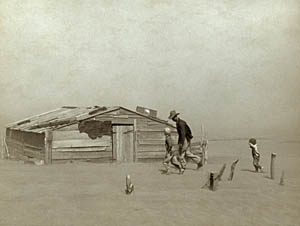
Fleeing a Dust Storm in Oklahoma, by Arthur Rothstein, 1936.
In 1937, the Farm Security Administration employed several other photographers, including Marion Post Wolcott, Walker Evans, Russell Lee, Gordon Parks, Jack Delano, John Vachon, Dorothea Lange, and Ben Shahn, to publicize the living conditions of the rural poor. During this time, his trips would take him to places affected by the Dust Bowl and cattle ranches.
During the five years he worked in this division for Stryker, Rothstein took around 80,000 images, many of which later became some of the most iconic images of the Great Depression.
After leaving the FSA in 1940, Rothstein became a staff photographer for Look magazine. However, he left shortly after that to join the Office of War Information and then the U.S. Army as a photographer in the Signal Corps. In 1945, he left the military and worked as the chief photographer for the United Nations Relief and Rehabilitation Administration.
In 1947, he married Grace Goodman, and the couple had four children. The same year, Rothstein rejoined Look as Director of Photography. He remained at Look until 1971 when the magazine ceased publication.
The following year, he joined Parade magazine, serving in various capacities until his death. During that period, he also taught photography and was a founding member of the American Society of Magazine Photographers, editing its in-house periodical for a year. Rothstein authored seven books about photojournalism that featured his images.
Arthur Rothstein died on November 11, 1985, in New Rochelle, New York.
“Because powerful images are fixed in the mind more readily than words, the photographer needs no interpreter. A photograph means the same thing worldwide, and no translator is required. Photography is truly a universal language, transcending all boundaries of race, politics, and nationality.”
–Arthur Rothstein
©Kathy Alexander/Legends of America, updated March 2025.
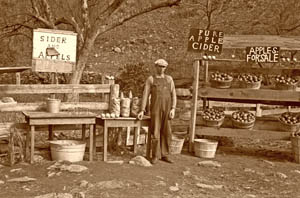
Virginia Cider Stand, by Arthur Rothstein, 1935.
Also See:
Arthur Rothstein Photo Gallery
Artist, Photographer, & Publisher Photo Galleries
Historic Photographers of America’s History
Sources: