

Tom Horn
This article has been updated and rewritten with input from Evan Green, Firearms Historian for the Wyoming State Museum.
Thomas “Tom” Horn, Jr. remains a debated figure in the history of the American West. From his work as a scout, cowboy, and Pinkerton agent to his notorious reputation as a hired gunman, Horn’s life was filled with contradictions and controversy, not to mention his braggadocio.
Early Life and Arrival in Arizona
Born on November 21, 1860, near Memphis, Missouri, Horn was the fifth of 12 children in a family marked by hardship and struggle. He reportedly endured severe abuse from his father, prompting him to leave home at a young age. Horn’s own account has him in Arizona as early as 1875, though records don’t place him there until 1881, when he was 21. Early on, he worked as a teamster, driving a stage between Santa Fe, New Mexico, and Prescott, Arizona. According to Evan Green, Firearms Historian for the Wyoming State Museum, from there he went to Camp Verde and then on to the San Carlos Reservation where he worked as a livestock herder and mule packer.
Horn’s introduction to the U.S. Army came in 1882 when he worked as a mule packer for a civilian contractor, supporting military efforts against the Apache. His tracking skills caught the attention of Al Sieber, Chief of the Apache Scouts, who recruited him for scouting duties. Horn’s linguistic abilities, particularly in Spanish, remain a subject of debate—some sources suggest he was not fluent but enough to communicate for his purposes.
Military Service and Apache Wars
Horn’s official record with the U.S. Army dates to 1885 when he was employed as a scout during General Nelson Miles‘ campaign against Geronimo. Contrary to his own claims, Horn was not a chief of scouts at the time nor involved in major battles, including the 1882 Battle of Big Dry Wash. Nevertheless, he played a role in the Army’s final campaign against Geronimo in 1886, serving as part of the column that captured the Apache leader.
Although Horn’s autobiography portrays him as a pivotal figure in these events, many historians dispute these accounts, noting significant embellishments. For example, Horn’s alleged presence at the Battle of Cibecue Creek has been thoroughly discredited.
Pinkerton Agency and Transition to Wyoming
Pinkerton National Detective Agency
In 1890, Horn joined the Pinkerton Detective Agency, headquartered in Denver. During his tenure, he tracked down several outlaws but was later arrested for robbing a casino in Las Vegas, New Mexico, in 1891. By 1892, Horn had moved to Wyoming, where he became a “stock detective” working for the Swan Land and Cattle Company.
As a hired gun, Horn charged $500-$600 per killing, earning a reputation as both an effective enforcer and a ruthless killer. He was suspected of killing 17 men, though some of these deaths were cases of mistaken identity. Despite claims of participation in the infamous Johnson County War of 1892, there is no definitive evidence linking him to the events.
The Killing of Willie Nickell and Trial
In July 1901, 14-year-old Willie Nickell was ambushed and killed near Iron Mountain, Wyoming. The boy, on his father’s horse, was believed to have been mistaken for his father, a sheep rancher embroiled in conflicts with cattlemen. A week later, Willie’s father, Kels Nickell, was wounded in another ambush.
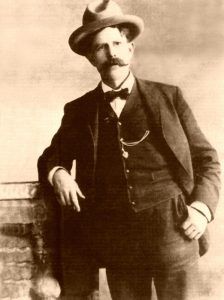
Joe LeFors, U.S. Deputy Marshal, 1899
Deputy U.S. Marshal Joe LeFors suspected Horn’s involvement and arranged a meeting to obtain a confession. During their conversation, Horn reportedly admitted to the killing, unaware that a deputy sheriff and a concealed court stenographer were recording his statements from an adjacent room. However, Horn later claimed he and LeFors were merely exchanging tall tales.
“Killing men is my specialty. I look at it as a business proposition, and I think I have a corner on the market.”
— Tom Horn
Horn was arrested, tried, and found guilty of Willie Nickell’s murder. The conviction relied heavily on his confession, with little physical evidence. On November 20, 1903, Horn was executed by hanging in Cheyenne, Wyoming.
Legacy and Controversy
Horn’s life and actions remain subjects of fascination and debate. While some view him as a skilled tracker and lawman, others condemn him as a cold-blooded killer. His autobiography, “Life of Tom Horn: Government Scout and Interpreter. Written by Himself” further muddied the waters, blending fact with fiction.
In 1993, a mock trial in Wyoming revisited Horn’s case, ultimately declaring him innocent due to insufficient evidence. Whether seen as a victim of circumstance or a remorseless hired gun, Tom Horn’s legacy continues to captivate historians and enthusiasts of the Old West.
©Dave Alexander, Kathy Alexander, Legends of America with input from Evan Green, Firearms Historian for the Wyoming State Museum. April 2025.
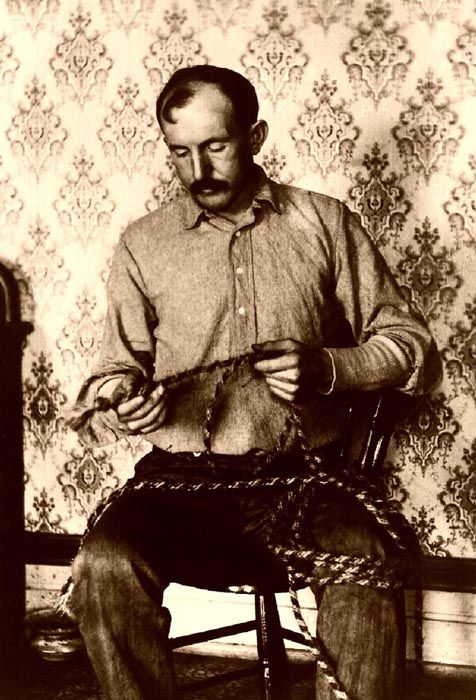
Tom Horn, 1903
Also See:
Geronimo – The Last Apache Hold Out