by Steven “Pacheco” McCann, great-grandson of Lawman Nabor Pacheco
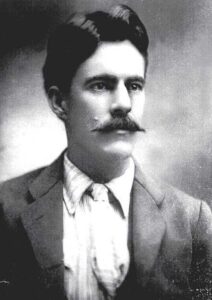
Harry Wheeler
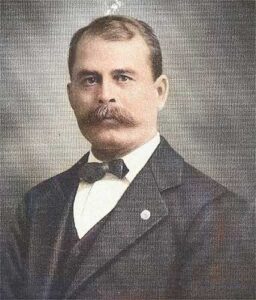
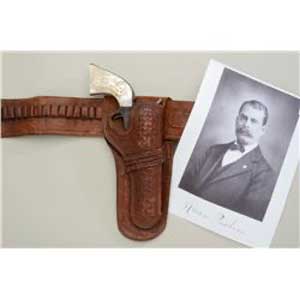
Tucson Lawman and Pima County Sheriff Nabor Pacheco.
Any student of Arizona’s Wild West history in the late 1800’s and early 1900’s will surely recognize the name of one its greatest lawman ever, Captain Harry Wheeler of the Arizona Rangers. His dedication to his law enforcement duties and numerous career accomplishments as a faithful public service are unparelled.
However, few will know the name of an Arizona lawman that is a very close equal (at least in this author’s opinion) and was called in several publications the “Bravest of the Brave”. His name is Nabor Pacheco who wore a badge from the 1890’s until his retirement to the ranching business in 1911.
This is the story of how these two men from entirely different upbringings as well as being separated by 15+ years in age became bound together by duty and united in a true friendship. However, they would also share so many of the same experiences as well as hardships that accompany a law enforcement career.
Both men were wounded in the line of duty, both men would serve as Arizona Sheriffs and Deputy U.S. Marshals, both men would be the first of their kind to work with service dogs. Pacheco having “Jack the Dog” by his side since “Jack” adopted him when he was a Tucson policeman and would help him take down law breakers who resisted arrest.
Wheeler was adament about being allowed to work with Bloodhound dogs in assistence to apprehend numerous law breakers. Both men were responsible for taking the lives of two wanted criminals each, Pacheco in carrying out the execution by hanging of two convicted murderers, Wheeler involved in two separate gunfights ending in the deaths of two of the men he faced off against. Both men were extremely efficient in the handling of their firearms, both with their 1873 Colt SA revolvers and their Winchester 1895 30-40 caliber lever action rifles.
And, unfortunately, both men would die much too young leaving behind their grieving wives and fatherless children.
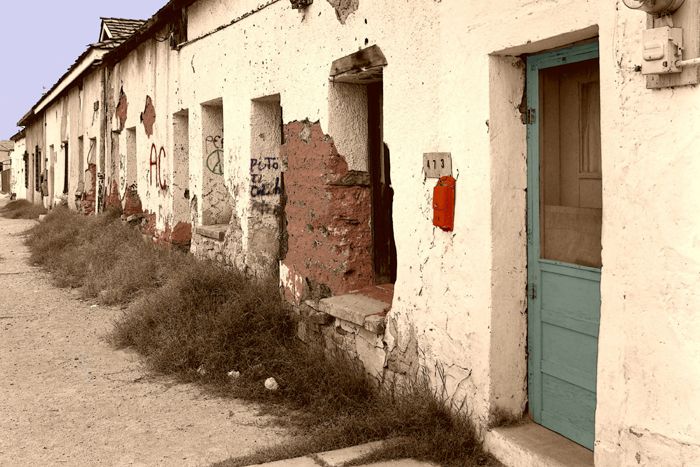
Vintage photo of a building in the Barrio Libre District of Tucson, Arizona. Colorized by Kathy Alexander.
Having pure Spanish ancestry on both sides of his parents, Nabor Pacheco was born in Tucson, Arizona in 1861 the oldest of five brothers and two sisters. He grew up in and around farming and ranching where his family had received several land grants from the then King of Spain and was awarded the first Arizona registered brand, the “Diamond Bell”. Nabor’s father, Refugio, being endowed with a good business sense, was highly successful in business and was very active in the local political scene.
Harry Wheeler was born in Jacksonville, Florida in 1875 to father 2nd Lt. William Wheeler, a West Point graduate, and mother Annie Cornwall, both of English decent. Having grown up in this military family, Harry went on to serve five years in the U.S. Cavalry and was discharged from Fort Grant in Arizona in 1902 attaining the rank of Sergeant. On July 6, 1903, Harry applied to and was accepted as a Arizona Ranger and that is when the Pacheco/Wheeler story begins.
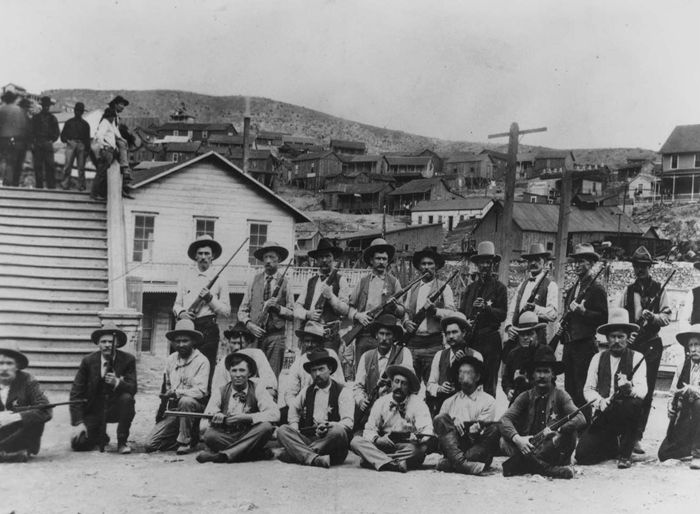
Arizona Rangers, 1903
When Harry Wheeler joined the Arizona Rangers in 1903, Nabor Pacheco was a Constable in the Tucson Police Force having risen up through the ranks starting in 1896 as a beat policeman. Just to name a few of his police actions up until that time, Nabor had already arrested numerous law breakers, prevented a heinous murder by a jilted boyfriend, been wounded during a violent shootout with a drunken hotel owner, and had been part of a Tucson formed posse in pursuit of one of the most dangerous group of outlaws in the southwest, the Burt Alvord gang. The Arizona Rangers would also have several encounters with this desperado throughout the years after they were first organized with his eventual capture and arrest. Harry and Nabor would have surely met or run across each other several times during 1903-1904. However, their working relationship and friendship would really start to develop when Nabor was elected for two consecutive two-year terms as Pima County Sheriff in November 1904 through 1908 while Arizona Ranger Wheeler had been promoted to rank of Sergeant.
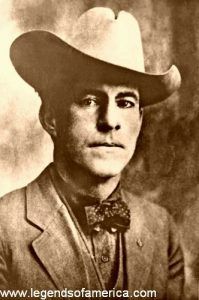
Harry Wheeler
While there are numerous instances when Sheriff Nabor Pacheco and Arizona Ranger Harry Wheeler worked and communicated with each other from 1905 to 1909, there are two specific instances that I believe brought them together as friends for the rest of the their lives.
The first occurrence followed after Captain Harry Wheeler ended up seriously wounded after his well-known deadly shootout with J.A. Tracy in Benson on February 28, 1907. All of the details of this famous gunfight are pretty well known and written about most expertly detailed in Bill O’Neal’s Book Captain Harry Wheeler Arizona Lawman.
What may not be as well known is the letter Harry wrote to his dear friend Sheriff Nabor Pacheco while recovering from his gunshot wounds in the hospital.
The following is the letter detailed in this newspaper article of the time
Bisbee Daily Review – March 7, 1907
“WILL NEVER BE FIRST TO FIRE”
These are Brave Words of a Ranger Lieutenant in a Letter to a Brother Officer, Giving First Detailed Account by Either of the Participants in Tragic Killing of Tracy at Benson to Sheriff Pacheco of Tucson, is in receipt of the following letter from Lieutenant Wheeler, of the Arizona Rangers, which is the first authentic report of the incidents which led up to the tragedy enacted at Benson last Thursday morning, in which J.A. Tracy was mortally wounded by that faithful officer who first received two bullet wounds from a revolver in the hands of the man whom he killed. Lieutenants Wheeler’s letter to his faithful friend, Sheriff Pacheco, is herewith produced in full.
Tombstone, Ariz. March 4, 1907 – Dear Nabor – I cannot use ink for I cannot sit up, and the ink will not stay at the end of a pen point, when pointed down at so slight an angle necessitated from my position on my back. I want to tell you as near as I can just how my unhappy trouble came about – for unhappy it is in whatever light one may view it. The most terrible duty a man can be called upon to render his state or country is without doubt the taking away of the life of a fellow man. Twice now it has come to me and twice have I responded sorrowfully each time, and yet with consolation of knowing that I had first seen the other man’s fire and smelled his smoke. In other words, I never have fired first and never intend to do so. In my mind the best record an officer can have is the record which stands clear and white of the blood of any man. But we plan and hope and trust and the “The best laid plans” etc. You know the rest. Well it happened thus:
February 28th Henry Castenada told me one of his guests was in terror of his life – fearing another man would kill himself and his wife when they started to the morning train. Castenada told me the guest’s name was Silverton and the man he feared was at the depot, having arrived from Vail during the night. I at once went to Silverton’s room, where I found both Mr. and Mrs. Silverton. They were much agitated and Silverton at once requested my gun, which of course I refused him. I was very pointed in my questions, particularly as to whether the woman was the wife of Silverton or the man they said had followed them. They both declared spiritedly that they were married and that the man they then named Tracy was simply unaccountably infatuated with Mrs Silverton. They told me Tracy had killed a man in Nevada a year ago, without cause, and that they had in some of their effects a letter of his of recent date threatening both their lives, that only the day before at Vail he verbally threatened them and only missed the train because he went to get a gun and missed the last car. While I was talking to them, a strange negro entered and told Mr. Silverton that the man was still waiting for them. I waited no longer. My duty was plain. I assured myself Silverton was unarmed and requested him to point Tracy out to me. It was only a few minutes til the train time and I saw no other until after the fight. Then one came, who I learned now was only separated from Tracy and I by a car, who was several minutes showing up and then only when all was safe. Anyway, Silverton and I went to the end of the deport crossing and from there Silverton pointed out Tracy. He was walking between some freight cars on a side track and the Bisbee morning train.
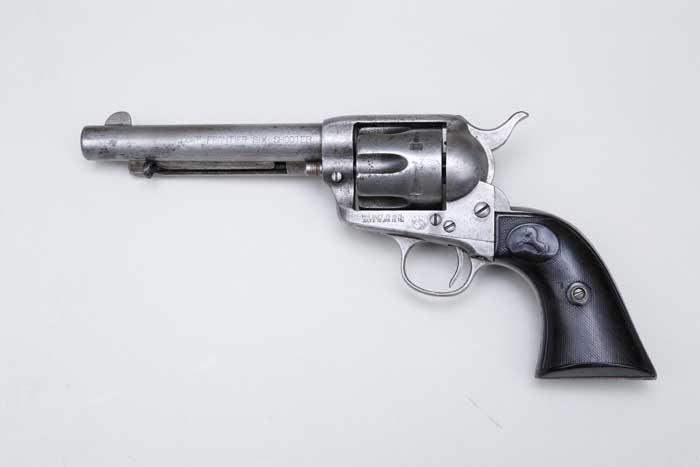
Harry Wheeler’s Colt 1873 SA 45 caliber revolver with his name on it that is in the NRA Museuem in Virginia.
I told Silverton to go back (after I again refused him my gun) to his wife – to give me time to speak to Tracy – and I would assure him protection, for if I found Tracy was armed I intended to arrest him. This might have been and poor Tracy would be alive now, but Silverton evidently did not heed my advice or instructions. He gave me barely time to reach Tracy when he and his wife went across the street. Tracy was now on the car platform – box cars hid from him anything at the hotel, but he could see anyone who got half way across the street to the train. So it happened Tracy saw them when I was very close to him. I had no chance to say anything. he jumped down at once and started for them, drawing a wicked looking revolver half way from his clothes. I told him: “Lieutenant Wheeler arrests you. Give me that gun!” He never spoke a word nor showed surprise, chagrin or anything but simply poked his gun at me – less than two feet away and fired. The shot burnt and cut my coat, right side between my arm and body, about even with my naval. But when I didn’t fall, he backed away and his second and my first shots were about together. It was a slow, deliberate affair. I was determined to arrest him – he was anxious to stop me so he could finish the others. We moved slowly over 75 yards all told. He aimed deliberatly and fired. I did likewise in answer. Finally he said: “My Gun is empty, I am all in,” then lowered his weapon. I had one cartridge left in mine and being deathly sick and weak from a shot in my left leg, almost at groin, which tore the sciatic nerve, and not knowing how strong he was, I left my gun and walked toward him. When I was several steps from my gun he shot at me. I at once picked several big rocks and threw them at him. He fired twice, once again hitting me, but his gun was empty now. I heard it snap. He did not like the rocks as one hit him. He again told mde he was all in. I got to him, put my hand on his shoulder and again put him under arrest. He begged me not to take his gun, saying, “it is empty Wheeler and I am done for.” Someone had to help me get it. About that time a negro, evidently thinking he was trying to shoot again rushed up with a .22 or possibly a 32 bull dog pistol and stuck it in Tracy’s face. I made him put it down. At this moment, Silverton rushed up and tried to disarm the negro to get the gun to finish Tracy with, but I made it quite plain that Tracy was my prisoner and anyone molesting him had to answer to me for so doing. That quieted things. I then sent for both physicians and we waited together until they came at the Hotel Virginia.
I was glad to learn that Tracy bore me no ill will. He spoke highly of me to Captain Rynning and we each wished each other a speedy recovery, and both expressed our regrets to the other for the unhappy occurrence. He was a strange man, yet I believe ordinarily a good man. He was in a state of mind where he would have killed a dozen men in order to get to Silverton. His pocket was full of cartridges. That was why he begged so hard to keep his gun. He wanted to re-load it and get – not me – unless I was in the way – but them. That was his one idea. Well, Nabor, I’ve written until I’m weak. It comes back plainly to me, more plainly now, but though I was right and could not have done otherwise, still there is sorrow in my heart at the thought of him that will not soon wear away.
Always your faithful WHEELER
(Sidenote: J.A. Tracy died before reaching the hospital from his four gunshot wounds)
This letter to Sheriff Nabor Pacheco shows the true respect and friendship these two great men had for each other. Sheriff Pacheco visited Captain Harry Wheeler recovering in Benson soon after this historic gunfight, and I am sure they consoled each other on what it is was like being shot and gave each other much needed moral support.
The second incident involved these two great officers later in September 1907 after Wheeler had fully recovered from his near death gunfight. A posse was formed led by these two Arizona lawmen together in the hunt for murderer Indian John Johns is another great example of their dedicated work together and respect for one another. Author Bill O’Neal has a complete detailing of the search and arrest of this wanted criminal in his The Arizona Rangers and Captain Harry Wheeler books. Excellent reading by one of the greatest western historians of our lifetime.
The article in the newspaper below, published at the time, really sums this manhunt up.
Bisbee Daily Review September 24, 1907
Expedition Was Peaceful Affair
Posse that Went After Papago Indian Murderer Met No Opposition At All, And Returned With Prisoners
Tucson, Sept 23 – The posse under the command of Captain Harry Wheeler of the Arizona Rangers, and Sheriff Pacheco of Pima County, which made a trip into the Papago Indian country about 150 miles south and west of here, returned home Sunday evening, bringing with them the alleged murderer, John Johns, whom they went after, as well as another Indian named Kautano, whom the former implicated with himself in the killing of a Papago named Lariano, at El Cobo on August 10. Although it was reported that the posse would be met with an armed force of Indians, the officers reported that they had experienced no trouble whatsoever. Previous to the officers departure for the Indian country, reports of all kinds were spread to the effect that the Papagoes had sworn to protect the murderer, if it were necessary to go to war with the whites. These stories emanated mostly from that section of the territory and grave fears were entertained of the most serious trouble.
Colt SA 44-40 caliber Six Shooter revolver that Nabor was carrying during the Indian John John posse in 1907
To set all the fears at rest Captain Wheeler and Sheriff Pacheco determined to take a posse with them, and for that reason the Captain of the rangers brought along nine of his men. On September 15, the posse left Tucson with Wheeler and Pacheco in joint command, having with them Sergeants Miles, Kidder and Speed and Privates Stanford, Bates, Fraser, Smith, Poole and Rhodes of the Rangers, also Deputy Sheriff Thomas Mills.
Along the route stories were circulated to the effect that the Rangers would be ambushed and killed off before they ever reached the Papago country, so for that reason the journey was made by stages, the whole distance of 150 miles being covered on Thursday evening following, when the cavalcade arrived at El Cobo, where they knew John Johns was. Arriving at the village the officers found women and children at home but all of the men were in the fields working along toward sunset when the men began straggling home in groups of two or three and as they arrived at the villae they were placed under arrest by the rangers to prevent their organizing any movement to either defend Johns who, it was learned, was in one of the wheat fields. When all of the Indians had reached their homes Johns was still missing and suspecting that he might in some manner have learned the presence of the officers, the prisoners were left in charge of a guard while the remainder of the force rode into the fields and soon found the man, who was then in the act of getting away. He was told he was under arrest and taken into the village. On being questioned by the officers Johns admitted to having killed Lariano on August 10, also stating another Indian named Kaytano, whom he identified, had helped him. The second man was taken from the crowd and arrested. They explained their action, saying that they were all intoxicated on Indian liquor made from the juice of the cactus, and while in this condition they became involved in a drunken brawl as a result of which Lariano was killed.
Releasing the other men of the village, the officers told them they would take their prisoners to Tucson. An immediate start was made, and the posse arrived here late last evening, having traversed the last sixty miles of the journey on Sunday. The prisoners were placed in the county jail, where they will be held to await the action of the grand jury.
This morning Captain Wheeler detailed his men for the big round-up of horses by the Ranger force, which is now in progress and here himself started for his headquarters in Naco.
(Special to Review)
Naco, Sept. 22 – Captain Wheeler of the Arizona Rangers, returned to the city this morning from his trip into Papago Indian country in joint command of the posse which went to capture John Johns, the murderer. On account of the return of the officers without having experienced trouble with the Indians, great surprise has been expressed, as reports were to the effect that the Indians would defend their tribesmen with their lives.
When seen by a Review representative and asked concerning the trip Captain Wheeler said “We experienced no trouble whatsoever with the Indians, who seem to be a most industrious and peaceful people. The arresting of the innocent members of the tribe temporarily was simply done as a precautionary measure, it was being desired that we have no trouble. None of the Papagoes offered any resistence. Sheriff Pacheco handled the expedition with great skill, being conversant with the Spanish language, which the Indians understand thoroughly and they displayed confidence in him, when he explained that we merely wanted the man who violated the law. I really believe the Indians had forgotten the murder of Lariano”. End quote The Rangers who composed the party are known to be among the most fearless men that can be found and under the command of Captain Wheeler, whose coolness and bravery has made him an enviable reputation would have proved a most formidable enemy for the entire Papago tribe to have trouble with. There was not the slightest doubt that the posse would bring back the wanted Indian or they would not be back themselves.
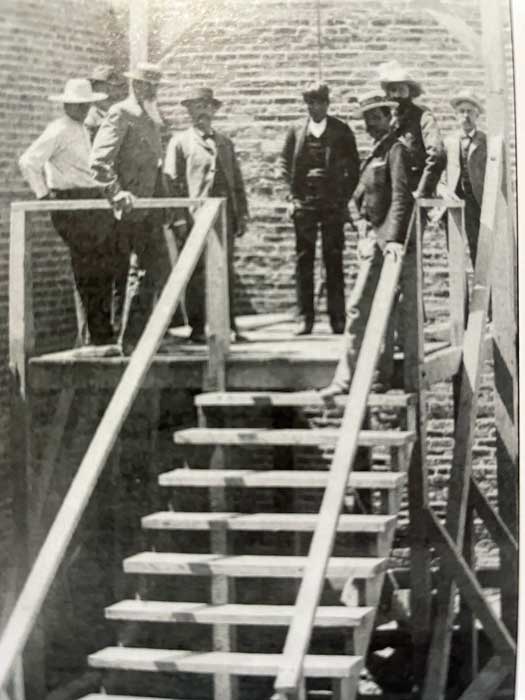
One of the last public hangings in Tucson, AZ, on July 17, 1908. Horace Groce was executed for the murder of his wife.
Sheriff Pacheco would also go on and be known to preside over the last two public hangings in the Tucson courtyard in the summer of 1908. With respect to his Captainship in the Arizona Rangers, Harry Wheeler would have received an invitation as a dignitary to personally attend both of these ultimate fulfullments of justice. Pacheco campaigned tirelessly to get these hangings moved to the Territorial Prison. After the Edwin Hawkins hanging in August 1908, Pacheco declared:
“It seems to me that Arizona is behind the states of the east in this respect. There they take the men to the state penitentiary and the thing is done quietly by the warden and his assistants. There is none of this disgusting and unavoidable lack of privacy which turns a hanging into a morbid holiday and kills a convict while hundreds of men and boys stare and gape at him.”
Nabor Pacheco would become Tucson Chief of Police for one year in 1909 and would be appointed a Deputy U.S. Marshal in 1910 before retiring to become a full time rancher until his unexpected death on February 14, 1920, age 59. I am sure Harry was certainly one of the honorary pallbearers at Nabor’s funeral.
After the Arizona Rangers disbanded in 1909, Harry Wheeler would also become a Deputy U.S. Marshal and then Sheriff of Cochise County before entering the fight for his country in World War I. He too died much too young in 1925 at the age of 50.
Nabor Pacheco and Harry Wheeler worked with and rode together with many of the finest Arizona lawmen of the time, including Arizona Ranger Captains Thomas Rynning and Burt Mossman, Sargents Jeff Kidder and Billy Old, U.S. Marshals Ben Daniels and Charles Overlock, Deputy U.S. Marshal Marcus Nevares, and numerous other historic lawmen during their storied careers.
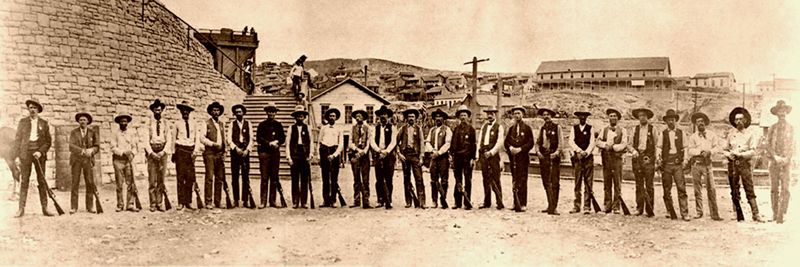
Arizona Rangers, 1903
The dictionary defines the phrase “bound by duty, united in friendship” as suggesting a relationship where individuals are connected through shared obligations, responsibilities, and loyalties, but also find common ground and support through a bond of friendship. It implies that both the formal and informal aspects of their relationship are equally important, and that these two elements work together to create a strong and meaningful connection.
This author feels that the working relationship and developed friendship of Nabor Pacheco and Harry Wheeler was rare and something very special. I tip my hat to these two outstanding officers, to Author Bill O’Neal, to Harry Wheeler’s granddaughter Pam Hamlett, and to all of the Arizona Rangers, past and present who keep the memory alive of these finest of Arizona’s lawmen.
©Steven “Pacheco” McCann, great-grandson of Lawman Nabor Pacheco, for Legends Of America, May 2025.
Also See: