
This story was told to me by my father, who heard it from his great-uncle Clyde Gibbs in the late 1930s. I have retold it here as best as I can remember.
By Rory Gibbs
Poquoson, Virginia – 1924
The war took many men, but it did not take Arthur Holloway. Not the gas, not the rats, nor the shells that shrieked through the sodden air like banshees. What it did take was harder to measure—his laughter, his sleep, and the warmth in his bones. He came back from Europe with the rattle of death buried in his lungs and hands that could no longer unclench.
It was the fall of 1924 when Arthur finished building the boat.
He called it The Mercy, though he told no one why. He’d hewn her with his own hands, shaping her very hull from the timbers scavenged from an old barn that had sunk into the mud behind a long abandoned house down Messick Road —left to rot after fire and age had chewed its spine. Folks whispered the place was cursed. Arthur only saw good wood, seasoned and solid. It bore the stains of some long-forgotten tragedy, but he did not flinch. He had seen worse.
His brother, Henry, never lifted a finger.
Handsome Henry, with his gold-ringed smile and calloused heart, was the kind of man who walked like the world owed him something. While Arthur had bled in foreign trenches, Henry had been drunk on local whiskey, pawing at barmaids and punching sailors in the teeth. When the war ended, Henry married Sissy—Sissy, with her wind-spun hair and moonlit eyes, the only woman Arthur had ever truly loved.
Arthur said nothing. He watched. He carried on.
Henry had two children now—sweet-faced, hollow-bellied things. Sissy did what she could, but Henry pissed away most of what little they had in gin mills and poker dens. Arthur, silent and stalwart, began bringing fish and oysters by the house, pretending he’d “caught too much again.” Sissy knew. She always knew.
Come November, Arthur and Henry were supposed to take The Mercy out daily, running gill nets in the deeper channels. Watermen said a storm was coming—a Nor’easter with teeth like broken glass. The air was already turning cruel. But the work had to be done. The bay did not wait for beggars or sick men.
On the morning of the twelfth, Arthur stood at the dock wrapped in oilskin and wool. His breath fogged thick in the gray light. The wind knifed through the cattails and tugged at the ropes like fingers of the dead.
Henry didn’t come.
Arthur waited until the sky went from slate to iron. His lungs burned from the fever clinging to his chest like wet wool, but he went anyway. The nets had to come in. No one else would feed Sissy’s children.
He pushed off into the bay alone.
The water was cruel and black as sin. Each pull on the nets was like hauling up boulders from the deep. The cold gnawed at his joints, his breath rattled. The lines caught. The boat rocked. One step wrong and he was overboard—arms wrapped in net, dragged under as easily as a doll into the dark.
The water closed over him with a silence deeper than any trench.
They found him five days later.
The storm had torn through Poquoson like a judgment. When it passed, the other watermen dragged the bay bottom for their lost brother. They found Arthur tangled in his own nets, face turned upward, lips parted like he was still asking why. His skin was pale blue and his hands were clawed tight around the line.
They buried him on a Wednesday.
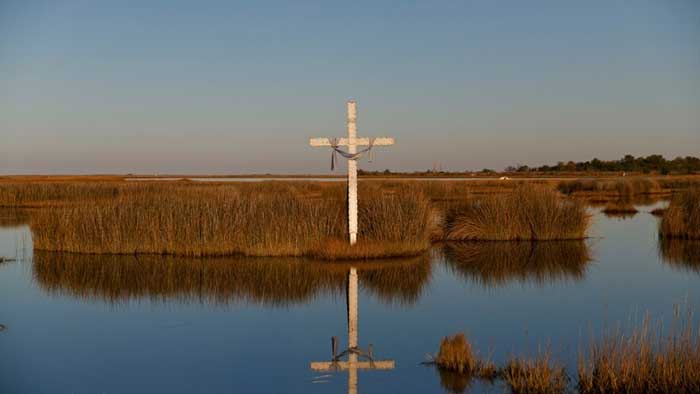
Henry didn’t speak at the funeral. Sissy wept over the grave like a woman who had lost a husband instead of a brother-in-law. Henry just stared, the guilt blooming behind his eyes like mold. He never told anyone where he’d been that morning—drunk in the back room of Duke’s Tavern, dreaming off the storm in a warm bed beside a woman who wasn’t his wife.
That night, Henry couldn’t sleep.
He lay in bed next to Sissy’s turned back, and in the darkness, he heard it: the creak of wet rope, slow footsteps across the floorboards. A cough—ragged, phlegmy, the same sick sound Arthur had made those last few days. Henry rose, heart pounding, but the room was empty.
Still, the cold lingered, and the scent of salt filled the air.
Weeks passed. Then months.
The boat never returned. The Mercy vanished like Arthur’s soul had taken her down with him. Fishermen claimed she was lost in the storm, dragged to the bottom. Others whispered darker things—that the wood, pulled from the bones of that cursed land, had taken its revenge.
But in the marshlands near the mouth of the Poquoson River, an old man found her in February.
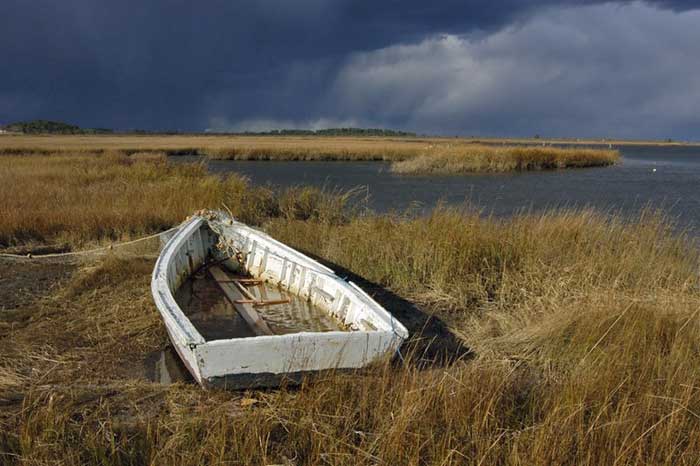
The Mercy, covered in mud and barnacles, was beached in the reeds, tilted like a dying man. Inside, they found wet footprints on the deck—bare and human, too large for a boy, too fresh for a wreck so long gone. No one claimed her. No one dared.
Henry changed.
He stopped drinking. Stopped smiling. The light behind his eyes dimmed. He worked the oyster beds now, every day, rain or shine. His hands grew cracked and red. He gave every dollar to Sissy and barely spoke above a whisper. But he never once stepped into The Mercy, which now sat half-rotted on her moorings, never moving, even when the flood tides and winds came.
And at night… the ghost came.
It started as whispers: the sound of a man’s breath on the back of his neck, a throat that rattled with fever. Then footsteps—soaking wet, slow, deliberate—across the floor of his bedroom. One night, he awoke to the sound of coughing and saw the dark figure standing at the foot of the bed, pale and dripping, hands still tangled in phantom net.
Arthur never spoke. He only stared.
Sometimes, Henry would scream. Other nights he would simply weep, begging forgiveness in the dark. Sissy never saw anything, but she felt the cold that lingered after. The children spoke of the “wet man” who stood outside their window at night, watching with hollow eyes.
One March morning, Henry walked to the dock before first light. The neighbors said he looked tired, like he hadn’t slept in weeks.
They never saw him again.
Two days later, The Mercy was gone—slipped its moorings and vanished in the fog. They found her weeks later, back in the marsh, only this time she was heavier in the water. A fisherman who dared look inside found seaweed and broken boards… and a boot, full of bones.
Henry Holloway was declared drowned. But some say he didn’t die.
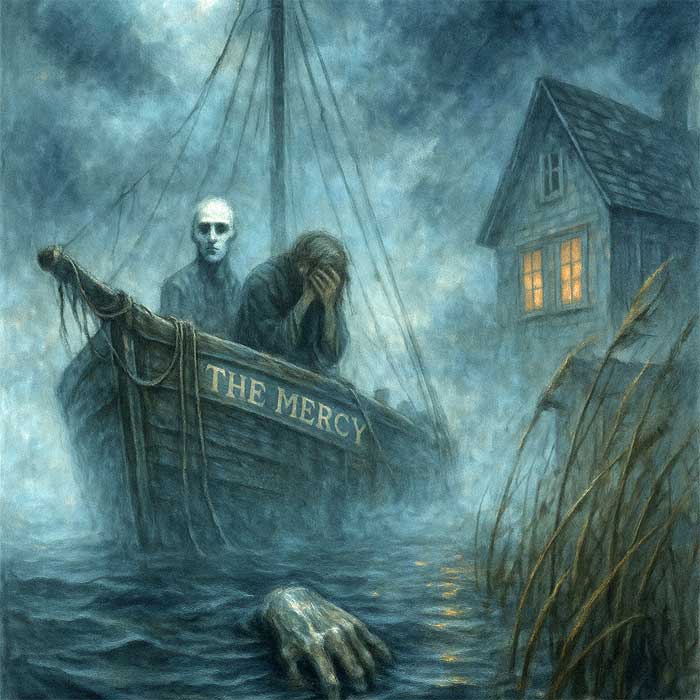
Some say The Mercy is still seen on moonless nights, drifting through the fog—no sail, no oar, just the sound of wet ropes dragging across the deck, and two figures aboard: one pale and silent, the other weeping.
Others say that if you’re out in the bay, especially near where Arthur died, you might hear coughing just beneath the water, or see the slick hand of a drowned man brush against the hull.
And in Poquoson, when the wind howls through the reeds and rattles the panes, the old-timers shut their doors tight.
For they know the Holloway boys still ride the tide—one out of guilt, and the other out of love so deep it pulled him to the bottom.
©Rory Gibbs, submitted for Legends of America, June 2025.
About the author: Rory Gibbs was born in Poquoson, Virginia, and lived there for 14 years until his family moved to Louisiana for work. He still has many cousins and kin in the Great Salt Marsh and visits regularly.
Also See:
Pitty Pat Hollow – Tennessee Lore
A Cold Greeting in San Francisco, California