
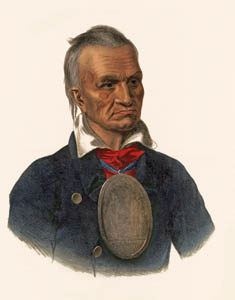
Seneca War Chief Red Jacket by C.B. King, 1836.
The renowned Seneca warrior and orator, Sa-go-ye-wa-thee, or Red Jacket, was a war chief of the Wolf Clan who lived in Western New York.
Red Jacket’s birthdate and place are unknown, though some historians claim he was born about 1750 at Kanadaseaga, also known as the Old Seneca Castle near present-day Geneva, New York. Others believe he was born near Cayuga Lake or south of present-day Branchport, at Keuka Lake near the mouth of Basswood Creek. He grew up with his family at Basswood Creek, where his mother was buried after her death. The Iroquois had a matrilineal kinship system, with inheritance and descent figured through the maternal line. He was always remarkably swift-footed and was often employed as a courier among his own people.
Red Jacket lived much of his adult life in the Genesee River Valley in western New York. Later, he moved to Canada for a short period. He and the Mohawk Chief Joseph Brant became bitter enemies and rivals before the American Revolution. However, they often met at the Iroquois Confederacy’s Longhouse.
Red Jacket had a large family of children, some of whom, like their mother, became professing Christians. Eleven of them died of consumption, one after another, and Red Jacket felt his bereavement to be the chastisement of the Great Spirit for his habitual drunkenness.
He participated with the British and Tories during the war but was more noted for his power as an orator who aroused Seneca to action than as a leader on the warpath. Red Jacket appeared in history in an unfavorable light in the record of Sullivan’s Campaign in 1779. Chief Brant, whom Red Jacket greatly annoyed, even charged him with cowardice during the campaign and spoke of Red Jacket with mingled feelings of hatred and contempt as a traitor and dishonest man.
His later adult name, Sagoyewatha, which roughly translates as “he keeps them awake,” was given by the Seneca about 1780 to recognize his oratory skills.
In 1784, he appeared at the great treaty at Fort Stanwix in present-day Rome, NY, where certain concessions of territory by the Six Nations brought them under the protection of the United States.
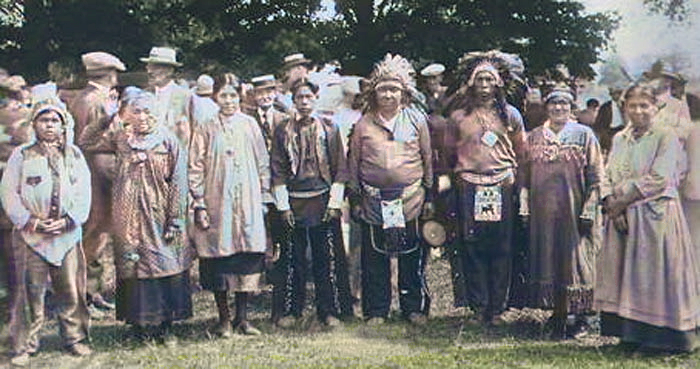
Seneca Indians.
He was also prominent at a council held at the mouth of the Detroit River in 1786. After that, there were many disputes and heartburnings concerning land titles between the white people and the Indians of Western New York, with Red Jacket as the defender of his people’s rights. At all treaties and councils, he was the chief orator. He frequently visited Washington, D.C. on behalf of his race and was always treated with the utmost respect.
In 1790, the Public Universal Friends and the Philadelphia Society of Friends were the first settlers in the formerly Seneca region. Despite Generals James Clinton and John Sullivan’s pillaging of the Native River Settlement in Ah-Wa-Ga, Owego, New York, during the American Revolution, the Society made peace with the wary Seneca tribe. The Seneca Tribe made peace with settlers in the Finger Lakes region but suffered hardship in the Genesee Region and other parts of Western New York.
Red Jacket became famous as an orator, speaking for the rights of his people. After the war, he played a prominent role in negotiations with the new United States federal government. In 1792, he led a delegation of 50 Native American leaders to Philadelphia, Pennsylvania. President George Washington presented him with a special “peace medal,” a large oval of silverplate engraved with an image of Washington on the right-hand side shaking Red Jacket’s hand; below was inscribed “George Washington,” “Red Jacket,” and “1792”. Red Jacket wore this medal on his chest in every portrait painted of him. He was also presented with a silver inlaid half-stock long rifle, bearing his initials and Wolf clan emblem in the stock and his later name, Sagoyewatha, inlaid on the barrel.
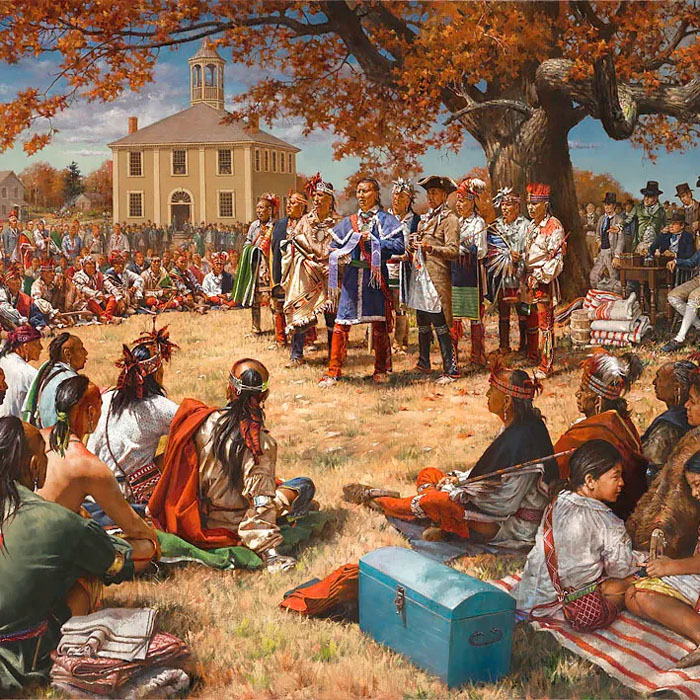
Treaty of Canandaigua.
In 1794, Red Jacket signed the Treaty of Canandaigua, along with Cornplanter, Handsome Lake, and 50 other Iroquois leaders. Under this treaty, the Iroquois were forced to cede much of their land to the United States due to the defeat of their British ally during the war. Britain had ceded all its claims to land in the colonies without consulting the Iroquois or other Native American allies. However, most of his people had migrated to Canada for resettlement after the Paris Treaty.
In 1797, by the Treaty of Big Tree, Robert Morris paid $100,000 to the Seneca for rights to some of their lands west of the Genesee River in present-day Livingston County. Red Jacket had tried to prevent the sale, but, unable to persuade the other chiefs, he gave up his opposition. As often occurred, Morris used gifts of liquor to the Seneca men and trinkets to the women to encourage the sale. Morris had previously purchased the land from Massachusetts, subject to the Indian title, then sold it to the Holland Land Company for speculative development. He retained only the Morris Reserve, an estate near the present-day city of Rochester. During the negotiations, Brant was reported to have told an insulting story about Red Jacket. Cornplanter intervened and prevented the Seneca leader from attacking and killing Brant.
In 1805, Mr. Cram, a New England missionary, asked to do mission work among the Seneca. Red Jacket responded by saying that the Seneca had suffered much at the hands of Europeans. His speech, “Religion for the White Man and the Red,” expressed his profound belief that Native American religion was fitting and sufficient for Seneca and Native American culture. It has been documented and preserved as one of the best examples of North American oratory.
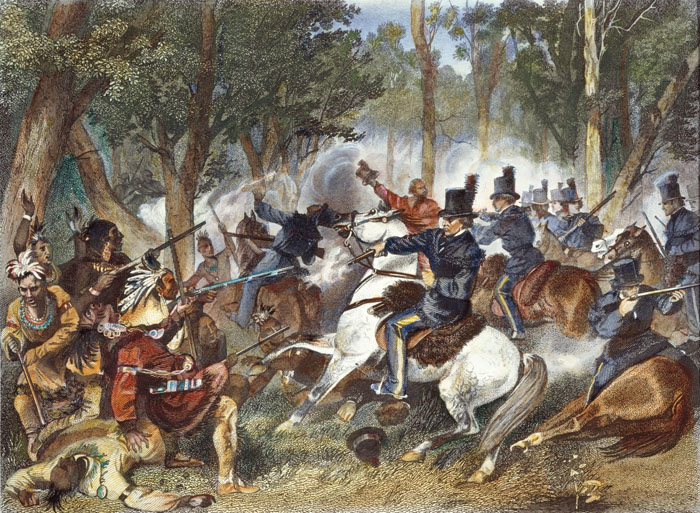
War of 1812.
When the War of 1812 erupted, the Seneca, under the leadership of Red Jacket, declared themselves neutral. Still, they soon became allies of the United States and engaged in hostilities on the Canadian frontier. Because he urged his people to support the United States in the war and make peace with the white man’s government, some Indians accused him of being a coward.
During the 1820s, Red Jacket lost prestige as his drinking and general dissipation became evident. In 1827, a council of tribal leaders deposed him as chief, but he was reinstated following a personal effort at reform and the intercession of the U.S. Office of Indian Affairs.
The influence of Christianity and civilization upon the Seneca nation disturbed Red Jacket’s repose during the latter part of his life. These influences, working with a general disgust produced by his excessive intemperance, alienated his people.
In his later years, Red Jacket (Sagoyewatha) lived in Buffalo, New York. He died on January 20, 1830, at the age of about 80 years.
When he died, his remains were buried in an Indian cemetery, now within Seneca Indian Park in South Buffalo. In 1876, the politician William C. Bryant presented a plan to the Council of the Seneca Nation to reinter Red Jacket’s remains in Forest Lawn Cemetery, Buffalo. This was carried out on October 9, 1884.
Red Jacket’s peace medal was in the Buffalo History Museum’s collection from 1895 to 2021. In May 2021, it was repatriated to the Seneca Nation and is currently held in the Onöhsagwë:De’ Cultural Center collection, also known as the Seneca-Iroquois National Museum. This rifle has been in private hands since his death.
©Kathy Alexander/Legends of America, June 2025.
Also See:
Native American Photo Galleries
Native Americans – First Owners of America
Sources:
Encyclopedia Britannica
Lossing, Benson John; Eminent Americans, Volume II; American Publishers Corporation, New York, 1890.
Wikipedia
Ya-Native