

Republican River in Republic County by Kathy Alexander.
Fort Lookout, in the northeast corner of Republic County, Kansas, was established by the U.S. Army in 1861, near the beginning of the Civil War. Its purpose was to protect the military road from Fort Riley, Kansas, to Fort Kearney, Nebraska Territory. Perched on a high bluff overlooking the Republican River, it was three miles southeast of Hardy, Nebraska.
The log blockhouse-style fort was two stories high and had a flat roof. The second story was built at a 45-degree angle across the top of the first story, providing eight sides from which its occupants could observe the surrounding countryside. Some logs had six-inch square notches cut into them for use as rifle ports. The area witnessed many attacks by Indians.

Blockhouse Fort.
During the Civil War, many wagon trains used the Fort Riley-Fort Kearny Military Road, guarded by Fort Lookout. Indians may have attacked some, but the threat of Indian attacks significantly diminished by the end of the war.
However, in the spring of 1867, the mail and stage stations along the Smoky Hill Trail drew the deadly attention of the Indians. The stations, each ten to twelve miles from each other, were usually occupied by the stage company’s three to ten civilian workers. Their locations made them targets of attack. The Cheyenne and Arapaho heading north to hunting areas between the Arkansas and Platte Rivers crossed the stage line between Fort Hays and Fort Wallace.
The stage stations with their horses and mules were tempting targets to Indians.
George Custer noted an Indian raid on Lookout Station on the Smoky Hill Trail on April 17, stating:
“They killed and burned the three men employed at the station; also burned the station and hay and ran off 18 horses and four mules. They scalped one of the men before burning them.”
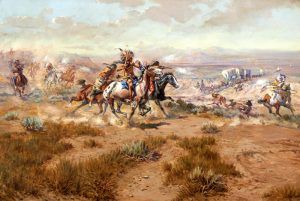
Indian Attack on a Wagon Train by Charles Marion Russell.
The Army abandoned the fort in about 1868. The state militia used it during Indian uprisings.
On the evening of May 25, 1869, a group of buffalo hunters from Waterville, Kansas, took shelter at the old fort after being attacked by Cheyenne Dog Soldiers as they tried to cross the swollen Republican River. However, all but one were killed.
Until the early 1870s, the local population used the fort as a refuge during disturbances with the Indians. After that, the structure was used as a home and eventually abandoned.
In 1903, the location was marked as the site of a dwelling on the Sweet farm, which was dilapidated at the time. As the supporting timbers decayed, the top-heavy structure collapsed, squashing the lower level into a pile of rubble. What remained as a recognizable building was mainly the upper level, resting on a woodpile.
A log from the blockhouse is preserved in the Republic County Historical Museum at Belleville.