

Fort Wallace, Kansas, 1867.
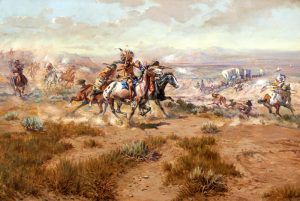
Indian Attack on a Wagon Train by Charles Marion Russell.
Fort Wallace, Kansas, was first established as a Butterfield Overland Dispatch station on the Smoky Hill Trail in 1865. It was called the Pond Creek Stage Station. Located 1.5 miles west of present-day Wallace, Kansas, the stop was a rest station that provided food to travelers. However, the route was not without peril, and the station saw so many Indian attacks that a temporary military camp called Camp Pond Creek was situated right next to it. Due to the Indian raids, the stage line soon became insolvent, and in 1866, it was sold. The soldiers moved a few miles east to the south fork of the Smoky Hill River, and the new post was named Fort Wallace in honor of General W.H.L. Wallace, who died at the Battle of Shiloh, Tennessee, in the Civil War. Built by the soldiers, the buildings were constructed of native stone or wood, which peaked at 40 in number.
Fort Wallace was the last and most western military post of any permanency in Kansas. From 1865 to 1878, it bore the brunt of the contest with the Indian tribes. Its functions were similar to those of Forts Hays and Harker, except that the latter were more extensive and were more often selected as headquarters for large expeditions against the Indians. However, the fact that Fort Wallace was unusually active in frontier protection cannot be doubted. There is little evidence to refute the following statement concerning the importance of the fort:
“It is very evident after checking up the assignments of troops and engagements between the Indians and the military in Kansas that the small garrisons at Fort Wallace participated in more actual engagements with the Indians and were sent to the relief of more scout and escort parties than the soldiers from any other post in Kansas. Other posts were bases of supplies and regimental headquarters where large forces were mobilized for Indian campaigns. But none defended a more extensive territory on the western frontier of Kansas.”
The westernmost frontier post in Kansas was kept busy trying to protect travelers as the Indians, whose homeland was being invaded, continued to attack. The troops, which never exceeded more than 350 and averaged just 75, saw more Indian encounters than any other fort, earning Fort Wallace the nickname the “Fightin’est Fort in the West.”
Garrisons at Fort Wallace were usually low during the Indian Wars of 1866 to 1869 because troops constantly acted as escorts for railroad surveyors and laborers, stagecoaches, wagon trains, government officials, and quartermaster trains.
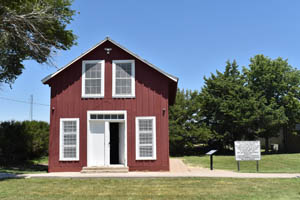
Pond Creek Stage Station at Fort Wallace, Kansas, by Kathy Alexander.
In addition to the constant dangerous battles, the soldiers suffered from a lack of food and several disease outbreaks, including cholera, in 1867. That same year, in June, Lieutenant Lyman Kidder led ten men from the 7th Cavalry from Fort Wallace, headed for Fort Sedgwick, Colorado. They never made it. All eleven of the men were killed by Indians at Beaver Creek in present-day Sherman County on July 1, 1867.
During the years the fort operated, several influential men were stationed there, including General George Armstrong Custer, who fought in his first Indian battle not far from the fort, and Buffalo Bill Cody, Wild Bill Hickok, and George Forsyth.
The troops continued to protect the trail until it was officially decommissioned on May 31, 1882. A small detachment of soldiers was left to protect the fort for some time, but they, too, were eventually removed. Due to the region’s scarcity of materials, settlers scavenged building materials and occasionally relocated entire buildings from the post. Within a few short years, everything was gone.
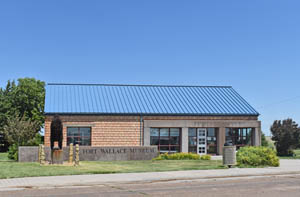
Fort Wallace, Kansas Museum by Kathy Alexander.
Though nothing remains of the fort itself, the city of Wallace features the Fort Wallace Museum and the Pond Creek Stage Station located just to the southeast.
©Kathy Alexander/Legends of America, updated August 2025.
Also See:
Haunted Forts & Battle Grounds
See Sources.