

President Harry S. Truman.
Harry S. Truman was the 33rd President of the United States, serving from 1945 to 1953. A member of the Democratic Party, he previously served as a United States senator from Missouri from 1935 to 1945 and briefly as the 34th vice president in 1945 under Franklin D. Roosevelt. President Truman took America from its traditional isolationism into the age of international involvement.
Harry S. Truman was born in Lamar, Missouri, on May 8, 1884, the oldest child of John Anderson Truman, a farmer and livestock dealer, and Martha Ellen Young Truman. He was named for his maternal uncle, Harrison “Harry” Young. His middle initial “S.” doesn’t stand for a specific name, rather it honors both of his grandfathers, Anderson Shipp Truman and Solomon Young. His brother, John Vivian, was born soon after him, followed by a sister, Mary Jane. The family lived in Lamar until Harry was ten months old when they moved to a farm near Harrisonville, Missouri. They then moved to Belton and, in 1887, to his grandparents’ 600-acre farm in Grandview.
When Truman was six, his parents moved to Independence, Missouri, in 1890 so that he could attend the Presbyterian Church Sunday School. He did not attend a conventional school until he was eight years old. He was a good student, and his mother, with whom he was very close, encouraged him to be interested in music, reading, history, and math. He also learned to play the piano and took lessons from Mrs. E.C. White, a well-respected teacher in Kansas City. He got up at five o’clock every morning to practice and studied more than twice a week until he was 15, becoming a skilled player.
Truman worked as a page at the 1900 Democratic National Convention in Kansas City. His father had many friends active in the Democratic Party, who helped young Harry gain his first political position.

Harry Truman in the National Guard.
After graduating from Independence High School in 1901, Truman took classes at Spalding’s Commercial College, a Kansas City business school. He studied bookkeeping, shorthand, and typing but stopped after a year. At that time, he also worked as a bank clerk in Kansas City, Missouri. From 1905 to 1911, Truman served in the Missouri National Guard. In 1906, he returned to Grandview to help his father run the farm. He took over the farm management after his father died in 1914.
When the United States entered World War I in 1917, he immediately volunteered and helped organize the 2nd Regiment of Missouri Field Artillery, which was quickly called into Federal service as the 129th Field Artillery and sent to France. Truman was promoted to Captain in the field artillery and given command of the regiment’s Battery D. His unit saw action at Saint Mihiel and the Meuse-Argonne, and the men under his command admired him for his bravery and evenhanded leadership.
After returning from war, he married Elizabeth “Bess” Virginia Wallace, whom he had known since childhood, on June 28, 1919. From 1919 to 1922, he ran a men’s clothing store in Kansas City with his wartime friend, Eddie Jacobson. However, the business failed in the severe post-war recession of the early 1920s.
Afterward, another army friend introduced him to Thomas Pendergast, the Democratic boss of Kansas City. With the backing of the Pendergast machine, Truman launched his political career in 1922, running successfully for judge in the eastern district of Jackson County. In 1923, he attended night classes at the Kansas City School of Law.
Harry and Bess’ only child, Mary Margaret, was born on February 17, 1924. That year, he lost his bid for reelection as a judge. He continued taking law classes until 1925, when he dropped out at the end of the second year of a four-year curriculum.
“I had so many people interested in the county’s welfare who wanted to see me that I couldn’t study law.”
— Harry S. Truman

Bess Truman
In 1926, he was again elected presiding judge of the county court, with Pendergast’s support. Serving two four-year terms, he acquired a reputation for honesty and skillful management, which was unusual among Pendergast politicians.
In 1934, Truman’s political career seemed to end because of the two-term tradition attached to his job and the reluctance of the Pendergast machine to advance him to higher office. However, when several people rejected Thomas Pendergast’s offer to run in the Democratic primary for a seat in the U.S. Senate, Pendergast extended the offer to Truman, who quickly accepted. He won the primary with a 40,000-vote majority, assuring his election. In January 1935, Truman was sworn in as Missouri’s junior senator by Vice President John Nance Garner.
He soon gained national prominence as chairman of the Senate Special Committee to Investigate the National Defense Program. This committee, which came to be called the Truman Committee, sought with considerable success to ensure that defense contractors delivered quality goods at fair prices to the nation. During World War II, Truman headed the Senate war-investigating committee, which investigated waste and corruption and saved perhaps as much as 15 billion dollars. He served as a United States Senator representing Missouri until 1945.
In July 1944, Truman was nominated to be Vice President with President Franklin D. Roosevelt. On January 20, 1945, he took the vice-presidential oath.

Roosevelt-Truman 1944 poster.
During his few weeks as Vice President, Harry Truman scarcely saw President Franklin Roosevelt and received no briefing on the development of the atomic bomb or the unfolding difficulties with Soviet Russia. These and many other wartime problems suddenly fell into his lap two months later. On April 12, 1945, he was sworn in as the nation’s 33rd president after President Roosevelt’s unexpected death. He told reporters, “I felt like the moon, the stars, and all the planets had fallen on me.”
President Truman faced unprecedented and defining challenges with the war in Europe nearly over. Soon after Victory in Europe Day on May 8, 1945, the war against Japan had reached its final stage.
In June 1945, Truman witnessed the signing of the United Nations Charter, which was intended to preserve peace.
Wanting a quick end to the Pacific fighting, he participated in a conference at Potsdam, Germany, from July 17 to August 2, 1945, and worked to lay the groundwork for the final stage of the war against Japan. He then notified the Japanese of his intended use and the consequences of the atomic bomb unless they surrendered. However, it was rejected. Truman, after consultations with his advisers, ordered atomic bombs dropped on Hiroshima and Nagasaki, cities devoted to war work, on August 6 and 9, 1945. Japanese surrender quickly followed.
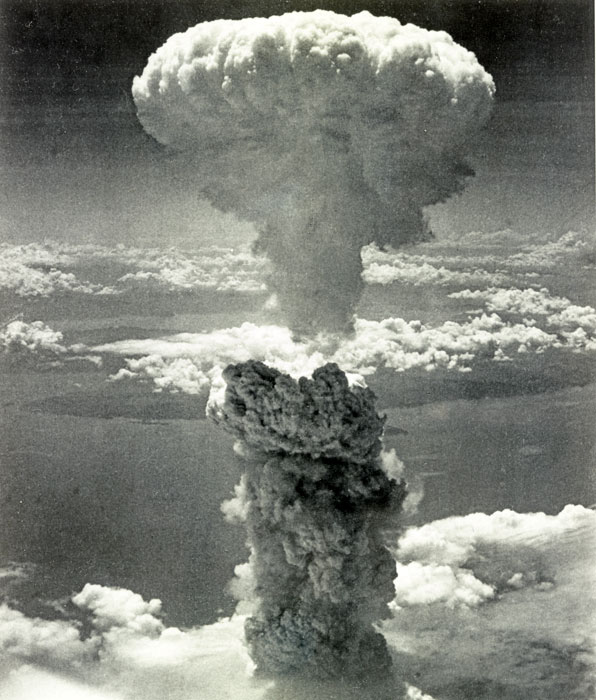
Atomic bomb in Nagasaki, Japan, 1945.
The post-war left Truman with the difficult transition from a wartime to a peacetime economy. In the wake of World War II, Truman implemented the Marshall Plan to rebuild the economy of Western Europe. He established the Truman Doctrine and NATO to contain the expansion of Soviet communism. He proposed numerous liberal domestic reforms, but few were enacted by the conservative coalition that dominated the Congress.
Thus far, Truman followed his predecessor’s policies but soon developed his own. He presented to Congress a 21-point program, proposing the expansion of Social Security, a full-employment program, a permanent Fair Employment Practices Act, and public housing and slum clearance. Truman wrote that the program “symbolizes for me my assumption of the office of President in my own right.” It became known as the Fair Deal.
During his years in the White House following World War II, he committed significant policy blunders. However, Truman achieved notable successes. Domestically, he took important steps in civil rights and presided over an economy that would enjoy two decades of unprecedented growth. In foreign affairs, he established programs that would guide the nation in the decades ahead, especially in American-Soviet relations.
Truman’s recognition of Israel in May 1948 demonstrated his support for democracy and his commitment to a homeland for the Jewish people. The one time during his presidency when a communist nation invaded a non-communist one — when North Korea invaded South Korea in June 1950 — Truman responded by waging undeclared war.
The Truman administration went beyond the New Deal in Civil Rights. Truman could use his powers as President to achieve some important changes. He issued executive orders desegregating the armed forces and forbidding racial discrimination in Federal employment. He also established a Committee on Civil Rights and encouraged the Justice Department to argue before the Supreme Court on behalf of plaintiffs fighting against segregation.
He energized the New Deal coalition during the November 1948 presidential election despite a divided Democratic Party and won a surprise victory against Republican Party nominee Thomas E. Dewey. His defeat had been widely expected and often predicted, but Truman’s energy in undertaking his campaign and his willingness to confront issues won a majority of the electorate for him. His famous “Whistlestop” campaign tour through the country has passed into political folklore, as has the photograph of the beaming Truman holding up the newspaper whose headline proclaimed, “Dewey Defeats Truman.”

Harry S. Truman wins the presidency.
On November 1, 1950, Puerto Rican nationalists Griselio Torresola and Oscar Collazo attempted to assassinate Truman at Blair House. On the street outside the residence, Torresola mortally wounded a White House policeman, Leslie Coffelt. Before he died, the officer shot and killed Torresola. Collazo was wounded and stopped before he entered the house. He was found guilty of murder and sentenced to death in 1952. Truman commuted his sentence to life in prison.
To settle the question of Puerto Rican independence, Truman allowed Puerto Rico to determine its relationship status with the United States in 1952. Nearly 82 percent of the people voted for a new constitution for the Estado Libre Asociado, a continued ‘associated free state.’

Truman Assignation Attempt.
Truman chose not to run for a third term and retired to Independence in January 1953. Spending most of his time at home supervising the construction of the Truman Presidential Library and Museum, he continued his early morning walks, reading, writing, and lecturing. However, by the mid-1960s, his health was declining. On December 5, 1972, Truman was admitted to Kansas City’s Research Hospital and Medical Center with pneumonia. He developed multiple organ failure and lapsed into unconsciousness on Christmas Day. He died at 7:50 a.m. on December 26, at the age of 88. His funeral was held at the Truman Presidential Library in Independence, Missouri, with burial in the library courtyard. Bess Truman died on October 18, 1982, at age 97. They are buried side by side in his Presidential Library’s courtyard just down the road from his “Summer White House.”
Today, the Truman Legacy dominates the city of Independence, Missouri. From the massive Truman Library to the three standing and well-maintained boyhood homes, the Truman House on Delaware Street was where the Presidential couple lived from their marriage. Bess remained at the house after her husband passed away for ten more years. His birth house in Lamar was purchased by the United Auto Workers, who restored it and then donated the site to the Missouri State Park System with a dedication attended by President Truman.
The Truman farm in Grandview, where he attempted to forge a detested farming career, has been restored and is a State Historic Site.

Harry S. Truman House in Independence, Missouri, by the Historic American Buildings Survey.
©Kathy Alexander/Legends of America, July 2024.
Also See:
Presidential Trivia & Fun Facts
Presidents of the United States
Sources:

The Harry S. Truman Presidential Library & Museum in Independence, Missouri. Photo by Carol Highsmith.
Encyclopedia Britannica
Find-a-Grave
National Archives
National Park Service
Whitehouse.gov (archived)
Wikipedia