

Margaret Haughery Monument Orphan Asylum Postcard 1908.
Margaret Gaffney Haughery was a beloved historical figure in New Orleans, Louisiana, in the 1880s. She devoted her life’s work to caring for and feeding the poor and hungry and funding and building orphanages throughout the city. The poor orphaned Irish immigrant who grew up to be a renowned philanthropist was widely known as “Our Margaret,” “The Bread Woman of New Orleans,” and “Mother of Orphans.”
Margaret Gaffney was born in County Leitrim, Ireland, in 1813, the fifth of the six children of William and Margaret O’Rourke Gaffney. William Gaffney owned a small farm but ran into hard times shortly after Margaret’s birth. Two years of bad weather left him and thousands of other Irish farmers unable to support their families.
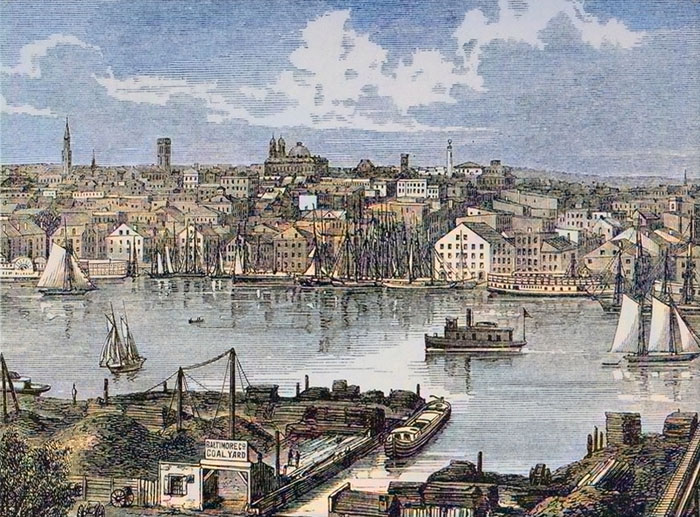
Baltimore, Maryland Port.
In 1818, hoping to build a better life, the poor family moved to Baltimore, Maryland, with three of their six children—including five-year-old Margaret, her older brother Kevin, and baby sister Kathleen. Not having enough money to bring all their children, the three eldest children were to remain temporarily with their uncle Matthew O’Rourke in Ireland until they could be sent for. During the six-month journey by steamer, the passengers suffered from severe storms, scarce provisions, and destroyed luggage. During the long voyage, a Welsh woman with the surname Richards became acquainted with the Gaffney family.
Upon their arrival, baby Kathleen died. William Gaffney went to work as a carter at the Baltimore docks and soon sent money to his brother-in-law O’Rourke for the upkeep of his three children remaining in Ireland. By 1822, he had almost saved enough to send for them when a yellow fever epidemic ravaged Baltimore, claiming Margaret’s parents, William and Margaret, who died within days of each other.
Nine-year-old Margaret was soon homeless and alone as her older brother Kevin disappeared and was never heard from again. However, Mrs. Richards, who had crossed the sea with the Gaffney family, heard of Margaret’s plight. Having lost her husband to yellow fever, she took Margaret into her home, where she remained for several years, working for her keep. She received no formal education and never learned to read or write. When she was old enough, Margaret went into domestic service. She never saw her elder three siblings, who had remained in Ireland again.
In 1835, at age 21, Margaret married Irish-born Charles Haughery, and within a month, they joined the steady stream of people seeking their fortunes in the American West. Settling in New Orleans, Louisiana, to escape the cold weather, Margaret soon gave birth to a daughter they named Frances. At the age of 23, Margaret would, once again, lose everything, as her husband and young child also died of Yellow Fever.

New Orleans in the 1800s.
In the 1830s, being an Irish widow in America was not easy. Irish immigrants were not popular with most Americans, who believed that they were dirty, uneducated, and stealing the jobs of people born in the United States. The Irish also followed the teachings of the Catholic Church, which earned them the anger and distrust of Protestant Americans.

First St. Charles Hotel in New Orleans, Louisiana.
Margaret found support from the Sisters of Charity, a community of Catholic nuns. They gave Margaret a place to live and helped her find a job as a laundress in the St. Charles Hotel. Despite her tragedies, Margaret was determined to do something in her life to help the plight of widows and orphans. While working as a laundress at the nearby hotel, Margaret began visiting the Female Orphan Asylum of the Sisters of Charity, caring for the young children at the Poydras Orphan Asylum, and donating as much as two-thirds of her earnings.
She expanded her aid by working more hours at the orphanage while collecting additional food for the kids. With her keen business sense, she also solicited financial aid and sponsorship from some local businesses. Seeing how successful and dedicated Margaret had become, the Daughters of Charity warded her with an administrative position at the orphanage. Margaret would take things further by purchasing two cows to start a dairy. After supplying the orphanage with milk, she sold the excess door-to-door in the French Quarter from a small cart. She also attempted to obtain leftover food from private residences and businesses, bringing whatever extras she could back to the children.
Eventually, she left her position at the hotel to work for the sisters as manager of the orphan asylum. Soon, her dairy business prospered and expanded with 19 cows, and she also sold cream and butter. Within two years, Margaret had a dairy herd of 40 cows and a profitable business.
Eventually, she helped open St. Theresa’s Orphan Asylum on Camp Street in 1840. F. Saulet donated the site, and Margaret primarily funded the project with help from donations. In conjunction with Sister Regis, she practically built St. Theresa’s Church.

Yellow fever epidemic, New Orleans, Louisiana, 1853.
During the yellow fever epidemic in New Orleans in 1853, Margaret went from house to house, nursing the victims and consoling the dying mothers with the promise to look after their little ones. This acute disease spread by mosquitos had no cure at the time, and the death toll was staggering and steadily climbing. As the death toll rose, especially in adults, more and more children were left behind as orphans with no one to tend to them. Local churches tried their best to accommodate the children, but it was not enough, causing a rise in local orphanages. Between 1853 and 55, the viral illness claimed 13,000 lives.
With the profits from the dairy, she bought a failing bakery and transformed it into Margaret Haughery & Company, one of the first steam-powered bakeries in the South. Margaret drove a bread cart around the city, selling her wares. But her bakery was successful enough to export goods for a significant profit. Margaret did not allow her success to change her. Every evening, Margaret would distribute unsold products to the city’s poor. Whenever there was an outbreak of yellow fever, Margaret worked as a nurse wherever needed. And, of course, she never stopped supporting the city’s orphans. She continued to make significant donations to orphanages and sold her bread to all the city’s orphanages at such a low price that it was practically free. Eventually, she also owned a popular store called the Klotz Cracker Factory, associated with the Klotz Bakery.

Margaret’s Steam Bakery in New Orleans, Louisiana.
Of the three older Gaffney family children left behind in Ireland — Thomas, Mary, and Annie — she only reunited with her remaining foreign-soil siblings once, when elder brother Thomas visited her in New Orleans in 1857.
Other homes opened in the 1850s and 1860s included the Louise Home for Working Girls at 1404 Clio Street and the St. Elizabeth House of Industry at 1314 Napoleon Street.
St. Vincent’s Infant Asylum was built in 1861 by the Sisters of Charity and was soon crowded with children left homeless after epidemics of yellow fever and cholera. The red-brick building, designed in the Italianate Victorian style, is in the Lower Garden District on Magazine and Race Streets. The asylum could house around 35 infants each year.
In 1862, during the Civil War, the Union Army occupied New Orleans and placed it under martial law, with barriers and curfews. Though no one was to pass these barriers or be outside the curfew, Margaret continued distributing food and milk to the needy beyond the barriers. When General Benjamin Butler admonished her to stay behind the lines, or she could be shot or hanged, she asked him if it was President Abraham Lincoln’s will to starve the poor. General Butler replied, “You are not to go through the picket lines without my permission; is that clear?” “Quite clear,” answered Margaret. To which Butler responded, “You have my permission.”

Margaret Haughery and her Bakery Cart.
By the end of the Civil War, Margaret’s reputation as a local hero was secure, and her role as a pillar of her community only grew in the following years. Margaret still traveled through New Orleans daily, selling bread and checking in with her community. The war and the continuing crisis of yellow fever brought the number of orphans in New Orleans to an all-time high, so Margaret built seven more orphanages. She was explicit in all her donations that the institutions should serve all children in need regardless of race, religion, ethnicity, or social class. News of her great works spread far, reaching even the Pope in Rome. Haughery supported the orphanages for the rest of her life.
She also donated to the Protestant Episcopal Home and Jewish charities in New Orleans. In her will, she gave to the Seventh Street Protestant Orphan Asylum, the German Protestant Orphan Asylum, the German Orphan Catholic Asylum, the Widows and Orphans of Jews Asylum, the Daughters of Charity of St. Vincent de Paul, and many others.
Margaret became seriously ill in 1882. During the last months of her life, the city made every effort to show her how appreciated she was. She even received a crucifix and blessing from the Pope to comfort her in her final days. Her passing on February 9, 1882, was announced as front-page news in the leading New Orleans newspaper and was met with an unprecedented outpouring of grief. Her body was taken to St. Vincent Infant Asylum, where it was embalmed and laid in state. The funeral took place on the following Saturday morning.

Margaret Haughery with Orphans. Painting by Jacques Amans, New Orleans, c. 1842.
She was given a state funeral, and all stores, city offices, and businesses were closed in respect. The mayor of New Orleans led her funeral procession, the Archbishop presided over her mass, and two lieutenant governors helped carry her casket. The cathedral was so crowded they struggled to carry the casket down the center aisle. She was buried in the same Saint Louis Cemetery No. 2 tomb with her great friend Sister Francis Regis, the Sister of Charity who died in 1862.
In about 1971, the Sisters of Charity communal tomb was moved to a mausoleum vault at St. Louis Cemetery No. 3 on Esplanade Avenue in New Orleans. Margaret’s St. Louis Mausoleum’s final resting place is an unmarked Vault numbered 18A on Mary Magdalene Corridor.
She left her considerable estate to the orphanages of New Orleans and the Daughters of Charity of St. Vincent de Paul. It is estimated that Margaret gave $600,000 to charity in one form or another. She bequeathed the bakery to her foster son, Bernard Klotz.
Afterward, plans were immediately made to erect a statue of Margaret so that the memory of her contributions to the city would not be forgotten. When unveiled in 1884, it was only the second statue in the U.S. to honor a woman. It depicts her wrapped in her perennial shawl, her hair pulled back in a bun, and her arm around a small child. The statue, Margaret’s Place, sits where Clio Street intersects with Prytania and Camp Streets.
“Owing to the great epidemics that have visited New Orleans, often sweeping away parents and leaving numerous children to the charity of the world, it became necessary to found asylums for the many orphans, and there is perhaps no other city in the United States where there are more establishments of the kind and where such institutions enlist as much popular sympathy. The names of Poydras, Milne, Fink, Sister Regis, and kind Margaret Haughey, the baker, are greatly revered for their good works and timely aid in founding and sustaining these homes of mercy. The institutions are supported by money derived from bequests, popular contributions, proceeds of charitable entertainment, and city and state aid. Besides, great pains are taken to make the institutions as nearly self-supporting as possible by taking in washing, sewing, and doing other manual labor.”
— New Orleans Guide by James S. Zacharie, 1885
St. Vincent’s Infant Asylum was expanded in 1890 to double its capacity.

St. Vincent’s Infant Orphan Asylum
The orphanage continued operating for many years, and later, unwed mothers and children until the 1970s. After shutting down, the building sat abandoned for several decades.
In 1994, the building was purchased and remodeled, transforming it into the St. Vincent’s Guest House. Considered more of a hostel, it offered few amenities besides an affordable, no-frills place to stay.
In 2021, St. Vincent’s Guest House was restored and reimagined, and the new 75-room Hotel Saint Vincent opened on the corner of Magazine and Race Streets in the Lower Garden District. Today, this upscale hotel offers full in-room minibars, Italian bed linens, custom silk bathrobes, a swimming pool, concierge services, and a “fashion and lifestyle boutique” featuring luxury goods. Located at 1507 Magazine Street, the neighborhood is rich in 19th-century architecture, including Greek Revival and Italianate-style mansions, iconic side-hall double-galleried residences, open green spaces, and an active arts community. Placed on the National Register of Historic Places in 1972, the Lower Garden District, with its oak tree-lined streets and walkability, is known as being a relaxing and quiet neighborhood with a wealth of eclectic restaurants, bars, retail shops, and other destinations within walking distance of the hotel.
The building is said to allegedly be haunted by the children who passed away here from yellow fever. Their spirits have been spotted in the hallways, sitting on their guest’s beds, and they have been heard giggling within the walls. A nun’s apparition has also been seen.

Hotel St. Vincent in New Orleans, Louisiana.
The Poydras Home, first known as the Female Orphan Society, is a continuing care retirement community located at the downtown river corner of Magazine Street and Jefferson Avenue. Its main building dates back to 1857, when the institution moved uptown from its original 1817 location on St. Charles Avenue at Julia Street.
©Kathy Alexander/Legends of America, updated July 2024.
Also See:
Haunted Cities of the Dead – New Orleans
New Orleans, Louisiana – The Big Easy
Sources:
Haunted Nation
Historic New Orleans Connection
Hotel St. Vincent
Old New Orleans
Wikipedia
Women of American History