
Bill Jordan was one of the most famous lawmen of the 20th century, having served in uniform for over 30 years. Serving with the U.S. Border Patrol along the U.S.-Mexico border at a time when that job guaranteed exposure to gunfire and risk, his accomplishments led to developing the guns and gear used by law enforcement across the nation.

Clearing caves in the Pacific was more dangerous than defusing bombs, as the Japanese didn’t comprehend the whole “surrender” thing. Jordan survived this job on Iwo Jima and Eniwetok. Photo credit Staff Sergeant Walter F. Kleine, National Archives
Bill’s Border Patrol service was interrupted twice. He served as a U.S. Marine in the Pacific campaign, clearing caves of Japanese snipers in some of the nastiest combat action ever seen. He again took leave of the border to fight as a Marine reservist during the Korean conflict. He retired from both organizations as a Colonel in 1965.
For much of its existence, the Border Patrol was underfunded and understaffed. The men who patrolled the Rio Grande were not motivated by personal gain; they barely eked out an existence in the dry Southwest. It was a rough job with little recognition. Much of the innovation in equipment and training was developed internally to compensate for the lack of external support.
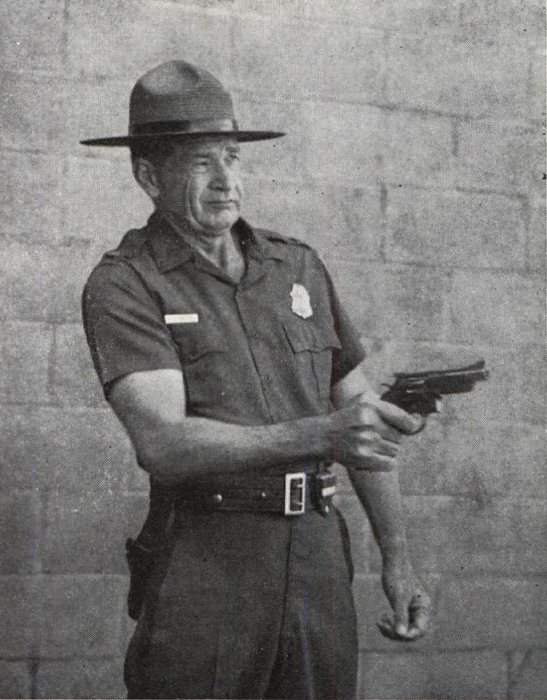
Bill Jordan demonstrates his famous quick-draw skills. He was known to draw, fire, and hit a target in .27 seconds. The source is unknown, but it is most likely Charles Askins.
His contributions to the shooting community include the development of the Jordan, or Border Patrol, holster rig, the large “target” style revolver stocks, and the S&W K-frame .357 magnums. These advancements represented the pinnacle of law enforcement revolver technology until the semiauto duty pistol replaced them.
Jordan started with the Askins Border Patrol holster when he began development with S.D. Myres in the 1940s. Jordan outlined the specific traits a duty holster should have, which are emulated to this day in current holster designs:
“Here then are the things that a holster should do: It should hold the gun securely yet allow the maximum speed attainable within the limits of comfort, safety, and security.”
Jordan’s main objective was to set up a fast draw, so the gun needed to be in the same position. The Askins rig construction allowed it to shift position, so the gun wasn’t always where the shooter thought it was. To address this, the Jordan rig used thicker leather and extended the steel shank of the Askins through the loop and over the belt for maximum rigidity.
The result was a holster that kept the gun perpendicular to the ground, held slightly off the curvature of the body, much like an IDPA setup. The Askins would pull the grip close to the body and couldn’t muzzle out to the side.
The steel shank in the Jordan holster also prevented it from binding during the draw, whereas flimsy holsters, such as the suede clip-on IWBs, tend to stay with the gun when drawn. The Jordan’s form-fit also meant a more secure carry and a cleaner release when drawn.
The forward cant and low-cut top allowed the muzzle to clear the leather fast. The revolver’s trigger guard was exposed entirely (completely contrary to current doctrine), and the gun was held away from the back portion of the holster, allowing the trigger finger to enter the guard as the draw was begun (also completely contrary to current doctrine).
As a matter of practicality, Jordan added a safety strap to retain the gun during vigorous activity. The strap on the Jordan was positioned in front of the hammer spur, which was easier to clear and less likely to get trapped and foul the draw. This feature was eventually improved upon by the development of the “thumb break” retention style, which is still in use today.
The Jordan holster was designed to work with a thick, wide gun belt that fits snugly around the loop of the holster to hold it in place without sagging. These “Jordan,” or duty-style belts, remain popular today and help distribute the load carried by law enforcement officers.
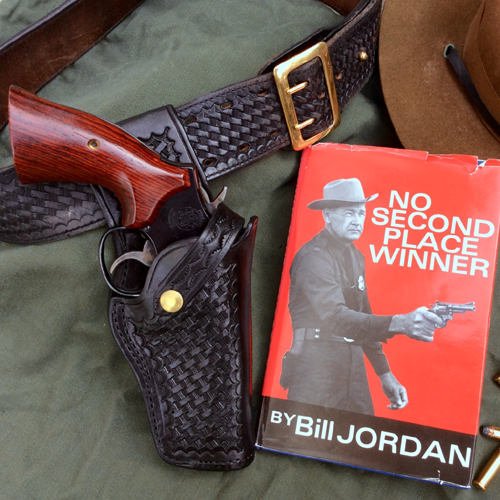
Jordan rig, complete with holster, duty belt, S&W Combat Magnum with Jordan stocks, along with Jordan’s most famous book, No Second Place Winner. Image credit www.revolverguy.com
Jordan also collaborated with Walter Roper in the design of wooden grips intended for heavy-caliber double-action revolvers, which are currently made by Herrett’s Stocks as the “Jordan Trooper.” At six and a half feet tall, Jordan had a big mitt, and the tiny grips of the day didn’t cut it. Versions of these larger stocks made their way on the S&W’s factory magnums as original equipment.
A fan of the double-action revolver, Jordan was primarily responsible for convincing Smith & Wesson to adapt its K-frame series revolver to handle the .357 Magnum cartridge, resulting in the (S&W Model 19 and S&W Model 66) “Combat Magnum.” These revolvers were the mainstay of many departments until automatics replaced them in the late 1980s.
After retiring from the Border Patrol and Marine Reserves, Jordan served as the Southwestern Field Representative for the National Rifle Association. He continued to contribute to the development of firearms and ammunition, assisting with the creation of the .41 Magnum cartridge. He also authored articles on all aspects of firearms and books such as No Second Place Winner, Mostly Huntin’, and Tales of the Rio Grande.
Anyone growing up reading Guns and Ammo in the ’70s and ’80s will remember Jordan’s regular column recalling his exploits from his days in the patrol or interacting with the movers and shakers in the gun world of the day.
Although he passed away in 1997, his legacy endures through the equipment used by today’s law enforcement officers and his efforts to share his hard-earned experience with the training programs of agencies worldwide. Jordan and contemporaries like Charles Askins paved the way for the officer survival movement.
Submitted by Concealment Express, June 2019, updated August 2025.
Also See: