
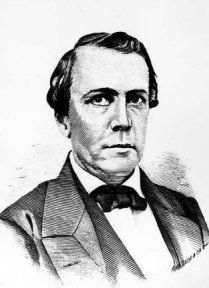
Joseph Doyle, Colorado trader.
Joseph Bainbridge Doyle was a trapper, Indian trader, businessman, Colorado pioneer, and politician.
Often called “Jose,” Joseph Bainbridge Doyle was born on July 10, 1817, in Shenandoah County, Virginia, to Alexander Doyle and Ana Maria Evans Doyle. By the early 1830s, his family moved across the Mississippi River from St. Louis, Missouri, to Belleville, Illinois.
In 1838, he worked as a clerk for the Bent, St. Vrain & Company in their St. Louis operations. Then, he worked as a storekeeper, bookkeeper, trader, and teamster for the next several years, traveling along the Santa Fe Trail several times. By 1841, he worked full-time at Bents Fort on the Arkansas River in Colorado. He became acquainted with Alexander Barclay, George Simpson, and Robert Fisher, who also worked at the fort.
When these men and several others established the El Pueblo trading post about 70 miles upstream from Bents Fort in 1842, Doyle followed and used his savings to buy into the trading partnerships. Also, there were several other traders, including Mathew Kinkead, Francisco Conn, Joseph Mantz, and “Uncle Dick” Richens Wootton.
In 1844, Doyle, George Simpson, and Alexander Barclay constructed a new trading post about 23 miles west of El Pueblo in a settlement known as Hardscrabble. The same year, Joseph Doyle married Maria De La Cruz “Cruzita” Suaso on October 14, when she was only about 13 years old. The couple would have several children. Cruz was the daughter of Alexander Barclay’s wife, Teresita Sandoval Suaso. Another of Teresita’s daughters married George Simpson.
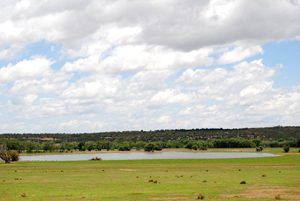
Mora River Valley, New Mexico, by Kathy Alexander.
In 1848, Doyle and Alexander Barclay built Fort Barclay at the Mora and Sapello Rivers junction on the Santa Fe Trail near Watrous, New Mexico. They hoped to capitalize on the trade with the emigrants and eventually sell the fort to the military. However, the Army turned them down and tried to order them off their land so the Army could build their fort there.
In the beginning, Fort Barclay was bustling with daily trading activity. It served as a stagecoach station, provided housing for men and shelter for animals, and its stockade furnished protection from Indian raids. Then, in 1851, the establishment of Fort Union, about nine miles northwest of Watrous, began. Located near Doyle and Barclay’s land, the Army again tried to order them off, but Doyle and Barclay took the Army to court, which dragged on for several years.
Despite its promising beginning, Barclay’s Fort never turned into a profitable business, and by October 1853, Alexander Barclay was living at the fort by himself. He and Doyle advertised the fort for sale in the Santa Fe newspapers but never had an inquiry. Barclay died at the fort in December 1855. Afterward, Joseph Doyle took in Barclay’s wife, Teresita. He continued the litigation with the Army and finally won out. In 1856, Doyle sold the land and the fort to a German immigrant named William Kronig, who eventually built the Phoenix Ranch. The ranch, which still exists today, is all that is left of Doyle and Barclay’s previous holdings at Fort Barclay.
In 1858, gold was discovered in Colorado, and Doyle formed the J.B. Doyle Company. Soon, he was hauling wagon loads of food, grain, clothing, and other supplies to Denver City, becoming very prosperous.
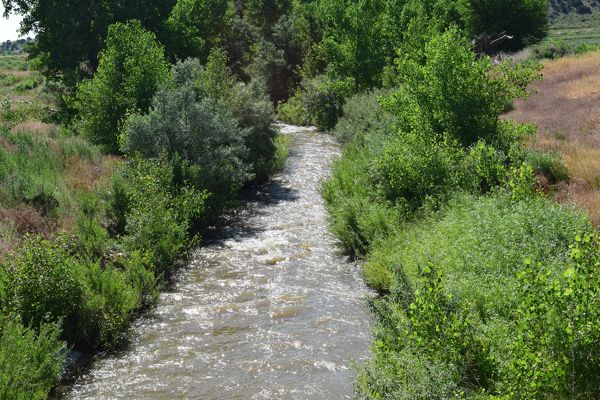
Huerfano River, Colorado.
In November 1859, Doyle purchased 1,200 acres from the Vigil and St. Vrain Land Grant on the west bank of the Huerfano River east of Pueblo, Colorado. Dick Wootton and Charles Autobees had ranches nearby. On his land, he brought in lumber milled in St. Louis, Missouri, and built a large two-story white clapboard house for his family known as “Casa Blanca” or the “White House.” With its green shutters, the house was not characteristic of the architectural style of the West but rather with the architectural style of Doyle’s youth in the East. Sitting near a segment of the Denver to Santa Fe Road, the “White House” became a landmark in the area, and the road became known as the “White House Road.”
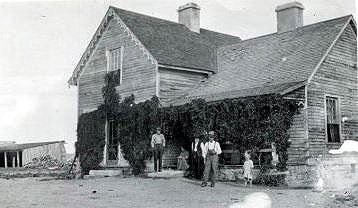
Casa Blanca, Doyle Ranch, Colorado.
He also built adobe cabins for his many farmworkers, one of the first flour mills in Colorado, granaries, storehouses, and one of the first schoolhouses that served his children and his workers. His land stretched for miles along the Huerfano River, and by 1861, he had built irrigation ditches, bringing 600 acres into cultivation, and built corrals for sheep and cattle, which grazed on the uplands. Corn, potatoes, beans, oats, cotton, melons, and tobacco were cultivated. Eventually, his ranch also boasted an adobe trading post, a blacksmith shop, and a post office where Joseph Doyle would serve as the first postmaster.
At the same time, Doyle began importing goods from the East. Along with his agricultural products and those of neighboring farms, he opened stores in Auraria (later a part of Denver), Canon City, Tarryall, Colorado Springs, and Pueblo.
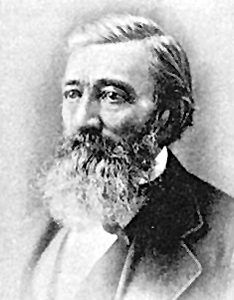
George Simpson.
At some point, George Simpson claimed land in the same area and built a house near Charles Autobees’ ranch. After Colorado officially became a territory on February 28, 1861, the small settlement that had grown up around Autobees’ Ranch became the county seat of the newly formed Huerfano County. The first election of officers occurred on December 2, 1861, when Charles Autobees and Joseph Doyle were made county commissioners, and George Simpson became the county clerk and recorder.
In 1864, Doyle was elected to represent the Colorado Territorial Council in Denver, representing Pueblo, Huerfano, El Paso, and Fremont Counties. While serving in Denver, Doyle died of a heart attack on March 4, 1864. He was 46 years old. Governor John Evans and other dignitaries escorted his body home to his ranch, where he was buried in the family cemetery on a hill overlooking his ranch. At the time of his death, he was considered the wealthiest man in Colorado. Unfortunately, his wife, Maria De La Cruz “Cruzita” Suaso Doyle, died the following year.
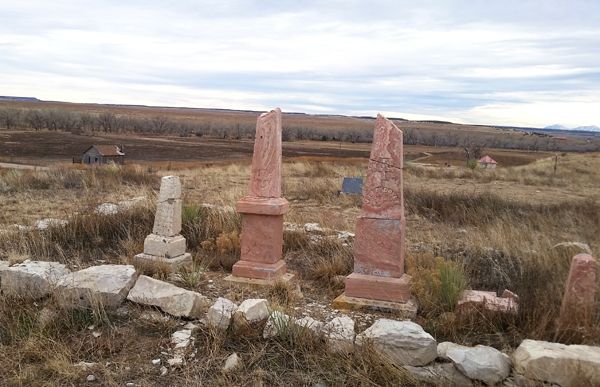
Doyle Cemetery, Colorado.
In 1874, the Doyle children sold the ranch, stipulating that the Mexican village that grew up around it could remain as long as their grandmother, Teresita Sandoval Suaso Alexander, lived there. She died in 1894 and was buried in the Doyle Cemetery.
The Doyle Settlement was listed on the National Register of Historic Places in April 1980. It represents one of the earliest non-mining communities in Colorado. It consists of some of the old farm and grazing lands, foundations, and ruins of various buildings, the old schoolhouse, and the Doyle cemetery. Though still standing, the schoolhouse is in a very poor state of repair. Despite some vandalism, the gravestones still lie on the hill overlooking where these early settlers lived, worked, and died.
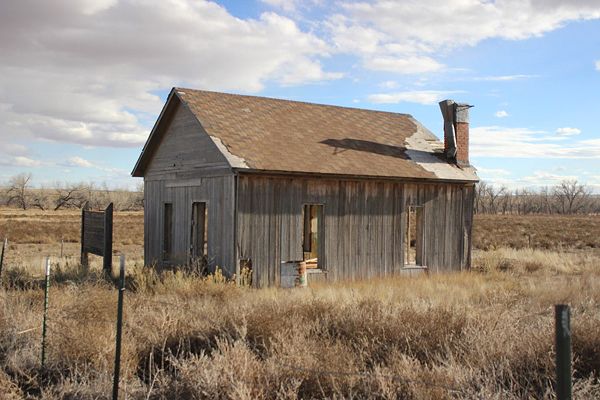
Doyle Settlement, Colorado Schoolhouse.
Also See:
Sources:
Find a Grave
Huerfano County, Colorado
National Register of Historic Places Nomination
Santa Fe Trail Newsletter