
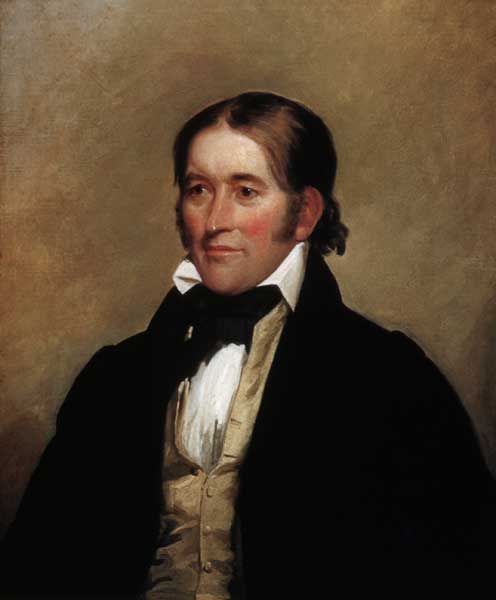
David “Davy” Crockett. Portrait by Chester Harding.
David “Davy” Crockett was a frontiersman, explorer, pioneer, folk hero, soldier, and politician commonly referred to in popular culture by the epithet “King of the Wild Frontier.”
David was born to John and Rebecca (Hawkins) Crockett on August 17, 1786, in Greene County, Tennessee. The family followed Western settlement patterns, moving thrice by the time David was 12. In 1796, the family opened the Crockett Tavern on the road from Knoxville, Tennessee, to Abingdon, Virginia, in present-day Morristown, Tennessee. Today, the building continues to stand on the National Register of Historic Places.
Two years later, in 1798, John Crockett hired his son out to Jacob Siler to help drive a herd of cattle to Rockbridge County, Virginia. When the job was complete, Siler tried to detain David by force, but the 12-year-old escaped at night by walking seven miles in two hours through knee-deep snow. He eventually made his way home in late 1798 or early 1799. Soon afterward, he started school but preferred playing hooky and ran away to escape his father’s punishment. He did not return home for some 30 months.
While away, he worked as a wagoner and day laborer at odd jobs to support himself. When he returned home in 1802, he had grown so much that his family did not initially recognize him. When they did, he found that all was forgiven. Crockett reciprocated their generosity by working for about a year to discharge his father’s debts, totaling $76, and returned to school for six months.
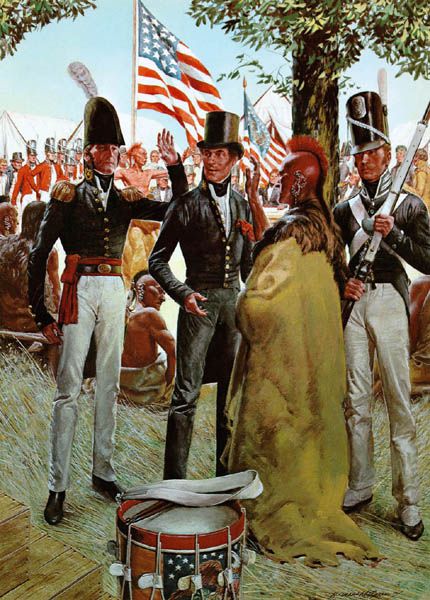
Soldiers in the War of 1812.
On August 14, 1806, Crockett married Mary “Polly” Finley, and the couple would eventually have three children. They remained in the mountains of East Tennessee for just over five years. In the fall of 1811, he moved his family to Lincoln County, Tennessee, and in 1813 moved them again to Franklin County, Tennessee. Crockett supported his family primarily as a farmer and hunter.
In 1813, Crockett enlisted in the Tennessee Militia following a massacre by Creek warriors of the occupants of Fort Mims, Alabama. He participated in the Battle of Tallussahatchee of the Creek War in northern Alabama but returned home when his enlistment was up, missing the decisive Battle of Horseshoe Bend on March 27, 1814, when the Creek were defeated. During his second enlistment, which began in September 1814, he joined Andrew Jackson’s forces at Pensacola, Florida, during the War of 1812 but was discharged again before the Battle of New Orleans.
In 1815, Polly Crockett died, and a year later, David married Elizabeth Patton.
In the fall of 1816, Crockett moved his family to Lawrence County, Tennessee. He served as justice of the peace and commissioner for the town of Lawrenceburg and rose to the lieutenant colonel-commandant in the local militia. In 1821, Crockett was elected to the Tennessee legislature, serving two terms.
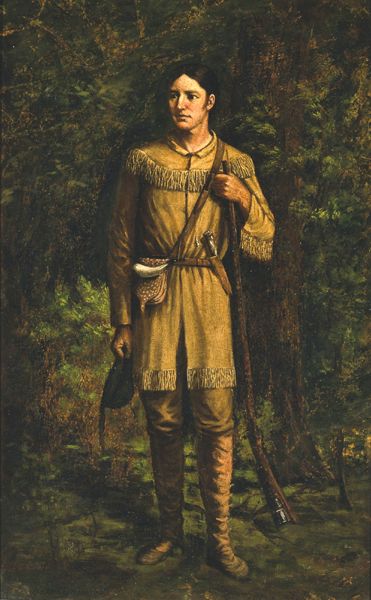
Davy Crockett.
In 1827, Crockett was elected to the United States Congress from Tennessee, where he served from 1827 to 1831 and again from 1833 to 1835. His opposition to the president most noted Crockett’s tenure in Congress and fellow Tennessean Andrew Jackson’s on land reform issues and the Indian removal bill.
During this time, the legend of Davy Crockett began to grow. Crockett promoted himself as a simple but honest man who was an outstanding hunter and marksman. In 1834, he published an autobiography, A Narrative of the Life of David Crockett of the State of Tennessee, making him a nationally popular figure. Afterward, a number of books and almanacs began to appear, claiming to be true stories about David Crockett. Narrated in frontier lingo, these tales often related bigger-than-life adventures, making Davy Crockett a frontier hero in his own time and for future generations.
Jackson and William Carroll, governor of Tennessee, engineered Crockett’s defeat in his bid for reelection to Congress in 1835 to derail Crockett’s political plans. After losing, Crockett said, “You may all go to hell, and I will go to Texas.” He next appeared in East Texas, ostensibly looking for land upon which to settle. Texas agreed with Crockett as he wrote a letter on January 9, 1836, stating:
“I must say as to what I have seen of Texas, it is the garden spot of the world. The best land and the best prospects for health I ever saw, and I do believe it is a fortune to any man to come here. There is a world of country here to settle… I have taken the oath of government and have enrolled my name as a volunteer. I will set out for the Rio Grande in a few days with volunteers from the United States. But all volunteers is entitled to vote for a member of the convention or to be voted for, and I have but little doubt of being elected a member to form a constitution for this province. I am rejoiced at my fate. I had rather be in my present situation than to be elected to a seat in Congress for life. I am in hopes of making a fortune yet for myself and family, bad as my prospect has been.”
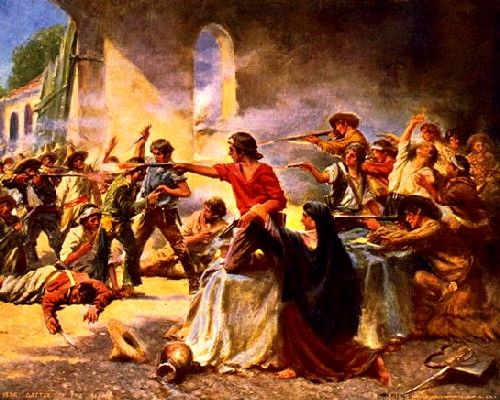
Alamo Battle.
The next month, he arrived at the Alamo with his Tennessee Mounted Volunteers. Fighting against Santa Anna during the siege of the Alamo, he lost his life on March 6, 1836, along with 189 defenders.
After his death, he continued to be credited with acts of mythical proportion. These led in the 20th century to television and movie portrayals, and he became one of the best-known American folk heroes.
©Kathy Alexander/Legends of America, updated January 2025.
Also See:
Davy Crockett at the Battle of the Alamo
Remember the Alamo – The Battle
Soldiers & Officers in American History
Sources: