
The American Southwest is rugged, beautiful, and filled with American History. It lures visitors with its red-rock canyons, Old West legends, Spanish and Native American cultures, and incredible national parks, including the Grand Canyon, Arches National Park, Big Bend National Park, and Carlsbad Caverns.
This region is loosely defined and has never been standardized, but it consistently includes Arizona and New Mexico, as well as portions of Utah, Colorado, Nevada, California, and Texas. Contrary to many people’s image of the American Southwest — that it is a sprawling desert — it is one of the most geographically diverse regions in the United States. From the Rocky Mountain landscape to the dramatic red rock bluffs and mesas, and the flatlands of the Rio Grande, the landscape is varied and surprising.
It is also home to a beautiful and vibrant mix of Anglo, Latino, Hispanic, and Native American traditions, offering diverse, engaging, and picturesque opportunities to experience history, landscape, and culture.
Human settlement in the Southwest dates back over 12,000 years and is preserved today by rock art, cliff dwellings, and other archaeological remains throughout the region.
The Puebloans, sometimes known as the Anasazi people, inhabited the area for over 1000 years but disappeared during the 12th or 13th century. The Athabascan people, including the Navajo and Apache, began arriving as early as 1000 AD and remain the largest indigenous group in the area today. These people contributed significantly to the vast area’s distinctive culture, learning how to adapt to its climate and geography.
While hunting and gathering activities predominated in the Great Basin and California, and bison hunting dominated the Great Plains, the people of the American Southwest established early agricultural communities and grew maize, beans, and squash. They constantly experimented with various irrigation techniques to overcome the hot, dry climate. Changes in rainfall patterns led to the construction of complex communities, which were eventually abandoned when rainfall could no longer support the population.
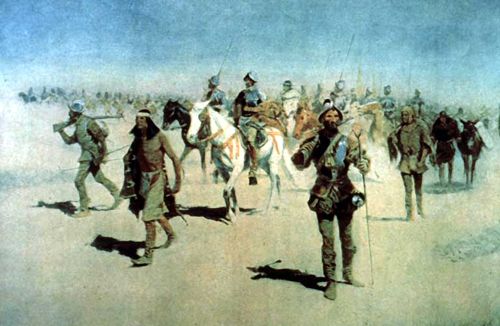
Coronado’s Expedition by Frederic Remington.
Spanish explorers of the American Southwest, beginning with Francisco Vasquez de Coronado’s 1540-42 expedition, encountered settled communities and deserted ruins. The Spanish remained a dominant military force for nearly 300 years.
In making the American Southwest an outpost of their far-flung empire, the Spanish introduced significant changes as religious orders, soldiers, and colonists built missions, presidios (forts), and towns with distinctive central plazas and churches; Santa Fe was founded around 1610. Albuquerque began in 1706, Las Trampas in 1751, and Taos between 1780 and 1800.
The area became part of Mexico in 1821, following Mexico’s independence from Spain. By the mid-1800s, the expanding United States had established a presence, and in 1848, following the Mexican-American War, much of the area became U.S. territory.
After the Southwest was brought into the orbit of the expansionist American nation, Anglo influence was imprinted on the land through forts, trading posts, mining centers for silver, gold, and copper, cattle ranches, railroads, and dams.
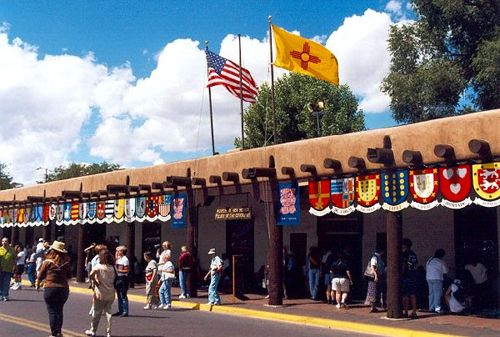
Santa Fe Palace of Governors
The American Southwest, with its distinctive building traditions, languages, religions, and cuisine, reflects the vitality of the Spanish, Mexican, Native American, and Anglo cultures that have shaped its history and the Southwest we see today. Here, you will be introduced to prehistoric and historic sites, buildings, structures, and districts associated with the long and colorful history of the American Southwest. Many of the sites in the American Southwest contain irreplaceable prehistoric and historic artifacts protected by Federal and state laws. In keeping with our responsibility to preserve these sites for future generations, visitors should exercise caution to avoid disturbing or removing any artifacts found at these sites.
Acoma, Santa Fe, Kit Carson House, El Santuario de Chimayo, and Taos, in New Mexico; Hovenweep and Mesa Verde in Colorado; and San Xavier del Bac, Fort Apache, Hubbell Trading Post, Barrio Libre, Fort Bowie, Tuzigoot, in Arizona; the names of the American Southwest evoke a starkly beautiful land of deserts, mountains and fertile valleys which is both very old and very new. Arizona and New Mexico, admitted to the Union in 1912, are two of the youngest states in the nation. Yet, Arizona, New Mexico, and Colorado contain venerable adobe communities and ancient, long-abandoned prehistoric ruins collectively representing thousands of years of human habitation.
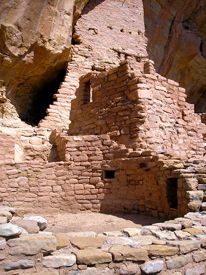
Mesa Verde National Park, Colorado.
©Kathy Alexander/Legends of America, updated July 2025.
Also See:
Ancient Puebloans of the Southwest
Forts & Presidios Across America
Santa Fe Trail – Highway to the Southwest
Sources: