
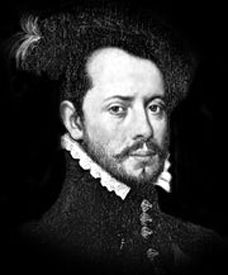
Alonso Álvarez de Pineda.
Spanish explorer and mapmaker Captain Alonso Álvarez de Pineda and his crew were likely the first Europeans to visit Texas, claiming it for Spain. Little is known of Pineda’s early life, but in 1517, he sailed for the Spanish Governor of Jamaica, Francisco de Garay. The Spanish thought there must be a sea lane from the Gulf of Mexico to Asia. In 1517 and 1519, Pineda led several expeditions to map the western coastlines of the Gulf of Mexico, from the Yucatan Peninsula to the Panuco River, just north of Veracruz, Mexico.
On June 2, 1519, Alvarez de Pineda entered a large bay with a sizable Native American settlement on one shore. He sailed upriver for 18 miles and observed as many as 40 villages on the banks of the large, deep river he named “Espíritu Santo.” It has long been assumed that he was the first European to report on the mouth of the Mississippi River. Pineda continued his journey westward, and one of the regions he explored and mapped was the area around Corpus Christi Bay, which he entered on the feast day of Corpus Christi, hence the name.
Shortly after that, he sailed up a river he named Las Palmas, where he spent over 40 days repairing his ships. The Las Palmas was most likely the Rio Grande. The expedition established the remainder of the boundaries of the Gulf of Mexico while disproving the idea of a sea passage to Asia. It also verified that Florida was a peninsula instead of an island, allowing Alvarez de Pineda to be the first European to see the coastal areas of western Florida, Alabama, Mississippi, Louisiana, and Texas, lands he called “Amichel.” His map is the first known document of Texas history and was the first map of the Gulf Coast region of the United States. The following year, he was killed in a fight with Huastec Indians in Panuco, Mexico.
© Kathy Alexander/Legends of America, updated August 2025.
Also See:
Discovery and Exploration of America
See Sources.