
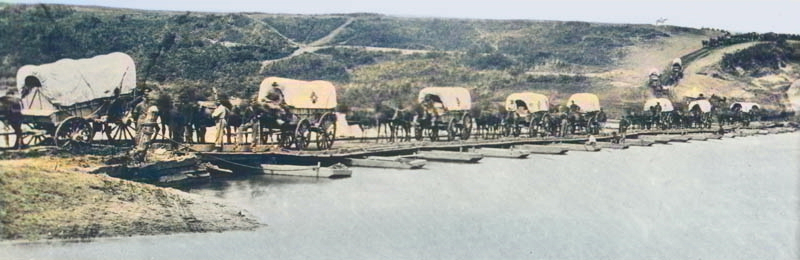
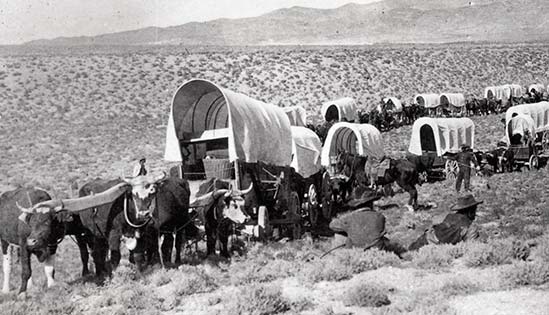
Wagon Train about 1863.
For 25 years, as many as 500,000 people traveled the overland trails to Oregon, California, and Utah. Oregon was estimated to be the destination for about a third of the emigrants, California for another third, and the remainder were bound for Utah, Colorado, and Montana.
1700s
British fur agents arrive along the Columbia River in the Oregon Country to establish trading posts.
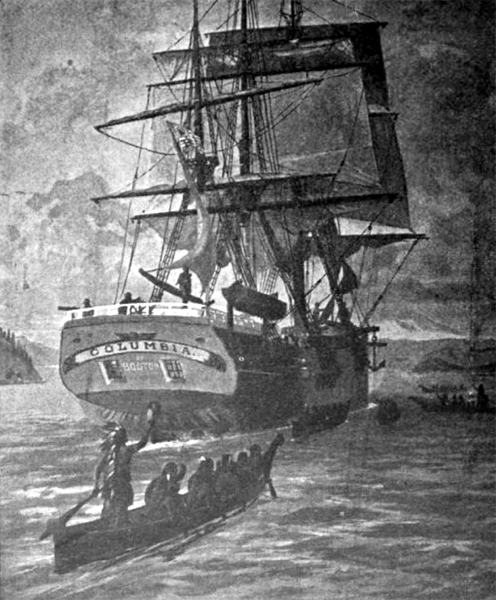
Robert Gray’s ship, the Columbia.
1792
American sea captain Robert Gray explored the mouth of the Columbia River on his ship, the Columbia, and claimed the region for the United States.
1793
Explorer Alexander Mackenzie completed the first overland expedition to the Pacific through the Rocky Mountains.
1803
The United States, under President Thomas Jefferson, purchased the Louisiana Territory.
1805-06
The Lewis and Clark Expedition reaches Oregon.

John Jacob Astor.
1811
John Jacob Astor established an American trading post in Oregon.
1812-1813
John Jacob Astor’s partner in the American Fur Company, dispatches a party led by Robert Stuart overland and eastbound. The group blazes the route later known as the Oregon Trail. Though they find a break in the Rocky Mountains called South Pass, the discovery is forgotten for a decade.
1818
The Treaty of 1818 established the border between the United States and Great Britain’s Canada at the 49th parallel up to the Rocky Mountains. The treaty allows for the joint control of the Oregon Territory
1820
The western fur trade begins.
1823-1824
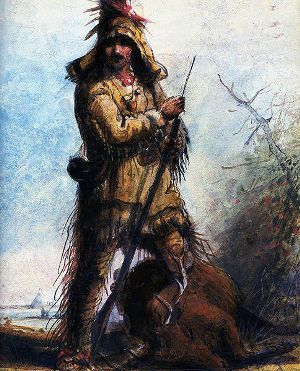
William Henry Ashley.
Fur trade organizer William Ashley of the Rocky Mountain Fur Company and mountain man Jedediah Smith take a party of trappers along the trail from east to West, rediscovering South Pass.
1825-West
In search of new trapping grounds, William Ashley and Jedediah Smith led the first wagon parties along the trail through South Pass, Wyoming, and eventually made their way to California.
1827
Dr. John McLoughlin, director of the Hudson’s Bay Company, builds the first lumber mill in the Pacific Northwest at Fort Vancouver, Washington.
1828
Rejoining his expedition in California, Jedediah Smith leads the way north into Oregon, where only Smith and three others escape an Indian massacre on the Umpqua River. The survivors flee to the Hudson’s Bay Company outpost at Fort Vancouver, Washington.
1829
Easterner Hall Jackson Kelley organized a missionary society to take the Gospel to the Western Indians. Although his plans didn’t come to fruition, he eventually reached Oregon.
1830
Jedediah Smith and William Sublette, partners in the Rocky Mountain Fur Company, lead the first wagon train (10 wagons) across the Rocky Mountains at South Pass and onto the Upper Wind River. The six-week journey proved that even heavily loaded wagons and livestock could travel overland to the Pacific.
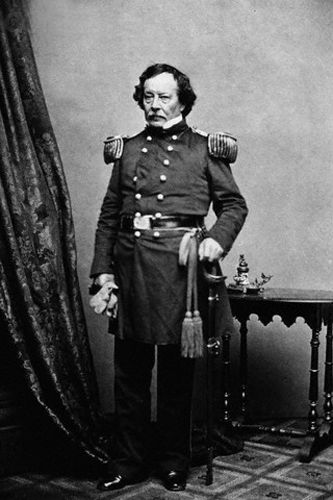
Benjamin Louis Eulalie de Bonneville.
1832
U.S. Army Captain Benjamin Bonneville successfully took wagons along the Oregon Trail as far west as Wyoming’s Green River.
Nathaniel Wyeth successfully leads a wagon party of colonizers to the Willamette River in present-day Oregon.
1834
William Sublette and Robert Campbell established Fort Laramie on the North Platte River in Wyoming, the first permanent trading post in the region and an important stopping point for pioneers traveling the Oregon Trail.
Methodist minister Jason Lee and a party of missionaries take the Oregon Trail to Oregon.
1836
Responding to the 1831 Nez Perce request for teachers, the Whitman party, including Dr. Marcus Whitman and his wife, Narcissa, and the Reverend H. H. Spalding and his wife, Eliza, traveled what would soon be known as the Oregon Trail. They arrived at the junction of the Columbia and Snake Rivers, where they established a mission to bring Christianity to the Indians of the Northwest. Narcissa and Eliza were the first white women to cross the Rocky Mountains.
1839
Thomas Jefferson Farnham organized the emigrant party, the Oregon Dragoons. Many emigrants turned back due to hardships, but Farnham reached Oregon.
1840

Father Pierre Jean De Smet.
Catholic Jesuit priest Father Pierre Jean De Smet takes the Oregon Trail west and establishes a mission in Oregon.
1841
The first emigrant party, the Bidwell-Bartleson party, heads for California with 100 farmers and their families. After crossing South Pass, the group is divided; some go to California, and some go to Oregon.
1842
Dr. Elijah White, the newly appointed Indian Sub-Agent to Oregon, led 112 emigrants to Oregon. Their wagons were cut down to two-wheeled carts at Fort Hall, Idaho, as it was generally believed that wagons could not make the journey over the upcoming rough terrain.
Lieutenant John C. Fremont of the Army Topographical Corps leads a scientific expedition into the Rocky Mountains, guided by mountain man Kit Carson. On his return, Congress ordered Fremont’s account of the expedition and expert maps to be published. His reports encouraged Americans to go West on the trail.
The U.S. Congress passed the Preemption Bill, which permitted any American to occupy or “squat” on a piece of land before being surveyed by the government. The law encouraged Americans to move to the Oregon Country.
The Great Migration.
1843
Some 1,000 people were outfitted in the small town of Elm Grove, Missouri. Called “the great migration,” the train comprised more than 100 wagons, with a herd of 5,000 oxen and cattle trailing behind. After more than 2000 miles, they arrived at Oregon’s Willamette Valley.
Oregon’s Provisional Government was formed in anticipation of the arrival of the emigrants of the great migration from Missouri.
Seasoned mountain men Jim Bridger and Louis Vasquez established Fort Bridger on the Green River to re-supply migrants traveling the Oregon Trail. Theirs was perhaps the first mountain outpost not designed as a trading post for trappers.
Again guided by Kit Carson, John C. Fremont launched a more ambitious expedition into the West. Fremont’s report, published in the West, again by Congressional order, became a best-seller, and his map of the West became a travel guide of the Oregon Trail.
1844
Four major wagon trains bring 2,000 farmers, merchants, mechanics, and lawyers to Oregon.
1845
An estimated 5,000 Oregon-bound emigrants are on the trail this year, most departing from Independence and Westport, Missouri.
1846
A relatively light year, with just 1,000 emigrants heading to California and Oregon. Barlow’s Mount Hood Toll Road and Applegate’s Southern Route extend the Oregon Trail into the Willamette Valley.
Britain and the United States reached a compromise in the Pacific Northwest, setting the Oregon Territory’s northern border at the 49th parallel.
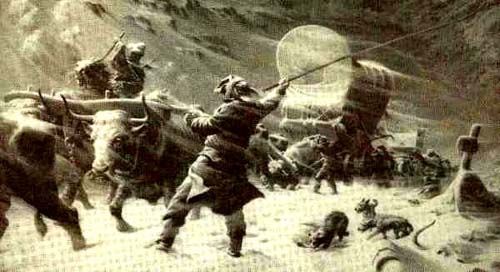
The Donner Party by Andy Thomas.
The Donner Party, trapped by heavy snows when it attempts to follow the Hastings Cutoff through the Sierra Nevada Mountains into California, is driven to cannibalism as it attempts to survive the winter.
Brothers Lindsay, Jesse, and Charles Applegate blazed the Applegate Trail as an alternative route to Oregon.
1847
A new destination opens as Brigham Young leads the Mormon Brigade to Utah.
Cayuse warriors massacre Dr. Marcus Whitman, his wife, Narcissa, and twelve others at Waiilatpu, their mission on the Columbia River, in reprisal for deaths caused by a measles epidemic among their tribe.
1848
The massive Mormon exodus swells the ranks of the emigrants to some 4,000 pioneers.
Cholera strikes Independence, Missouri, when Council Bluffs, Iowa, and St. Joseph, Missouri, become the leading jumping-off points.
The United States recognizes Oregon Territory as an official territory.
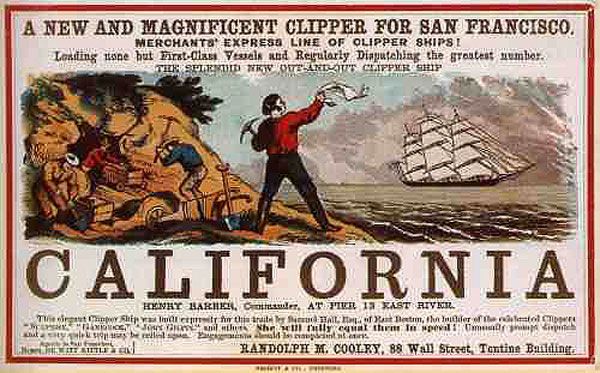
To California during the gold rush.
James Marshall discovers gold on the American River at Coloma, California, while building a lumber mill for John Sutter.
The discovery of gold in California drew more than three-quarters of Oregon’s male population away, but most returned before the 49ers arrived the following year.
In December, President James K. Polk confirmed the discovery of gold in California, sparking a nationwide stampede to the West.
1849
The Oregon Trail is crowdeWestth Forty-niners heading for California’s goldfields. With more than 30,000 people traveling the trail, they expand the network of trails across the continent as wagon trains stretch across the plains and struggle through the mountains.
Forty-niners pioneer the boomtown life that will follow miners throughout the West, a life of desperately hard workWestmbling, drinking, violence, and vigilante justice.
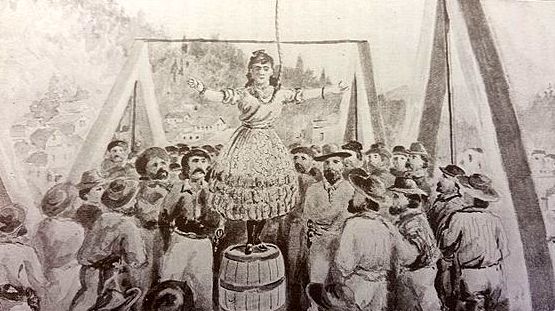
The hanging of Juanita in Downieville, California.
“Pretty Juanita” was convicted of murder after stabbing a man who had tried to rape her. She became the first person hanged in the California mining camps.
By year’s end, more than 80,000 fortune-seekers have made their way to California from every corner of the world, nearly tripling the territory’s population.
A guide was published describing the overland journey to California.
Cholera spreads west along the trail, helped by damp weather.
1850
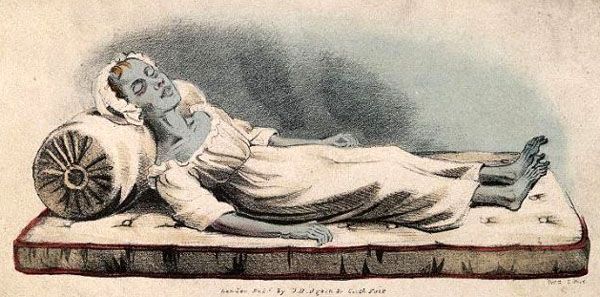
Cholera Victim.
Some 55,000 emigrants make this the year of the highest migration, but cholera runs rampant, killing thousands.
Five Cayuse Indians are hanged in Oregon City for the Whitman Massacre.
California enters the Union.
Many California Indians, finding themselves deprived of their traditional food sources, began to raid mining camps and white settlements.
The California legislature responds to the situation with an Indenture Act, which establishes a form of legal slavery for the native peoples by allowing whites to declare them vagrants and auction off their services for up to four months. The law also permits white settlers to indenture Indian children with the permission of a parent or friend, which leads to the widespread kidnapping of Indian children.
The Donation Land Act was passed by Congress, which offered free land to white settlers and “half-breed Indians.”
1851
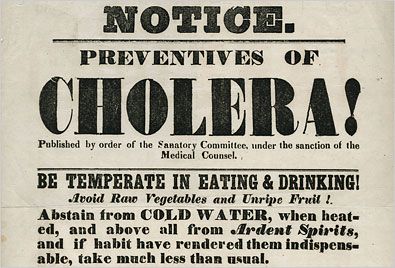
Cholera notice.
As the word spread of the cholera epidemic, travel on the trails is reduced to about 10,000.
The United States and representatives of the Lakota, Cheyenne, Arapaho, Crow, Arikara, Assiniboin, Mandan, Gros Ventre, and other tribes signed the Fort Laramie Treaty of 1851, which was intended to ensure peace on the plains.
John L. Soule, in an editorial in the Terre Haute Express, advises: “Go West, young man, go West.” But New York Tribune editor Horace Greeley gets credit for the line.
1852-1853
The gold rush resumed after the cholera epidemic nearly died out. Some 70,000 people headed west in these years, about 50,000 in 1852 and 20,000 in 1853.
1854
Most of the 10,000 emigrants on the trails are headed for Oregon this year.
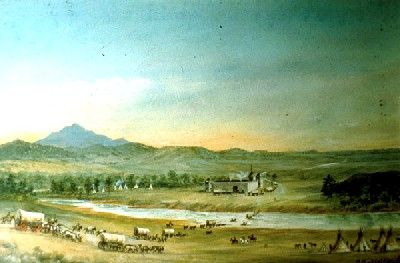
Old Fort Laramie.
Problems arise as an Army command is annihilated near Fort Laramie, Wyoming, precipitating a three-year Indian war.
1855-1857
Indian wars in the West keep emigration down to only 500 each year.
1857-1858
The Utah War, also known as the Utah Expedition and the Mormon War, occurred. It was an armed confrontation in the Utah Territory between members of the Church of Jesus Christ of Latter-day Saints (LDS), also known as Mormons, and the U.S. government’s armed forces.
1858
Gold was discovered in Colorado.
Heavy freight traffic to the military forts ensures safety for some 10,000 emigrants traveling this year.
1859
This year, about 30,000 people travel the trails destined for Colorado, Utah, California, and Oregon.
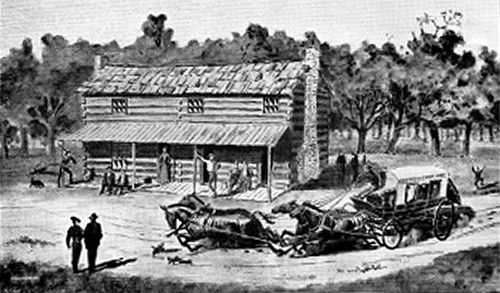
Pike’s Peak Express at Leavenworth, Kansas.
Stagecoaches first appear on the Oregon Trail with the Leavenworth and Pikes Peak Express carrying passengers and mail.
After many years of continued emigration to the Oregon territory, Oregon officially became a State
1860
Fifteen thousand people escape the threat of the Civil War by moving west.
Silver strikes bring thousands to Nevada.
Russell, Majors, and Waddell begin the Pony Express from St. Joseph, Missouri, to Sacramento, California.
1861
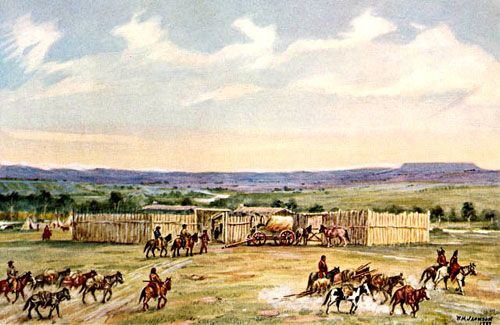
Fort Bridger, Wyoming.
Crews working on completing a coast-to-coast telegraph line meet at Fort Bridger in Utah Territory. The first transcontinental telegram, transmitted from Sacramento to Washington, carried a message from the state’s Chief Justice to President Abraham Lincoln. Completion of a transcontinental telegraph line signals the end of the Pony Express.
Ben Holladay extends his stage company to Oregon.
1861
Removing troops from the western frontier to fight in the Civil War dropped emigration to 5000.
The Pony Express goes bankrupt following the completion of transcontinental telegraph lines.
1862
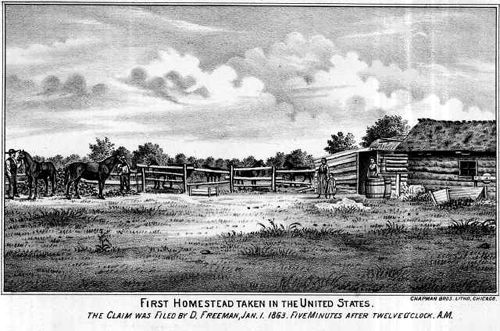
The first homestead sketch
Congress passed the Homestead Act, allowing citizens to settle on up to 160 acres of surveyed but unclaimed public land and receive title after making improvements and residing there for five years.
1863
Word of gold strikes in Montana filter back east, increasing traffic on the Oregon Trail.
1864-1865
Traffic on the trail was the heaviest since the California Gold Rush, as many emigrants were bound for Montana via the Bozeman Trail. Some 20,000 traveled in 1864 and 25,000 in 1865, despite Sioux uprisings at several points.
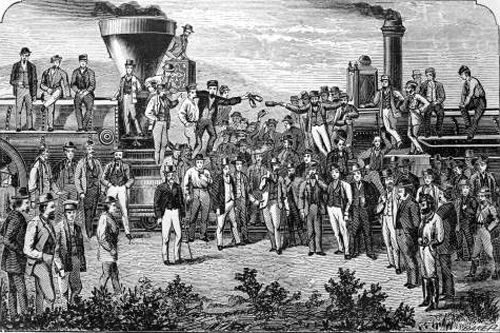
Promontory Point, Utah.
1866
Trail travel remains at about 25,000 per year, but the end of the overland trails era began with the forming of the Union Pacific Railroad Company.
1869
A Golden Spike completes the transcontinental railroad at Promontory Point, Utah.
Following the meeting of the rails, an immigrant could travel from Omaha, Nebraska, to the Pacific Ocean in less than two weeks. However, wagon trains could still be seen on the Oregon Trail through the 1880s. Ezra Meeker drove the last wagon widely known to have braved the Oregon Trail in 1906.
Compiled by Kathy Alexander/Legends of America, updated January 2025.

Albert Bierstadt’s Oregon Trail, 1869.
Also See:
Danger and Hardship on the Oregon Trail
Disease and Death on the Overland Trails
Oregon-Mormon-California-Pony Express Trails Photo Gallery
Oregon Trail – Pathway to the West
Sources:
American Westward Expansion
Historic Oregon City
McNeese, Tim; The Oregon Trail: Pathway to the West, Chelsea House Publishing, 2009.
PBS – The West