
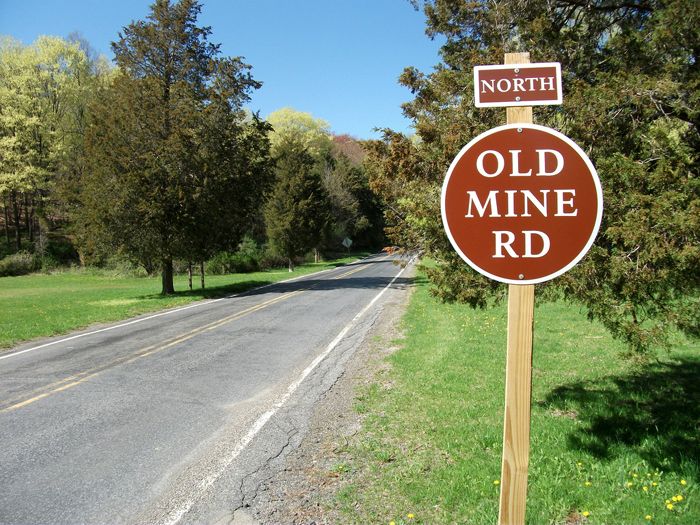
Old Mine Road in New Jersey by Doug Kerr, Flickr
One of the oldest continuously used roads in the United States, the Old Mine Road connected the Hudson River in Kingston, New York, to Philadelphia, Pennsylvania, and the Pahaquarry Mines in New Jersey. According to historical tradition, Dutch miners built the 104-mile pathway in the mid-1600s to transport copper ore.
However, many historians today discount the folklore, saying that the road was built later. During the 17th century, the Dutch population was relatively small, and they lacked the manpower to build a road through the wilderness. Further, there is no archaeological evidence of Dutch camps in the area during this time. Historians believe that mining in the area didn’t begin until about a century later, in the 1750s, when the road would have been built.
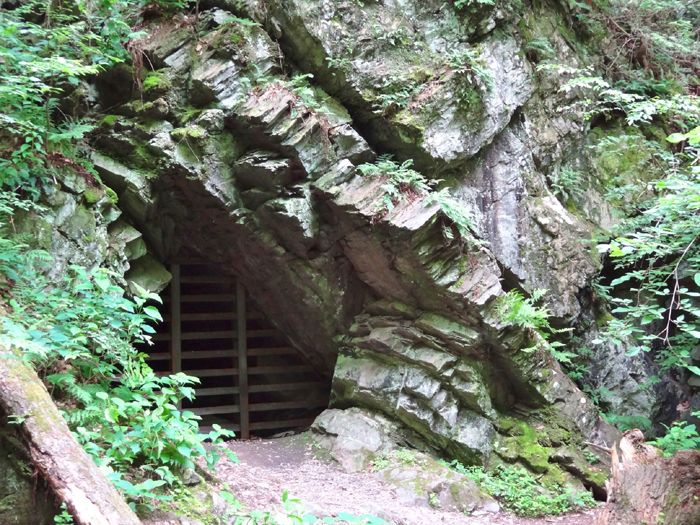
Pahaquarry Copper Mine, Warren County, New Jersey, courtesy Wikipedia
The Pahaquarry mine site was operated for three brief periods, the earliest in the mid-18th century, when John Reading, Jr. and his partners purchased land along Mine Brook in early Walpack Township, near the Delaware River. Reading was a prominent surveyor, land investor, and member of the Provincial Council and served as the New Jersey colony’s acting governor in 1747 and from 1757 to 1758. Unfortunately, the mine was not profitable, and efforts ceased. The next work was undertaken by the Alleghany Mining Company in 1847, but it was discontinued the very next year due to the poor quality of the ore. More attempts were made with the last in the early 20th century.
In any event, the road was built, but probably in the 1750s rather than the 1650s. Dutch settlement began along the course of the road in the Kingston, New York, area in the late 17th century and soon spread throughout the area. The first known settlement in the area was made near Port Jervis, New York, and then in New Jersey. It began after a blacksmith bought land from the Lenape Indians. Later, the English bought land in the area from the Indians.
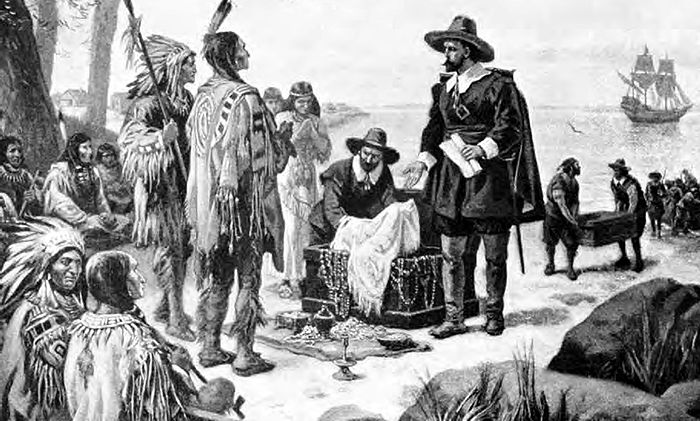
Dutch Settlers.
Once the road was blazed, it likely followed the path of old Indian trails. The region was first inhabited by Paleo Indians as early as 10,500 BC. When Europeans arrived, the region was occupied by the Lenape (Delaware) tribe, who had lived in the area for several thousand years. Both Indian groups would have paved trails to travel to hunting and fishing areas. Once the road was blazed, it led through the Kittatinny Mountain northwest of Blairstown and followed along the eastern side of the Delaware River. The trail never went through the Delaware Gap.
During the French and Indian War in the mid-18th century, eight fortified houses were made along the Delaware River from Phillipsburg, New Jersey, to Port Jervis, New York. About eight miles apart, the first fort was near Belvidere, New Jersey. The next house was Isaac Van Campen’s near Walpack, New Jersey.
Today, the centuries-old roadway, named for the mines at Pahaquarry, stitches sections of several roads into the Delaware Water Gap National Recreation Area’s main passage in New Jersey. It retains much of its flavor from 100 years ago, making it a popular destination for driving and biking.
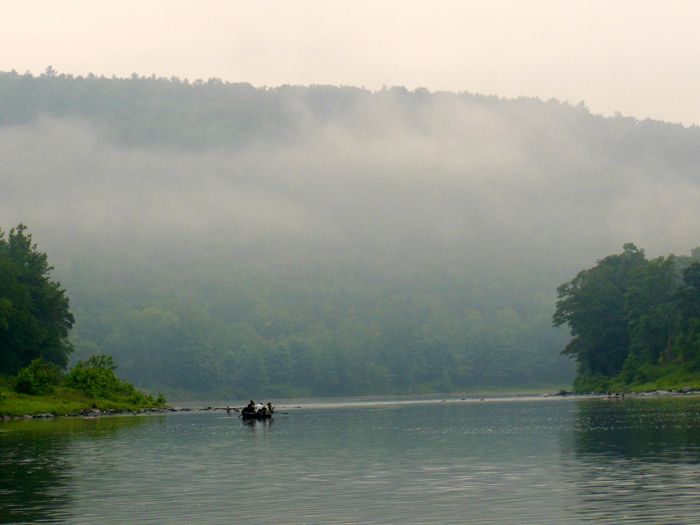
A foggy morning on the Delaware National Scenic and Recreational River by the National Park Service
The road roughly follows the course of the Delaware and Hudson Canal in its northern half and the Delaware River in its southern half, traversing the western edge of Sussex County and northern Warren County in northwestern New Jersey. Much of its length in New York has been modernized, widened, and incorporated into US 209. Before moving into New Jersey, this two-lane paved road travels from Kingston, New York, to Port Jervis, New York.
The Old Mine Road runs 40 miles through the Delaware Water Gap National Recreation Area in New Jersey. Its length is largely undeveloped, and historic sites along the path assert the area’s Dutch colonial heritage by preserving several homes, farms, and churches.
In the 1950s, the entire district was condemned, and most structures were razed to prepare for the construction of a Delaware River dam. However, the Corps of Engineers determined that this stretch was unsuitable for large-scale projects. But, it was too late for many of the razed structures in preparation for the dam.
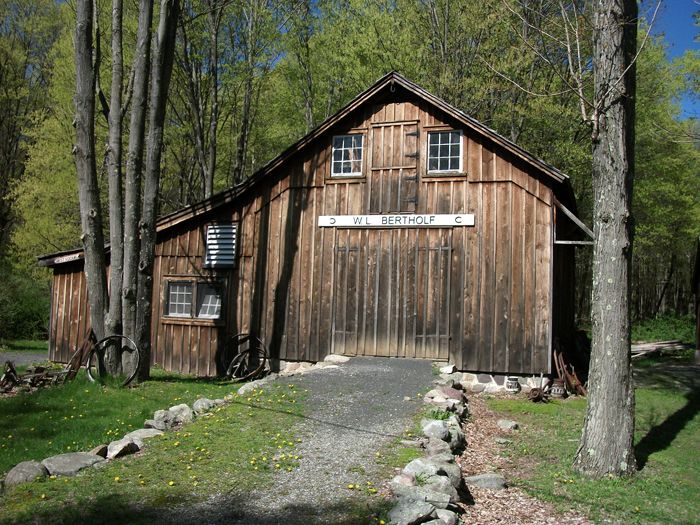
Millbrook Village, New Jersey, by Doug Kerr, Flickr
Though the forest has grown over many farm fields, the remaining villages retain their 19th-century scale, and several historic buildings remain along the historic path. At Fort Carmer, the Van Campen Inn, and the Hamilton Ridge Trail near Millbrook, visitors can still walk on the original unpaved roadbed once trod by Dutch farmers, colonial Americans, and soldiers of the French and Indian and Revolutionary Wars.
Some of these include:

Old Mine Road, Delaware Water Gap National Recreation Area, by the National Park Service
Old Mine Road Historic District – Located in Sussex and Warren Counties of New Jersey, the district is a linear area spanning 26 miles of the Old Mine Road, also known as County Route 521, Delaware Mine Road, Old Mine, and River Road. Located near Wallpack Center, this region, covering 687 acres, was listed on the National Register of Historic Places in 1980. There are 24 buildings and five contributing sites, including Early Republic, Late Victorian, and Early Colonial Dutch architecture. This stretch runs through Montague, Sandyston, Walpack, and Pahaquarry Townships.
Pahaquarry Copper Mine – The Coppermine Trail passes by the foundation of the Pahaquarry Cooper Mine processing mill and mineshafts. The abandoned copper mine is located on the west side of Kittatinny Mountain in Warren County, New Jersey. After the mine was closed, this area became a Boy Scout Camp. It was just one of numerous scout and church camps that once existed within the park boundaries.
Delaware View House – In the early 20th century, many historic area farmsteads were converted into country homes. This Greek Revival farmhouse was constructed around 1837. In 1892, a multi-story addition was built around the house and became known as the Flatbrook Hotel. Samuel Garris purchased this property in 1904, enlarged it, and operated it as a hunting lodge, which later became known as the Delaware View House. Later, he leased it to a family that operated it as a boarding house and later as the Flatbrookville Hotel. In 1926, the building became known as Salamovka, a resort for Russian émigrés. Today, the building serves as a general store for park visitors.
Walpack Center – This authentic country village began when Isaac and Jasper Rundle opened the first general store in 1850. The village followed the same growth pattern and declined as the others. Today, on summer weekends, the Walpack Historical Society operates a museum in the First Rosenkrans House.
Peters Valley (Bevans Village) – Peter Van Ness settled in this area during the late 18th century, and the hamlet bears his name today. In the late 20th century, the village became Peters Valley School of Craft. Self-guided tours of the village are available on summer weekends. Stop in the Craft Store and Gallery for more information.
Millbrook Village – In 1832, a local farmer built a grist mill along the newly-finished Columbia-Walpack Turnpike, crossing a “Van Campens Mill Brook.” By 1875, Millbrook had reached a peak of 75 inhabitants and about 19 significant buildings. However, by 1910, the mill, store, and hotel closed their doors. Today, only a handful of original Millbrook buildings remain. Other buildings have been relocated from other sites or are newly constructed to help depict village life in the valley during the late 19th and early 20th centuries. Several buildings are open on weekends during the summer.
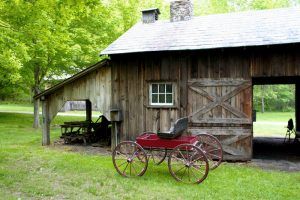
Carriage at Millbrook Village, New Jersey, by the National Park Service.
Bevans-Hellwig Kitchen – In the late 19th century, this small stone building served as the rear kitchen of a large farmhouse. Local tradition holds that the original structure was used as a French and Indian War fortification, Fort Cramer.
Alonzo Depue House – Like other historic homes along Old Mine Road, the landscape would have been quite different 100 years ago, with open fields, a clear river view, and several farm outbuildings.
Namanock – While nothing remains today, this was the site of Fort Namanock during the French and Indian War (1754-1763). Forts in this time and era were little more than sturdy stone houses with wooden defensive fences surrounding them.
Westbrook Bell House – Built by Johannis Westbrook, this is the oldest structure in the recreation area. It was built in about 1701.
Nelden-Roberts Stonehouse – The origins of this small house are obscure, although its construction is attributed to George Nelden, who acquired the property in 1816. The Montague Association for the Restoration of Community History operates a museum in the house on summer weekends.
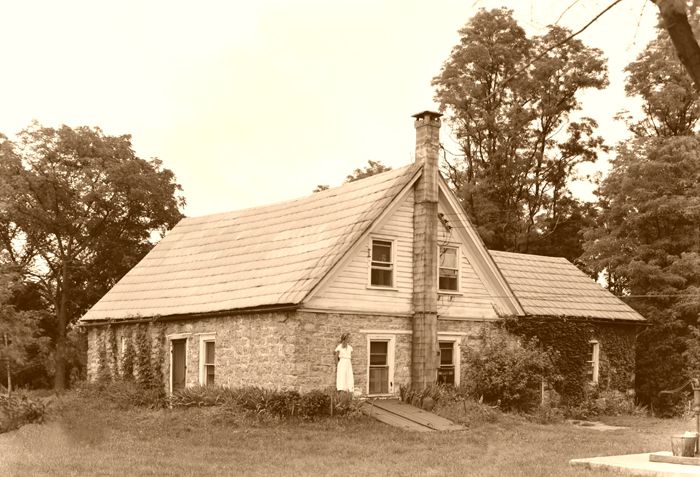
Westbrook-Bell House, Old Mine Road, Hainesville, New Jersey.
Van Campen Inn – This fine colonial home was never intended to be a commercial inn. By law, certain houses along a major roadway were required to house travelers. During the French and Indian War (1754-1763), the thick stone walls sheltered 150 people against the threat of Indian attack. The Walpack Historical Society offers house tours on Sundays during the summer.
Minisink Dutch Reformed Church – Dating back to 1737, this is the oldest congregation in the county. The present structure was built in 1899, and tombstones in the cemetery date to 1805.
Foster-Armstrong House – Foster and Armstrong operated a ferry, and the house was used as a tavern and inn for river travelers. The house reflects the standard of living of a prosperous family in the early 19th century. The Montague Association for the Restoration of Community History opens the house for tours on summer weekends and other events.
Montague Grange – The National Grange, founded in 1867, is an organization that advocates for rural America and the agricultural industry. The local Montague Grange was founded in 1904, and this Hall was built in 1906. The local group remains active and continues to use the building.
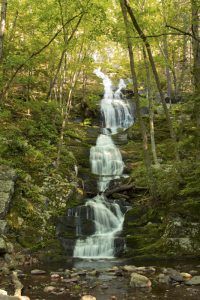
Buttermilk Falls, Delaware Water Gap National Recreation Area, New Jersey, by the National Park Service.
Many interesting sites along Old Mine Road exist before it exits New Jersey at Port Jervis, New York. The Old Mine Road is partially closed in the winter but is magnificent in the spring, summer, and fall. The rural road runs through Worthington State Forest.
©Kathy Alexander/Legends of America, updated July 2025.
Also See:
Byways & Historic Trails – Great Drives in America
Delaware Water Gap National Recreation Area
National Parks, Monuments & Historic Sites
Sources: