

By Lorenzo Dow Stephens in 1916.
At the age of 21, Lorenzo Dow Stephens heard the call of adventure and fortune and, on March 28, 1849, joined an Illinois party bound for California goldfields.
In his words:
The outfits generally consisted of three to four yoke of oxen, good strong wagons well loaded with provisions, bedding, and clothing. We found later that we were too heavily loaded. Let me say here that the hardest pull we had was the leave-taking. We were leaving behind home, all that was near and dear, all the friends among whom our youthful days were spent. In fact, I never realized how hard a pull it was until I came to bid goodbye and started to drive away. I never felt so much like backing out of any undertaking as I did then, but I had too much pride to stand laughter, so the reins were gathered up, and the expedition moved.
That spring happened to be a very wet one, and the roads were almost impassable. The streams were swollen and overflowing their banks, bridges were washed away, and consequently, much time had to be spent repairing and building new ones. On many of the larger streams, we constructed log rafts and rafted the wagons over, and the cattle were made to swim. Through Iowa, we found many prairie sloughs, and they seemed bottomless. Here, we had to cut sod and lay several thicknesses before we could pass over.
Having started early in the season, we had to buy feed for the stock until we reached the Missouri River, as the grass wasn’t high enough to keep the stock in traveling condition.
Iowa, at this time, was very sparsely settled. Farmhouses were 20 miles or more apart, and we found, here and there, villages of cheap, unpainted houses. We found game in plenty, consisting chiefly of deer, wild turkeys, and prairie chickens. When we reached the Missouri River at Council Bluff, Iowa, we traveled down the river to Traders’ Point, a distance of 10-12 miles. Here, we remained for a week, waiting for the grass to get a good start, arranging for a larger expedition. This point was the end of the settlements and, further on, lay the Indian country. We realized a larger body would be safer, but it took longer, and we could make little headway with such a large expedition. So we divided into companies, and in this way, we traveled faster.
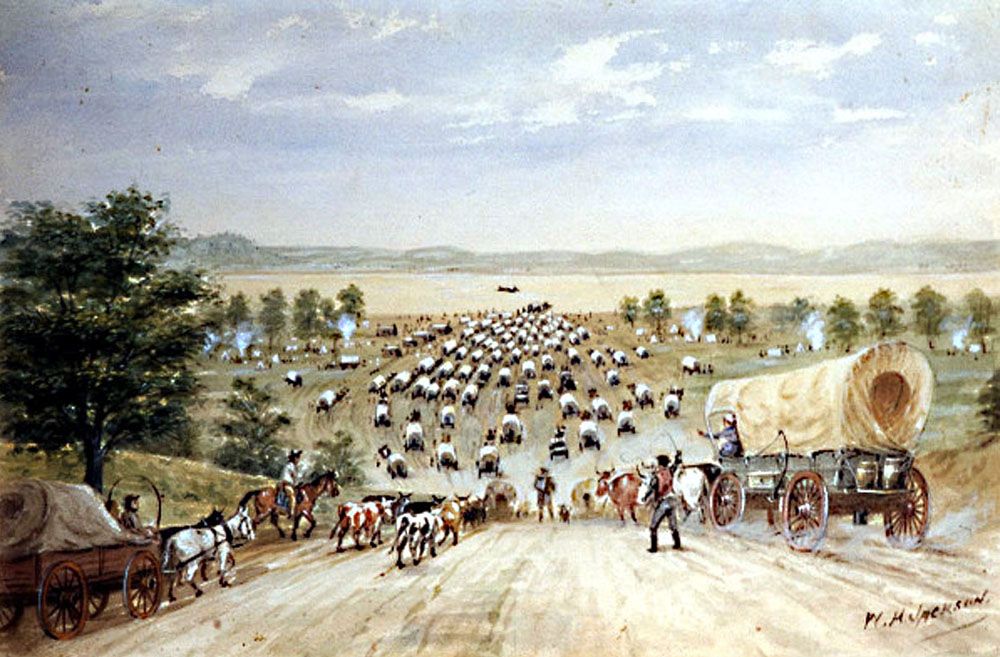
Jumping Off Point by William Henry Jackson.
We had quite an experience crossing the Missouri River. The ferry was a small scow and could carry only one empty wagon. The scow was propelled by two oars, two men at an oar, and the current was very swift. Imagine the time it took to transport 50 wagons and the loads; we had difficulty getting the cattle to swim at first. We didn’t realize that the sun shining on the water made much difference, so the first time, the cattle swam round and round for two hours, and we were compelled to let them land again where they started. But, the next morning before sunrise we started a small boat with a couple of men having a steer in tow, all the rest of the cattle followed without any trouble and made the opposite shore safely.
Our first experience with the Indians came with our first camp across the river. Our campfires were going nicely, and supper started when we heard gunshots, volley after volley. In a few minutes, from over the ridge came 200-300 Pawnee Indians, riding at full run straight for our camp. It was a few minutes of work for us to get our rifles in readiness, but the Indians put up a white flag, and they were allowed to enter the camp. It seemed that a party of the Sioux tribe had given them battle, the two being at war, and the Pawnee had rushed to our camp expecting protection. Still, we ordered them off, telling them we wished no trouble with the Sioux as we had to travel their country and wanted no enemies. We took precautions to organize our bodies in a regular military style with colonels and captains. For a while, we were very vigilant. Our picket guards were stationed 300 yards from camp and had to lie down to see any approaching object, but firing was strictly prohibited unless you thought an enemy approached.
We did not want any false alarms, but, like many others, we grew careless of danger. Many of us went two or three miles from camp, often being away all day hunting and looking over the country. I remember that two of us traveled a long distance on the bank of the river when, without any warning, an Indian appeared before us. At the same time, geese were flying overhead, and the Indian said, “Shoot, shoot.” My companion raised his gun, and I quickly lowered it and said: “We had better not waste our shot, for I don’t like the looks of things.” We had moved but a few steps when arrows rained down all about us, but not an Indian in sight, except the one we had spoken with. After a short distance more, beyond the range of arrows, we turned and saw over a dozen Indians rising out of the grass.
I was carrying an excellent rifle with 27 pieces of silver mounting, and I think this was what they wished. We must have been a little out of range for them to shoot directly at us, but a falling arrow would also answer their purpose. It is needless to relate that all possible haste was made for our train, ten miles away. Of course, the other boys doubted our story, and we were joshed about the scalps we didn’t take.
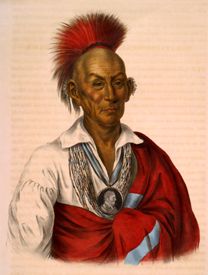
Chief Black Hawk, W. Greenough.
Somewhere in the western part of Iowa, we passed the grave of the Indian Chief Black Hawk of Black Hawk War fame. It was near the bank of a small stream, the name of which I’ve forgotten. We had a little mishap here in rafting the stream. Our raft was going along nicely when, in some way, the wagon went to the bottom of the river, out of sight. The stream was sluggish, and we had no difficulty fishing the wagon out. Fortunately, the load had been transferred to another wagon, but one load was damaged on another occasion when the wagon turned over and crossed a stream. This was quite serious, as three barrels of hard bread were entirely ruined.
About 20 miles from the Missouri River, we came to the winter quarters of the Mormon excursion of 1846 and 1847. There was no one there, but we secured a Mormon Guide Book, which proved of great assistance. They had measured the roads, and distances from camp to camp were recorded. The entire distance from the winter quarters to Salt Lake City was 1,031 miles, and only two houses were in the entire distance. These were at Fort Laramie and Fort Bridger, Wyoming.
At the first fort, there were 20 soldiers, and at the latter, only James Bridger and some Indians. I mention a little incident here. Several of us boys had gone ahead of the train and were enjoying ourselves asking Bridger questions. He was an old mountaineer and could give us good advice. While we were talking, Indians began to pour in from different quarters, excited and saying Indians were coming. Everybody hustled around, and the Indians flocked in. The doors were barred, and rifles were made ready for the scrap when a pack train appeared. It was an emigrant train from Arkansas, and being the first one from that direction, from a distance, it was natural to infer they were Indians.
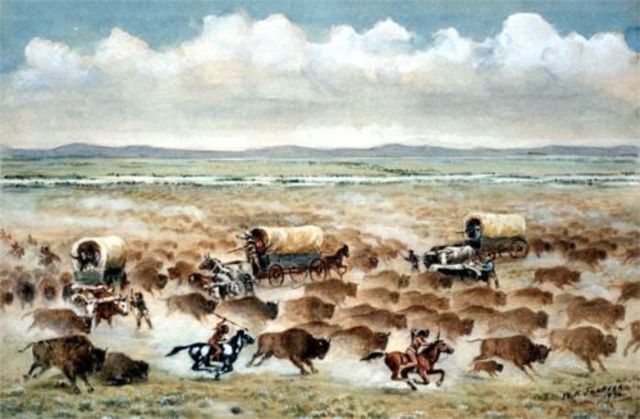
Buffalo along the Oregon Trail.
Things like this and happenings of interest made the time pass rapidly. Soon after passing Wood River, we came into the buffalo country. Here, we saw thousands at one time, all with their massive heads pointing to the north and feeding as they passed along. They didn’t seem wild, and getting in range with them was no trouble when we wished to. Some of the boys shot them down for the sake of the sport. It seemed wrong to me and sinful, but after years, they were slaughtered by the thousands just for their hides. But, a few years elapsed before the buffalo became practically extinct on the plains, and only a small number could be seen here and there in the fastnesses of the mountains.
There were many different classes of wolves on the prairies: the ordinary prairie wolf, the gray, the black, and another, a large, long-legged wolf. The latter was always found near the buffalo herds and constantly terrorized the calves. While the herds were traveling, the cows and calves kept the center with the bulls on the outside, affording protection against the Buffalo Rangers, as these wolves were called. These wolves were ferocious, and a band would attack men if hungry.
On one occasion, some boys were out and away from the train when a hard rainstorm overtook them at nightfall. They sought shelter under a bank seven to eight feet in height, all loaded with the choicest of buffalo meat, the tongues, and the hump. In a short time, they were attacked by a band of wolves. They would have surrounded the boys had it not been for the bank on one side, as it was they attacked from every side and came so close the boys had to poke them away with their guns. There were five boys, and they fought the wolves all night long, as shooting them had no effect at all. When daylight came, the wolves sneaked away. They had left the imprint of their teeth in the gun barrels that could be seen distinctly. The boys were glad enough to get back to camp and good and hungry after their night’s fight.
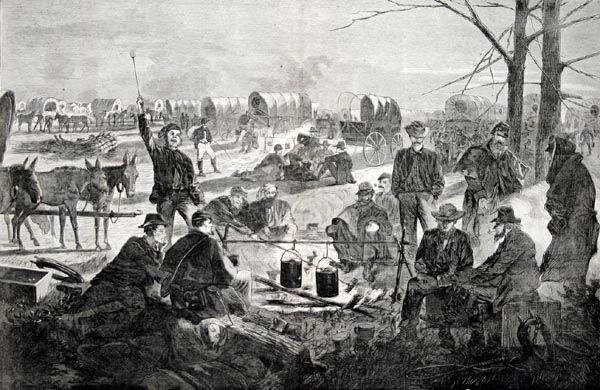
Men in a Wagon Train.
We did not lack for amusements; we had some excellent musicians in our company, and almost every night, we had a dance around the campfire. To avoid confusion, half wore handkerchiefs on their heads, so there was no trouble telling the girls from the boys, for out of the 50 wagons, there was not a single woman in the crowd. During the emigration of 1849, I think the average of women was about one in 500, so our chances of being bachelors were pretty good for several years. I know I roamed about for 20 years before I found my mate, and I have never regretted waiting.
The cholera was terrible that year. We passed trains every day laying by on account of cholera. Many died along the Platte River. After passing Fort Laramie, Wyoming, I had it myself, but we lost only one night and a half a day on my account. The slightest jolt of the wagon created intense suffering, but I had started for California and was bound to come through. I am satisfied that many people died with fever as well as with cholera, for once attacked, death seemed inevitable.
Many amusing incidents happen every day and are hardly worth recording. In the evenings, friendly Indians often came into camp, numbering 30-40. Sometimes, they brought things to trade, and many times, they begged for food. Indians seem to be hungry at all times. One evening, while the Indians were in camp, a man with false teeth went up to them, smiling a most pleasing smile and showing his beautiful white teeth. He would turn around and grin at them again, this time showing his gums. He had only to repeat this several times when the Indians would back away, walk off, and start into a trot in a few moments until they were out of sight. They thought, of course, that the man was an evil spirit, but I have often wondered just what they did think.
Along the Platte River, we found the corpses of Indians, well wrapped in bark and tied to the limbs of trees with bark. This was the custom of the Pawnee, but after we got further on the plains, there were no trees, in fact, no trees for 500 miles. So we had no fuel and had to use the buffalo chips, which, if dry, made a very hot fire. Just before camping time, each of us took a sack, scattered out, and returned to camp with sacks full, with a generous supply for cooking our supper and breakfast. But, if the rain came on, our much-prized chips would not burn at all, and we had to be content with hardtack and raw bacon and no hot coffee for breakfast.
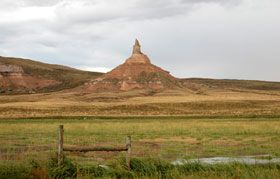
Chimney Rock in Nebraska, Kathy Alexander.
It was well nigh impossible to measure distance by the eye, as objects that appeared close often proved to be days away. A party of ours started for Chimney Rock, and as it seemed a short distance away, we started early in the morning. We walked fast until afternoon, and then it seemed no nearer, so we held a council and decided to retrace our steps, arriving at camp tired and hungry. There were no settlements and no smoke, so the atmosphere was as clear as possible. We sighted Pikes Peak, over 200 miles away, and it seemed we should never pass it.
In the Black Hills, we came into the Crow Indian country, but we never saw one. They were not friendly to the whites, and when an Indian is not friendly, you never see them in their own country. We came to the Shoshone Tribe, or Snake, as they were sometimes called, but they disliked that name. They were friendly to us. At one time, my chum and I slipped away and visited their camp, and they treated us royally. The chief’s wife talked good English, and we were shown all through the camp, there being over 500 in number. They had many pets, both birds and beasts. We were invited to go with them on a buffalo hunt, and I should have enjoyed it, but all my possessions were on the train, so we remained for only the day. But, this was long enough to worry the older men of the party, especially the father of my friend, and all thought the Indians had murdered us.
About four to six weeks later, as I was walking in the streets of Salt Lake City, I heard a horse galloping behind me. Here was the same Indian Chief, who appeared to be tickled to see me as a boy with his first toy. His wife, on her pony, appeared equally glad. She had been educated at some mission and so had acquired English.
We had many thunderstorms all up the Platte River and into the Black Hills; lightning seemed to strike all around us and sometimes very near. On one occasion, we came to a team of four yokes of oxen hitched to a wagon in regular order, and everyone was dead, having been struck by lightning. This must have been a terrible misfortune to the owners.
There were all kinds of disagreements and quarrels over trivial matters, and the only way to settle the difficulty was to divide the property. The wagon would be cut in two, one party taking the front and the other the hind part, dividing the team and provisions, and each party proceeded on the cart of two wheels.
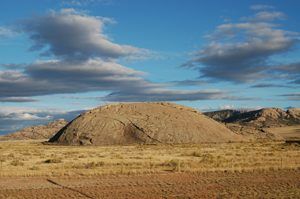
Independence Rock, Wyoming.
We reached the Sweet Water River, a small but swift stream a distance from the Platte River. We forded without trouble and found the noted landmark, Independence Rock, covering an acre of ground and 200 feet high. It was discovered, I believe, on the Fourth of July and so received its name. A little further on, we came to the Devil’s Gate, a narrow cut or gorge through the mountains like a crevice. It was reported that no one had ever passed through its passage. Many had started but had to turn back. So it was a great incentive for us to try. A party of ours started, but there were only two people to complete the trip: one other fellow, who had nearly lost his life, and myself.
We crossed and recrossed several times, and at one crossing, the current swept him downstream and under a shelving rock. He held to the rock with his hands, his body swept under the rock by the current.
I had crossed the stream safely a little further up and so was able to come to his rescue. In some places, we had to climb almost perpendicular walls, almost 100 feet in height, and then walk along a narrow ledge where a mountain goat would hardly venture.
I have heard of foolhardy escapades and have often wondered how we ever managed to survive, but luck must have been with us, for it makes me shudder even now to think of the danger we were constantly in.
Passing up the Sweet Water River for quite a distance, then turning to our right, we traveled up a long, gentle grade for almost 20 miles, where we came to the South Pass of the Rocky Mountains. There, we camped on a large flat, finding many springs. The water from these springs took its course to either side, some to the Atlantic and some to the Pacific Ocean. We had heavy frosts and some ice, and this was in the latter part of July.
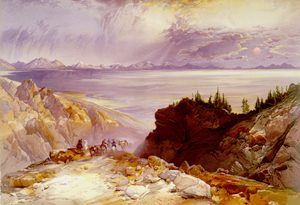
Great Salt Lake by Thomas Moran
Traveling on, we came to the Little and Big Sandy Rivers, where the roads forked, one leading to Fort Hall and the other to Salt Lake City. Here, a discussion arose as to the proper course to take. We argued the advantages and disadvantages, resulting in a natural disagreement. We parted company, each man choosing his company to travel in, so all were entirely satisfied.
Our next stream of any size was Green River, where we ferried again. The Mormons owned the ferry and charged five dollars a wagon; this was a regular gold mine for heavy travel. We had to swim the cattle as before but happily lost none. For many days, we pursued our way; nothing transpired of note beyond the usual occurrences found on the plains. We reached Emigrant Canyon shortly, a canyon that required six weeks of work from the Mormons who had passed through two years before. We crossed the stream 26 times, but it was also a small stream emptying into Salt Lake Valley.
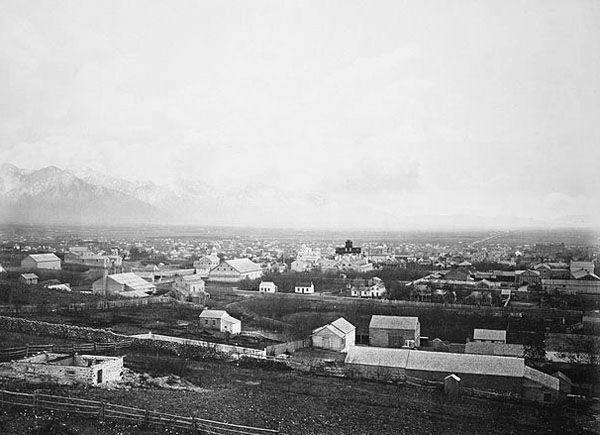
Salt Lake City by Carleton E. Watkins, about 1880.
At this juncture, we were approaching Salt Lake City, Utah, so the three of us decided to forge ahead of the train. When we reached the first bench or tableland, we saw the city itself and, in the greater distance, the Great Lake spread out before us. When we reached the first little farm, our attention was drawn to the garden full of vegetables of all kinds.
How our mouths watered at this welcome sight. We approached the house and asked for accommodations. They made excuses about sleeping quarters, but that didn’t trouble us, as we could sleep anywhere out of doors if one could have a meal. We kept our eyes on the garden and were willing and glad to help prepare the vegetables. No one knows how willing we were to pod the peas. We had green corn, peas, and other vegetables, something we had longed for and starved for four months. Never before or since have I tasted anything so good, and we ate and ate until we could eat no more, and only felt sorry that our capacity was so limited. We were up bright and early, getting peas ready for breakfast. This was a regular bonanza; our bill was only 50¢ each. It was well worth five dollars to us if worth a cent.
The city lay four miles distant, and a quick walk soon brought us in. There, we inquired about a good camping place for the train that had not yet arrived. We soon found a suitable place convenient to water and grass, the two most essential features of a camping place. We camped between the city and the Jordan River, as all emigrants had to camp on that side of the city.
Our train arrived the same day, and the Mormons soon surrounded us, principally women inquiring for tea and if we had any to sell. They seemed to be as starved for tea as we were for vegetables. We wouldn’t sell tea but said we would trade for vegetables. Tea was three dollars a pound, and we could get vegetables a week for a pound of tea. Some of the women said they had not tasted tea for two years. They were also short of groceries and wearing apparel. Many women were entirely barefooted, and many scantily dressed. All the clothes had been practically worn out, as there had been no supplies brought in for two years, consequently many of them were greatly in need of the luxuries of life. They had seeds and plenty of cattle, so they were well provided with the substantials, all having good gardens, beef, milk, and butter.
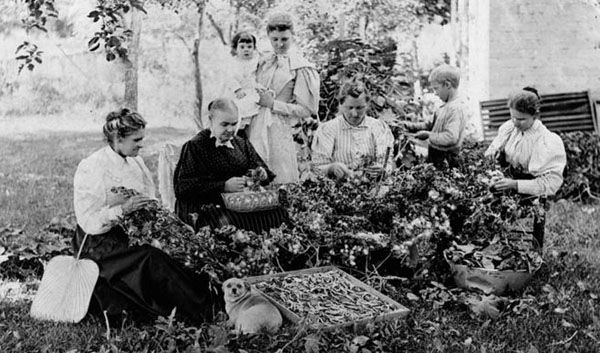
Mormon Women.
They raised wheat and ground their own flour but had no way to bolt it, so they had to live on unbolted flour. The women were doing mens’ work in the fields, pulling up the wheat and thrashing it with flails, they having no harvesting implements, as they were yet very scarce. We saw other women with their three or four yokes of oxen and team going into the canyon, a distance of twelve miles, and bringing downloads of wood. No men were on the load, and perhaps there would be two or three women to handle the team. After seeing the scheme of things I didn’t wonder so much they advocated the plurality of wives, the advantages were so great.
In a few days, I became tired of camp life and decided a change was good for me, so I found a board with a family named Smithson. There was a large family of children, some girls almost grown. The old gentleman was well in his seventies and concluded he wanted another wife. Naturally, his wife was much opposed, and I heard her tell him she would leave if he brought another wife home. The old fellow justified himself by declaring that “more wives meant more stars in his crown of glory.” This was a heavy argument, but his wife couldn’t see the force of the argument. No doubt she felt it better for him to do with fewer stars in his crown than for her to suffer the presence of another woman in the house.
Years afterward, I heard he never had a chance to add stars to his crown; probably, he was too old. I stayed with these people for a week, then boarded with one of the elders of the church, who already had two wives and had his eyes on a third, a young grass widow. She said she wouldn’t be number three to the best man living. I boarded with the elder’s family during the remainder of my stay in Salt Lake.
The officers of the Church consisted of a Prophet, 12 Apostles, and 70 elders, then come the teachers, and so on down to the laymen. They believe in baptizing the dead by baptizing the living for any relative who had passed away and by immersion. One old lady came near being drowned, for she was trying to save 70 that had gone before. One reason I had boarded with the elder was to learn what I could of the Mormon people. The women would talk more than the men, and I learned many things through them. I found none of them were exactly happy and would enjoy getting away, but such a thing was impossible at that time. They were there, and there, they had to remain. In speaking of the officers of the Church, I forgot the Angels. The destroying Angels, whose duty is to put away all undesirable beings. I have often thought these destroying Angels might have had a great deal to do with the Mountain Meadows Massacre.
Salt Lake City is well situated in the valley with gently rising ground to the foothills. The streets were wide and had running water in ditches through them. The buildings were mostly of logs, and in the center of the town was what might be termed a fort. The log cabins were built in a hollow square, enclosing two acres of ground, and at different intervals were gates; this no doubt being for defense in times of Indian troubles. However, the Mormons became friends with most of the Indians in that country, and any Indian you met always said, “Mormonee, Mormonee, heaps good Mormon.”
We hired teams to take us to the Lake, about 20 miles away. The water is so impregnated with salt you could wade out to your armpits and then be raised right off your feet. One can walk through the water without sinking any deeper, and a nap on the surface is not impossible. The water is very clear, so clear you can see the pebbles in the bottom at 20 feet. Along the shore were tons of salt, just win-rows of it two or three feet deep. We spent the day there and, on the return trip, stopped at a good camping place, where we refreshed ourselves with a few hours of sleep and then proceeded on our way to camp, arriving about sunrise the next day.
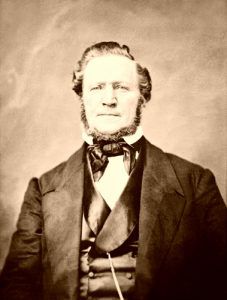
Brigham Young.
On Sundays, we heard Brigham Young preach. They held services in what they called their Tabernacle. It was made by planting posts in the ground, with poles across, and then brush on top, enough to make good shade. Seats were made of rough-sawed lumber and would seat about a thousand. The pulpit was made of the same rough material, and no pains were taken to plane the boards.
During the first twenty minutes of the sermon, Brigham Young lectured them roundly on things to do and not to do, something on this line: “Some of you hang around the emigrant wagons and fool your time away, and by and by, tithing day will come and you won’t have a cent to pay your tithing, and as for the emigrant, so long as they are here, obey our laws and regulations they are welcome to stay, but, when they don’t they can go to hell and be damned. We don’t care for them anyway; look at this pulpit. My new vest is already worn out on these rough boards. Some of you might think I am swearing, but I am not, for when I swear, I swear in the name of the Lord, therefore this is not swearing.” Maybe it wasn’t swearing, but it sounded much like cursing. However, he could say what he pleased to his people, and they came home from church mightily pleased that someone had caught it and never taken any of the lectures for themselves.
A party of us thought we should like to prospect in the Wasatch Mountains, so ten of us left about 10:00 p.m., quietly, as we didn’t want the Mormons to know anything of our intentions. We went up to the little Cotton Wood Canyon, reaching the mouth of the canyon about daylight. We saw two men on horseback about half a mile distant at the entrance, one on each side of the canyon, watching us. We traveled hard all day and camped at night, both good and tired. The majority turned back the following day and found a campfire still burning about a quarter of a mile away, but no one in sight. Whoever followed us thought we had turned back, and they did also. We were out five or six days, following up the creek to its source, and went clear to the summit of the mountain, but we ran out of grub and for three days had nothing to eat but chipmunks, at least what little there was left after shooting them with a rifle. We saw tracks of larger game, possibly elk, but none of us had ever seen any elk, and so did not know their tracks. Since being in California, and familiar with elk tracks I think there must have been elk in that country. Our prospecting didn’t amount to anything, as we knew nothing of prospecting. We might not have been sure of gold had we seen it lying loose in the ground. Since then, the Emmas mine and other rich mines have been worked, and millions have been taken right out of the ground we passed over at the mouth of the canyon. The boys of our crowd met us with a packhorse loaded with food, and you can imagine how the food disappeared after being without it for three or four days. While on the summit of the mountains, we had a snowstorm, and this was in September.
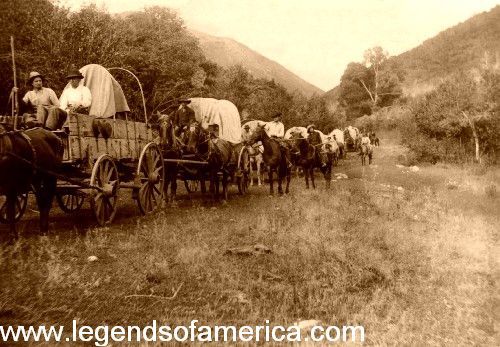
Wagon Train in Utah.
The Mormons were all fond of dancing, and fortunately, I was invited to several of the parties. Brigham Young always led off with the fairest in the assemblage, and it was always considered an honor to be chosen by Brother Brigham, as he was styled. In build, Brigham Young was very much like Theodore Roosevelt. He was a good speaker but no orator, but he shined as a leader. His people would do everything he proposed, and his control seemed to reign over them. I have often been asked how many wives he had, and all I had to judge by was the sleeping apartments. Walking past his residence, I saw about seven or eight wagon bodies with covers on, all in a row, ranged in his backyard, and was told his wives occupied these. Across the square from where I boarded were two more, which I knew well about.
The warm springs were there then, on an open plain, and we all thoroughly enjoyed the bathing. One day, a dozen of us were enjoying our bath when a wagon came up almost 30 paces from us, and the driver asked if we didn’t know this was the lady’s bath day. We told him we were entirely ignorant and would immediately get into our clothes and give them full possession, which we did. Many Mormons had been to California, returned with gold from the mines, and had it coined at Salt Lake into five-dollar gold pieces. On one side was printed the All-Seeing Eye, and on the other side, the Bee Hive. But, most of the currency consisted of shinplasters written on paper, signed by Brigham, and circulated only amongst themselves, for all things bought from emigrants were paid for in gold coin. The gold was soft, with no alloy being used, so it lasted a short time.
We commenced to think of leaving and inquired about the best route out. The Mormons told us of the Donner Party being snowed in the Sierra Nevada Mountains and that it was too late now for us to undertake any route but the Southern route. This sounded plausible to us, but there was a motive behind this that we didn’t comprehend. The Southern route was the Old Spanish Trail, and it was policy for them to have a traveled trail to the coast rather than go back to the Mississippi or Missouri Rivers for supplies.
In the latter part of September, we started the organization of a company, and by the first of October, we had gathered 105 wagons and a Mormon guide who claimed to know the road well, and he proved to be competent. Our contract with the guide, Captain Jefferson Hunt, called for $1,000 to Los Angeles, or $10.00 per wagon. As soon as the wagons were ready, the start was made on the first day of October from Provo, where we congregated, 50 miles from Salt Lake.
We were divided into seven divisions. Each division had a captain and a name coined to suit its fancy. Some of them were “Bug Smashers,” “Buck Skins,” “Wolverine,” “Hawk Eye,” etc. The one to which I belonged was styled the “Jay Hawkers of Forty Nine,” the party that plays a prominent part in this narrative.
Every day, we took turns leading the train as it was styled. The division that led the train one day fell into the rear the next day, for the leader always had the hardest work, for the road had to be broken. The first part of the journey was through the sagebrush, which proved challenging to travel with. We made but a few miles a day with such a large company. The trail was over low rolling hills covered with scrub cedars and somewhat sandy soil. The grass and water became scarcer daily, but we managed fairly well until we passed Little Salt Lake, where three Mormons appeared on horseback. The leader and spokesman said his name was Barney Ward and that he was an old mountaineer and plainsman and knew the country well, and by following his proposed route, we could cut from 400-500 miles off our journey.
He had the road all mapped out and a diagram showing the camping places, about 15 miles between. Naturally, we fell into a discussion, for the road would terminate at the mines instead of Los Angeles. After the meeting, all the advantages of the cut-off were discussed. In the meantime, we had reached what is now known as the Iron Mountain. I think that I, with one of the others, was the discoverer of this mountain of iron. After camping, we strolled up the mountain, and the rocks were noticeable for their weight and position. They lay in masses and had a metallic ring to them. I took one into camp and showed it to a professor we had with us, and he pronounced it iron.
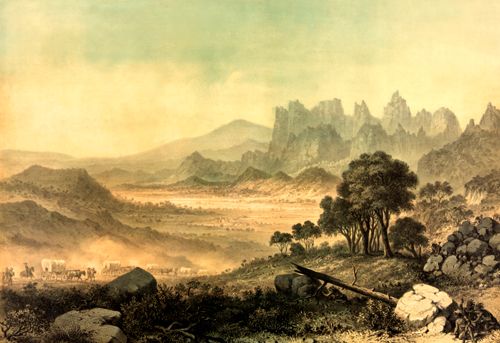
Mountain Meadows Site.
We camped next at Mountain Meadows, a place that afterward became known as the scene of the Mountain Meadow Massacre of 1857. It takes too much space to give in detail all the horrors of this massacre but to sum it up, according to the best information obtainable, 120 lives were taken, and 17 children between the ages of two months and seven years were spared from the butchery.
According to the evidence, the Mormons and the Indians divided the spoils, but the Indians became dissatisfied with the division. After a lapse of 29 years, during which there was trial after trial, with no jury ever agreeing, John D. Lee was convicted. In the hearing, he said, “There must be a victim, and I am selected as the victim. I studied for 30 years to make Brigham Young my pleasure and see what I have come to. I have been sacrificed in a cowardly, dastardly manner.” He was shot to death while seated in a rudely made coffin in the same spot where the massacre occurred.
We reached where the road left the main trail almost a day out from Mountain Meadow. A halt was called; Captain Hunt said those who wished to go with him could do so, and he would guide them to safety. The result was that only seven of the 105 wagons accompanied him. When we started on, Captain Hunt called out to us, “Boys, if you undertake that route, you will go to hell.”
I know now he knew whereof he spoke. He had had considerable desert experience, and we had none. He realized these men who were leading were fakes, sent out by the Church for a purpose, but, to tell us so would mean the loss of his life. Brigham and the church wanted a short route to the Pacific Coast, and here was the opportunity of having that route prospected. Counting the toll in lives was a nominal consideration.
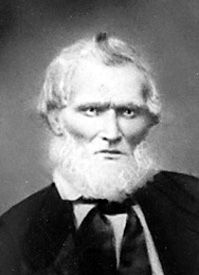
Captain Jefferson Hunt.
But, the train moved on, notwithstanding Captain Hunt telling us where we would land. After two days’ travel, we came to a bluff, seemingly a thousand feet to the bottom, straight up and down. A small stream flowed at the bottom, and by using ropes and buckets, we could get enough for camp use, using it sparingly. The oxen had to go without, and after a couple of days prospecting, a greater part of the train turned back to take up Captain Hunt’s trail. But, the “Jay Hawkers of ’49” said they had started on this trail and would follow it or leave their bones on the way.
After reconnoitering, we found that we could get the whole division except two wagons by taking a circuitous route. Others followed, but the “Jay Hawkers” took the lead, kept it, and followed as direct a western course as possible, turning aside for the low passes in the mountains. There was no solid range of mountains to cross but a series of broken ranges where we crossed the passes at relatively high altitudes. Thus, there was scarce grass week after week, and the oxen became weaker daily. The distances were so great between water places, and when water was found, it seemed impossible to use it, being so blackish.
On one occasion, we had gone five days without water, but through a kind Providence on the third night, snow came. About two or three inches fell, but before the ground was barely covered, we were all out gathering the snow to melt, and before the storm had passed, we had ample supply for ourselves and our oxen. No doubt this saved many of us, for we never reached water for two days more. It became a cause of anxiety, whether we would ever reach the next watering place or not. It became the custom toward the last to send out men to prospect for water, and if water was found, smoke was made, as in this desert country, smoke could be seen a great distance.
From day to day our cattle became weaker and weaker, and our provisions were getting low. So we were put on short allowance. Finally, the teams could pull no further, many had already died, so the wagons were abandoned and pack saddles made on the oxen.
On Christmas day, 1849, we were all busy making pack-saddles and cooking the scanty supply of flour into little biscuits or crackers, as they were perfectly hard. We were divided into twos, from eight men to two men mess, and each one had his share allotted to him. We had a half dozen of the little crackers, about three or four spoonfuls of rice, and about as many dried apples, and this ended the bill of fare, which must last until we reached settlements.
California seemed a long way off. We did not know where we were, but we were much further off than we realized. The proposition now became a single one, for we just had to subsist on the oxen, and they had become so poor there was little or no nourishment in their flesh, as they were dying from starvation.
As soon as an ox fell, he was butchered, and everything was saved, especially the blood. We did not know where we were and realized that the strictest economy must prevail. We even boiled the hide, and it became partially tender. When we left Salt Lake City, we had two teams of four yoke of oxen to each and only eight men, with what we considered ample provisions. Captain Jefferson Hunt had told us of the distance to Los Angeles, and if we had remained with him, we would have had abundance. When we killed an ox, we cut the meat into strips and dried it over a fire at night so it would be ready to pack the next day. We found little patches of greasewood, the only thing that grew in the desert, which was of a very scrubby variety at best. It grew not more than two feet high, of the size of a finger, still, by searching diligently we could secure enough to answer our needs in camp.
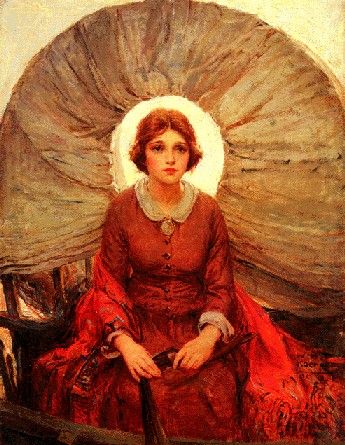
Woman in Wagon Train
Here is where the Reverend J. W. Brier and his family approached us and wanted to travel with us. At first, we objected, as we didn’t want to be encumbered with any women, but we hadn’t the heart to refuse. So they joined the “Jay Hawkers,” and the little woman proved to be as plucky and brave as any woman who had ever crossed the plains before or since. They had three small boys, about six or eight years old. When the smallest got too tired tramping, he was placed on the back of an ox for a change.
Others came to our camp; one was a company of Georgians, and about 15 of them were there. The next day, we saw snow in the mountains in the distance, and we knew if we could reach the pass through the mountains, we would find water, so we started straight for it. But, the Georgians hugged the foot of the mountain in hopes of finding water in the canyon. They found no water but did find a silver mine of almost pure silver. I saw a piece they melted and made a gunsight of. Thousands of dollars have been spent trying to find the gunsight lead. Governor Lore of Nevada fitted out several expeditions to try to find it, but it has never been located. I was offered all kinds of money in California to go back and hunt for it, but I never had the least inclination to accept.
Captain Townshend, who seemed to be the head man of the Georgia company, took the company through on another route. They packed their provisions on their backs and were better supplied than we were, as they still had some flour, of which they gave a portion to the Brier family. They succeeded in getting through Walkers Pass, on to the head of Kern River, then into San Joaquin Valley, and to Chowchilla River, where they were nearly all murdered by the Indians.
I believe there were but two who escaped. Another party of eleven men passed who thought they could make it by packing on their backs enough to last them. They had killed their oxen, dried the meat, and packed what they could, and out of the eleven, there were but two to finish the trip, the others having died in a pile. These two would have died also had it not been that they disagreed on the route to travel and stole away in the night.
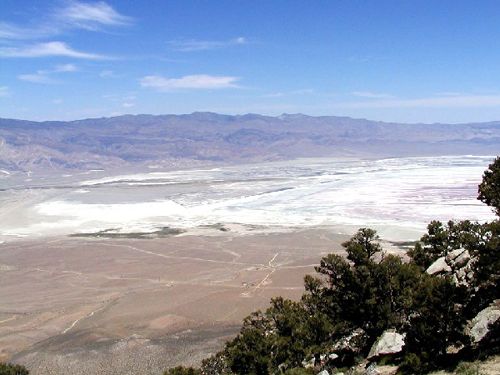
Owens Lake, Inyo County, California.
In 1864, I was traveling down Owens River Valley, below Owens Lake, and at a place now known as Indian Wells, a man came in from the Slate Range of Mountains. In the conversation, he told me that some of his party, in prospecting, had come across the remains of nine men all together behind a little barricade of brush. They had probably built a windbreak and had died right there from thirst. I made him promise to see the remains properly buried upon his return.
Speaking of thirst, there is no punishment that compares. It is the most agonizing suffering possible, and the feeling is indescribable. Our tongues would be swollen, our lips would crack, and a crust would form on our tongue and roof of the mouth that could not be removed. The body seemed to be dried through and through, and there wouldn’t be a drop of moisture in the mouth.
So day by day, we pursued our way, our cattle and ourselves growing weaker and weaker. The outlook was gloomy, and often, when we killed a steer, we looked forward to the marrow found in the bones. But in breaking the bones, often there would be nothing there but a little bloody substance, and I suppose our bones were much in the same condition as we had become as starved as they were.
Another party, the Bennett party, tried a different route from ours. They struck off South from us on the other side of the mountain. I didn’t know the number at the party, but there were two families of Bennetts and the Arcans, and each had a wife but no children. There may have been ten or a dozen altogether. They called a halt and sent two of their number, William Lewis Manly and John Rogers, onto the settlements for supplies and pack animals. They thought the trip there and back wouldn’t take more than two weeks, but they were gone five, and those behind gave up all hope and resigned themselves to their fate. About this time, the boys returned and, when within a few hundred yards of the camp, found one lying dead. They saw no sign of life in the camp and gave the rest up for dead. A few minutes later they heard a feeble cry, “there they are, the boys, I knew they would come back,” the women said, and such rejoicing as there was.
It has become a great task now to save our oxen. We had used all the iron shoes and had to depend upon moccasins for the oxen and ourselves. We made them from the hides, but some of the country was so rough with rock, sharp as flint, that new moccasins had to be put on the oxen every day.
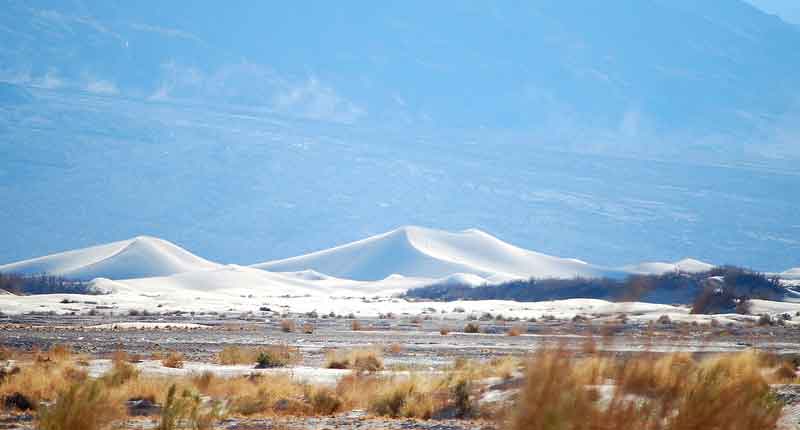
Dunes near Old Stovepipe Wells in Death Valley National Park, California. Photo by Dave Alexander.
We finally reached Death Valley, where we lost two men, Fish and Isham, who were of the Brier party. One of our party went out hunting water, Deacon Richards by name. He found a spring just about dusk. He gave the usual sign, and from that time until midnight, the company came staggering in, but in the morning, we found two missing. We took water and started back and found them dead within a hundred yards of each other. We named the spring Providence Spring, which still retains its name. It was always so when water was found, the strongest came in first, and the weakest was last. Those first in returned to help the others, and so long as they kept their courage, there was hope, but just as soon as they gave up a little, they wouldn’t last long.
I remember one incident relating to this: Captain Asa Haines’s case. He was pretty elderly compared with the rest of us, probably 60. He would remark, “Boys, if I only had the corn that my hogs at home are rooting in the mud, I would consider it the greatest luxury imaginable,” and then would cry like a baby. A few days later he said to us, “Boys, I feel that I can’t go any further and I’ll have to leave you”. I knew then that he would die soon and told my mess-mate, Bill Rude, that Captain Haines would not live until morning. We had each saved two or three of our little biscuits and a few spoonfuls of rice. I told Bill I would give all I had to Asa Haines if he would. So we took the last morsel we had saved, made a kind of stew, and carried it to Haines. He said, “Boys, you have saved my life,” we knew we had. It did us more good, yes ten times over than if we had eaten it ourselves.
We all thought a great deal of the Captain, and I have never felt so satisfied in my life with a deed as I did in knowing that I was the means of helping to save a valuable life. He remained in California briefly and returned to Illinois, where he lived not more than three miles from my father’s house. Father wrote me that Captain Haines often came to the house and told him that his son had saved his life in California. Bill Rude was also his neighbor and thought a great deal of him. He felt we could get to California, and a few spoonfuls of food were nothing compared to a human life.

Providence Mountains in San Bernardino County, California by Carol Highsmith.
From Providence Springs, we crossed the range of mountains, and going down the other side, one of the best oxen went over the cliff and broke his back. We had to stop and make him into jerky. It seemed only a short distance across to the snow mountains that loomed up in sight, but the remainder of that day and the next went by before we came to water, which has since been known as Indian Wells, owing to the water being in holes or wells.
William Lewis Manly and John Rogers saw our light at this camp and thought we were Indians until they heard my voice and knew we were “Jay Hawkers.” They came into camp and were made welcome to all we had. We struck a broad plain trail that we knew must lead to settlements and resolved to follow it no matter where it leads. It took a southerly direction instead of a westerly, but we were bound to stay with the trail. We found out afterward that this trail was made by the Owen River Indians, or Paiutes, who made raids into the large ranches of California and ran off hundreds of heads of horses at a single drive. The Spaniards were afraid to follow, as they would be outnumbered. A year or so afterward, I stayed overnight at Williams Ranch, where there were thousands and thousands of cattle and horses. The owner told me that he had made a treaty with the chief of the Indians, presenting him with a fine horse and silver-mounted saddle, and the Indians always knew his brand after that and never troubled him.
The following day, William Manly and John Rogers took the trail and hurried, anxious to make the trip and return to their company. We traveled two more days, and then the trail ran into an immense desert, and we could scarcely see the mountains beyond. If the trail had not led that way, we would never have considered facing such a dreary outlook. After years, I found this was the Mohave Desert. Going on, we found an immense number of bones throughout the trial. After two days of travel, we came to a spring right in the middle of the desert. There was quite a patch of willows growing around the water and plenty of water for our use, although it ran a few rods and sank into the sand. While here, we killed another ox and prepared the meat for jerky.
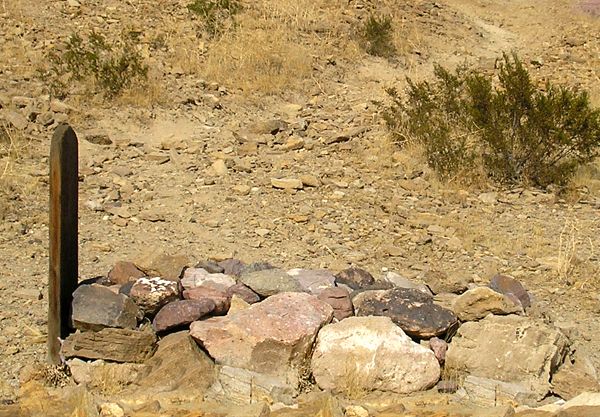
Desert Grave in California
It was a long way to the mountains, for we spent three days and nights making the trip. Our progress was slow, and there was much suffering. Many could travel only a few hundred yards at a time, so the weaker ones were hours behind in getting into camp. When water was found, the smoke was made, putting new life and energy into the weak ones. One man named Robinson had become so weak we had to put him on a poor little mule we had. He said he couldn’t make it in the morning, but we thought he could on the mule. When within 30-40 steps of the campfire, he fell off. We tried to assist him, but he begged to be left alone, saying he would come when rested. About 15 minutes later, as he hadn’t come in, we went to get him and found him dead. The following day, we buried him as best we could, for the ground was hard and rocky, and we only had our knives to dig with and our hands to throw out the dirt. At this same camp, a Frenchman, his name not known, became insane and, after wandering away, was captured by the Indians and kept a slave for 14 years. He was finally rescued by a United States surveying party and brought to the settlements.

Santa Clara River, California.
At this watering place, the trail seemed to be obliterated, and from here, we ascended a long hill or divide and, after crossing, saw a brook with running water, the first we had seen for months. It looked good to us, and we concluded it must empty into the Pacific Ocean, which was correct, for this proved to be the headwaters of the Santa Clara River that empties into the ocean near San Buena Ventura. Here, we found timber and signs of game – the tracks of a grizzly bear where we had crossed the creek. Three of us started after him and followed the tracks till dark. We camped on the tracks, intending to follow him the next morning. I stood watch the first half of the night, and the other two were to take the last half. I called them and then crawled under the blanket, and in a moment, I was asleep, but the boys never got up. In the morning, when I awoke, I could hardly breathe, so I threw back the blanket and found the snow fully four inches deep. This ended the bear hunt, and when we got back to camp, we found that the oxen had stampeded and had run away beyond all recovery. This left us with one ox, and we would not have had him, but someone had happened to be leading him. Besides two horses, this was all we had left out of the 16 we left Salt Lake. It was only our division that lost the cattle. The others were further behind and did not get into the stampede. We didn’t mind much, as we felt we were now in a game country and could live anyway, but, we didn’t find game so plentiful.
The next game we came across was an old mare and two colts, a yearling and a two-year-old. Ed Doty and Bill Rude happened to be ahead and got all three of them. We camped right there, built a fire, and went to eat. I thought I had never eaten anything that tasted as good. They had a little fat on them, which tasted so good. We ate the old mare up that night and made jerky of the colts to pack along. As the Reverend Brier was well supplied with oxen, he kindly permitted us to pack one or two of his oxen.
Two or three days later, some of the boys killed a deer, some of us stayed back to dry the meat, and the rest continued. Among those that stayed was old man Gould, as we called him, and he and I tried to sleep together. We had only one blanket between us, and he wouldn’t pull his boots off. He said if he had to die, he wanted to die with his boots on. He seemed a little off in his mind, and by the way, there were two in our party who never did get entirely in their right minds again. The next day brought us out into the most beautiful valley I ever saw in all my life, Paradise. It was covered with thousands of cattle feeding, and they looked so fat and sleek, I never had anything that impressed me as that sight did, I felt as though I could stand there and gaze on it forever.
After coming off the desert, the contrast was beyond all description. The boys that were ahead of us, when they came to the cattle, shot three or four. It seemed to them that each man could eat a steer. The Spaniards heard the shooting and didn’t know what to make of it but gathered such arms and other implements as they had and came out to where the boys were. They did not know then what they were, as the boys were so emaciated and ragged. Our boys didn’t pay much attention to them, for they were too busy skinning and tearing off the fat parts of the meat and eating it just as it was. They hadn’t taken time to start a fire to cook it.

Mexican Hacienda
It just happened that we had a man with us who had been in the Mexican-American War, and he knew little Spanish. His name was Tom Shannon. When the Spaniards saw the condition of the company, they said, “Buena Mericanas”, and told them to come on down to the ranch and they would kill an animal for them there, but the boys wouldn’t take any chances, and they began to load themselves with beef. The Spaniards told them that was too much hard work. The boys marched down to the ranch about four miles distant and, when they arrived, found a bullock already slaughtered. The boys went at once to eating roasted meat and eating all they could stuff. This came near killing some of them, as it was too rich for their weakened condition. We were lucky to be a day behind and profited from their experience. We ate sparingly at first, a little at a time. I know the first night at the ranch, I got up two or three times in the night and roasted me a piece of beef. I couldn’t sleep without thinking about how good the meat was. It tasted good, but our stomachs craved fat more than anything else; even castor oil tasted fine. This ranch lies on the Santa Clara River, called San Franciscita, and was owned by Del Vule.
We were well treated. They gave us everything they had, such as beef, corn, milk, wheat, and chili peppers, and offered us money, but, of course, we could not accept money, as they had been so kind. Some of the boys had money and offered to pay for what had been furnished to us, but they wouldn’t take a cent. They were the most hospitable people I ever was among where the country was first settled, but that state of affairs changed after a few years.
After being at this ranch for a day or two, we thought we would bathe in that beautiful water stream. Upon removing my clothes, I was frightened. I found I was nothing but a skeleton. My thighs were not larger than my arm, and the knee joints were like knots on a limb, and on my hip bone, the skin was calloused as thick as sole leather and just as hard, caused by lying on the hard ground and rocks. We were all in pitiful condition, hardly fit subjects for a picture show. After recuperating for a few days at the ranch, we made arrangements to get to the mines. Some went one way, and some another, and some came up by water from San Pedro, which was a very wise thing to do.
But, we all did not have the money to do that, and I was one of those numbers, so instead of starting up the Coast via San Buena Ventura, I went to Los Angeles to take a start from there. I was only there three or four days when I found an opportunity to accompany a couple of men buying up pack mules. I could travel with them if I could furnish my saddle and help drive the mules. So I paid four dollars for a saddle tree, or what the Spaniards call a busta. This left me with only a dollar. Everything went well enough until we arrived at Santa Barbara. I had been in the habit of taking the mules out to graze every morning as soon as it was light enough, so at Santa Barbara, I did the same thing, but it happened to be a cold, stormy morning, and rain poured down. I had no coat, just a woolen shirt, and no vest, and the mules were tough to manage. They wanted to travel with the storm despite all I could do. Time went on, and I kept getting colder and colder. Ten o’clock came, and no relief party was in sight as had been the custom up to that time, but I supposed it was too stormy for them to turn out. And the longer I waited and the more I thought of it, the madder I got. I gave the mules a good scare, and they went flying, and I turned and broke for shelter. By this time, we had drifted with the storm about four miles, and I had to face the storm going back. When I entered the dining room, where the pair were smoking their pipes by a good warm fire, the first greeting I got was, “Where are those mules gone to?” Then I let loose on them, and I don’t know what I told them, but it wasn’t very pretty. A large butcher knife was lying on the table nearby, and I kept my eye on that and was careful to stand near it, but they were great cowards and did not try taking revenge at that time. They were brutal, taking advantage of a poor, helpless boy and imposing on him in that manner.
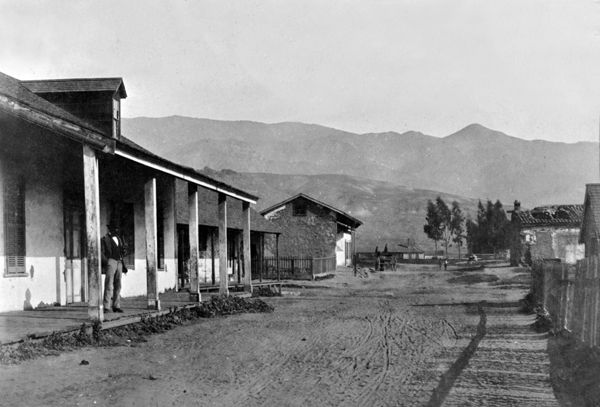
Early Santa Barbara, California.
This left me stranded in Santa Barbara with a single dollar, so to make my dollar go as far as I could, I would buy myself a piece of beef and a few crackers, or hardtack, and go out to where there was a big log burning just on the outskirts of the town. I kept this up for a few days until an old Spanish woman, who had seen me going out to the old log, finally hailed me and asked, “Why don’t you come here and eat?” Of course, I could not understand what she said, but she made me understand by putting her frijoles, tortillas, meat, and coffee before me. I understood what she meant then, and she made it plain that she wanted me to come every day and for every meal. She seemed to have plenty; evidently, she could see by my looks that I needed fattening. I hadn’t gained any flesh yet, and my cheekbones stood out quite prominently. I spent most of my time trying to find some work, but there was no building going on, and as I had no knowledge of Spanish, there were no openings for work. I believe there was but one American there, and he kept a grocery store, but he had nothing for me to do. The prospects looked gloomy, and I was 2,000 miles from home with no money. I had suffered everything but death to get there and was still some 500-600 miles from my destination, the mines. How to reach the mines was a problem.
I knew I could walk but had no money to help me on the way. While in this quandary, some emigrant wagons drove in and camped at the old log where I first cooked my meat. The teams all belonged to a man called Dallas. There were four of them, and they proved to be a part of our original train of 105 wagons. Old Dallas was one of the parties who turned back and took up Captain Hunt’s trail. I had a partial acquaintance with him, to begin with, but I knew him better by his reputation, and that wasn’t the best. If I could arrange to reach the mines with him, I wouldn’t care much if he got the best of the bargain. After talking with him, we agreed that he should board me at the price of twelve dollars a week and give me the privilege of riding in the wagon, as I was still too weak to attempt heavy walking, and I wanted to be in good condition to work when I reached the mines. I was supposed to pay for my passage when I got to work in the mines. Everything was satisfactory, and we started. About two days out, one of the drivers said he had a lame back; Dallas came to me and asked me to take the man’s place, saying he would make it alright with me. For five weeks, I drove the team through wet grass up to my waist in many places. If the sun was out, my clothes would hardly dry before noon. This was an every morning occurrence, and still, the man’s back continued to be lame, for it was much easier riding in the wagon than walking and driving the team.
At one place, a tree had fallen across the road and had been partially cut away, but when I attempted to pass, the tree stuck in the end gate of the wagon. There was but one thing to do, and that was to cut the tree off, and while I was busy doing this, “Old Dallas” came up and started his abuse. He stopped at nothing in his tirade, and I stood it as long as I could, finally starting for him, telling him he had gone too far already. He ran around the wagon, keeping the wagon between us, and by this time, others of the party came up, and quiet was restored. This ended my driving team, for I told him I wouldn’t drive another step for him.
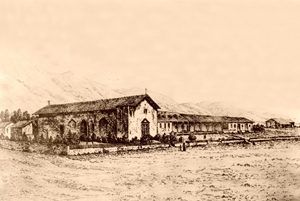
San Jose Mission, California.
We finally reached and passed through San Jose in about March 1850. The Legislature was in session here, and at this time, San Jose was nothing but a Mexican settlement of adobe shanties, dives, and all manner of gambling dens were running full force. Santa Clara Street ran to Third, and after that, you ran into the mustard grass. Three or four blocks from the center of town in any direction, you got into the mustard, which was so thick and high it was well-nigh impassable, except in the trails made by cattle.
Going towards San Jose Mission, we passed two houses. The first was occupied by Mr. Vestal, about a mile from town, and Jim Murphy lived in the second house. Just beyond the crossing of Coyote Creek, some Alvisos lived near the foothills on the east side of the valley. On the road where Milpitas now is, there was nothing but a horse corral, and in Milpitas, I built the first cabin in 1852.
Passing the Mission, we came into the Livermore Valley, where Livermore himself lived, and offered me work at $200 a month and board. He had a building he wanted done, but we passed on. We reached the San Joaquin Plains, and they looked terrific, for at this time, they were covered with wildflowers and were level as far as the eye could see. The plains resembled the Illinois prairies more than I had seen on the trip. There were bands of wild horses, or mustangs as they were called, and herds and herds of elk and antelope – there seemed to be no limit to them.
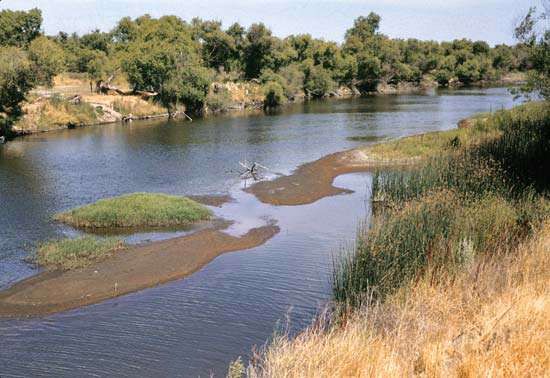
San Joaquin River, California.
I never saw so much game in such a space of country, except the buffalo on the plains. It seemed as if there was wild game enough to feed a nation. Speaking of game, California was the best country I ever saw; one could go anywhere in the state, and find all the game he wished.
We crossed the San Joaquin River at Bounsall’s ferry, where the railroad crosses now. The old man’s heart was nearly broken when he found he had to pay a fee of ten dollars a wagon and a dollar a yoke for the oxen to ferry, but it was either pay or stay on that side of the river. Fifteen miles brought us to Stockton, and on the day we arrived, I had been on the road for just one year, except for six weeks, which I had spent in Salt Lake City. Everything was lively in Stockton. Buildings of all kinds were being rushed, and lumber was selling for three hundred dollars a thousand, at that time all the lumber came around the Horn, and carpenters’ wages were an ounce or sixteen dollars a day. There were many cloth houses, tents of all kinds, and shacks of every description. Some of the better houses cost $150,000 and over. Freighting charges were from six to ten cents a pound to the mines. People were flocking to the mines, some walking with their blankets strapped on their backs; some were in stages, some on mule backs, but all were trying to reach the gold district. Many returned and reported the whole thing as a hoax and a failure.
Compiled and edited by Kathy Alexander/Legends of America, updated March 2025.
About the Article: This article was excerpted from Lorenzo Stephens’s book, Life Sketches of a Jayhawker of ’49, published in 1916. However, it is not verbatim, as it has been edited, truncated, and updated for the modern reader.
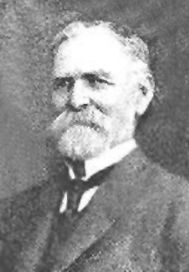
Lorenzo Dow Stephens, Pioneer.
Lorenzo Dow Stephens (1827-1921) – Death Valley pioneer, California ’49er, gold prospector, cattleman, sheepman, adventurer, entrepreneur, railroad investor, businessman, farmer, author, and historian.
Lorenzo was born near Hackettstown, New Jersey, on September 29, 1827, to Richard and Eleanor Addis Stephens, the youngest of five children. Before the Black Hawk War, the family moved from New Jersey to Illinois, where his father built the first frame house in Canton, Illinois. In about 1832, the region became much disturbed by the Black Hawk War, and the family moved to Ohio. After about six years, they returned to Illinois, settling near Galesburg. Lorenzo was reared on a farm and acquired agricultural knowledge, but was also taught the carpenter trade under his father’s instructions.
He was 21 when the news of the gold discovery arrived from California. He was anxious to try his fortune in the mines and joined an Illinois party bound for the Pacific Coast. On March 28, 1849, the expedition started its long and fatal journey. Finding that navigating in such large numbers slowed them down, they divided into small groups. Lorenzo’s men, mainly from the Knox County, Illinois area, called themselves “The Jayhawkers.” He would later write of his adventures in a book called Life Sketches of a Jayhawker of ’49, published in 1916, where he described the trials and tribulations of the overland journey west, including Brigham Young’s sermons at the Tabernacle in Salt Lake City, and the deaths of many along the trail. Because it was October when the group left Salt Lake City, they chose to take a southern route, which placed them in Death Valley. Lorenzo Dow Stephens was the last surviving member of the Jayhawker group and the only person among the first group of pioneers who crossed Death Valley to author a book about those days in the desert. His memoirs continue through the 1860s, describing prospecting on the Merced River, farming in the Santa Clara Valley, cattle drives from San Bernardino and San Diego, and participating in the 1862 British Columbia gold rush.

Santa Clara Valley, California.
Lorenzo married Julia Ludlum in San Francisco, California, on December 25, 1867, and the couple would have two children. Stephens didn’t make his fortune in mining; he was among the first Californians to capitalize on the great need for cattle in the north, buying herds in southern California and driving them to sell to the Sierra Nevada Mountains and San Francisco gold miners. He purchased over 2,000 acres in the San Joaquin Valley for a ranch to base his cattle on and was an early investor in lumbering and railroading ventures in the Santa Cruz Mountains. He also manufactured windmills and farmed in the Santa Clara Valley. He and his family settled in the Santa Clara Valley, where he remained for the rest of his life. However, he never gave up his adventurous nature, traveling to the goldfields in Nevada, Idaho, Oregon, and British Columbia and visiting Hawaii and the great Klondike Gold Rush in Alaska in 1899.
Lorenzo Dow Stephens died on February 10, 1921, and was buried in Oak Hill Memorial Park, San Jose, California.
The San Jose Mercury newspaper did a feature article about his life, which stated in part:
“The last of the Jayhawkers, Lorenzo Dow Stephens, whose figure on the streets of San Jose for many years was familiar, has passed away. For 70 years, he was known and generally beloved in this county. He was the last of the Jayhawkers, the first party of white people to invade Death Valley. It seems incredible that Mr. Stephens left his Illinois home 72 years ago in 1849 to trek across the continent by oxen transportation, the only means of interstate travel. Mr. Stephens was a pioneer of pioneers. He was one of a few men who could speak personally of the influx of seekers for wealth in the gold days of ’49. No more picturesque figure could be found in this county than Lorenzo Dow Stephens, a splendid relic of the old school of Americans.”
Also See:
Crossing the Great Plains in Ox-Wagons