
By Colonel Henry Inman in 1897
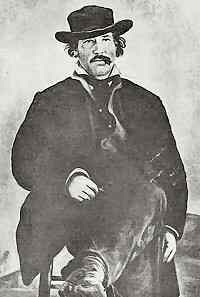
Lucien B. Maxwell.
One of the most interesting and picturesque regions of all New Mexico was the immense tract of nearly two million acres known as Maxwell’s Ranch, through which the Santa Fe Trail ran. Maxwell belonged to a generation and a class almost entirely extinct, and the like of which will, in all probability, never be seen again, for there is no more frontier to develop them.
Several years before the acquisition of the territory by the United States, the immense tract comprised of the geographical limits of the ranch was granted to Carlos Beaubien and Guadalupe Miranda, both citizens of the province of New Mexico and agents of the American Fur Company. Attached to the company as an employer, a trapper, and hunter was Lucien B. Maxwell, an Illinoisan by birth, who married a daughter of Beaubien. After the death of Guadalupe Miranda, Maxwell purchased his interest and that of the heirs of Beaubien, thus becoming the largest landowner in the United States.
At the zenith of his influence and wealth, during the Civil War, when New Mexico was isolated and almost independent of care or thought by the government at Washington, he lived in barbaric splendor akin to that of the nobles of England. The thousands of arable acres in the many fertile valleys of his immense estate were farmed principally by native Mexicans in a primitive, feudal sort of way under the system of peonage then existing in the Territory. He employed about 500 men, and though the men were virtually slaves, Maxwell was not a hard governor, and his people loved him as he was their friend and adviser.
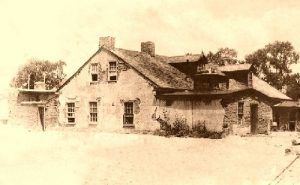
Maxwell House in Cimarron, New Mexico.
His house was a palace compared with the prevailing style of architecture in that country and cost an immense sum of money. It was large and roomy, purely American in its construction. Still, the manner of conducting it was strictly Mexican, varying between the customs of the higher and lower classes of those people.
Some of its apartments were elaborately furnished, others devoid of everything except a table for card-playing and a game’s complement of chairs. The principal room, an extended rectangular affair that might have been termed the Baronial Hall, was almost bare except for a few chairs, tables, and an antiquated bureau. Maxwell received his friends there, transacted business, and sometimes held high carnival.
I have slept on its hardwood floor, rolled up in my blanket, with the mighty men of the Ute nation lying heads and points all around me, as close as they could crowd, after a day’s fatiguing hunt in the mountains. I had sat there in the long winter evenings when the great room was lighted only by the cheerful blaze of the crackling logs roaring up the huge throats of its two fireplaces built diagonally across opposite corners, watching Lucien Maxwell, Kit Carson, and half a dozen chiefs silently interchange ideas in the wonderful sign language, until the glimmer of Aurora announced the advent of another day. But, not a sound had been uttered during the protracted hours save an occasional grunt of satisfaction on the part of the Indians or when we white men exchanged a sentence.
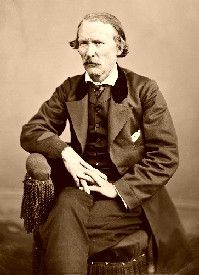
Kit Carson.
Maxwell and Carson would frequently play the game of seven-up for hours at a time, sitting at one of the tables. Kit was usually the victor, the greatest expert in that old, popular pastime I have ever met. Maxwell was an inveterate gambler, but not by any means in a professional sense; he indulged in the hazard of the cards simply for the amusement it afforded him in his rough life of ease, and he could very well afford the losses which the pleasure sometimes entailed. His special penchant, however, was betting on a horse race, and his stud comprised some of the fleetest animals in the Territory. Had he lived in England, he might have ruled the turf, but unscrupulous jockeys put many jobs upon him, by which he was outrageously defrauded of immense sums.
As I have said, he was fond of cards of the purely American game of poker and old sledge, but he was rarely played except with personal friends and never without stakes. He always exacted the last cent he had won, though the next morning, perhaps, he would present or loan his unsuccessful opponent of the night before $500-$1000, if he needed it; an immensely more significant sum, in all probability, than had been gained in the game.
His princely establishment’s kitchen and dining rooms were detached from the main residence. There was one of the latter for the male portion of his retinue and guests of that sex and another for the female, as, following the severe Mexican etiquette, men rarely saw a woman about the premises, though there were many. Only the quick rustle of a skirt or a hurried view of a rebozo, as its wearer flashed for an instant before some window or half-open door, told of their presence.
The more significant portion of his table service was solid silver; there were rarely any vacant chairs at his hospitable board. Covers were laid daily for about 30 people, for he always had many guests, invited or forced upon him in consequence of his proverbial generosity or by the peculiar location of his manor-house, which stood upon a magnificently shaded plateau at the foot of mighty mountains, a short distance from a ford on the Santa Fe Trail. As there were no bridges over the uncertain streams of the great overland route in those days, the ponderous Concord coaches, with their ever-full burden of passengers, were frequently water-bound, and Maxwell’s, the only asylum from the storm and flood; consequently, he entertained many.
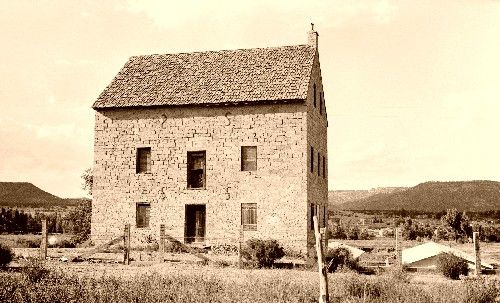
Aztec Mill, Cimarron, New Mexico.
At all times and in all seasons, the group of buildings, houses, stables, mill, store, and surrounding grounds were a constant resort and loafing place for Indians. From the superannuated chiefs, who reveled lazily during the sunny hours in the shady peacefulness of the broad porches; the young men of the tribe, who gazed with covetous eyes upon the sleek-skinned, blooded colts sporting in the spacious corrals; the women, fascinated by the gaudy calicoes, bright ribbons, and glittering strings of beads on the counters or shelves of the large store, to the half-naked, chubby little papooses around the kitchen doors, waiting with expectant mouths for some delicious morsel of refuse to be thrown to them — all assumed, in bearing and manner, a vested right of proprietorship in their agreeable environment.

Early day Cimarron, New Mexico.
Maxwell was ever passively gracious to this motley group, always under his feet, as it were, although they were battening in idleness on his prodigal bounty from year to year.
His retinue of servants, necessarily large, was made up of a heterogeneous mixture of Indians, Mexicans, and half-breeds. The kitchens were presided over by dusky maidens under the tutelage of experienced old crones, and its precincts were sacred to them, but the dining rooms were forbidden to women during the hours of meals, which boys served.
Maxwell was rarely, as far as my observation extended, without much money in his possession. He had no safe; however, his only place of temporary deposit for the accumulated cash was the bottom drawer of the old bureau in the large room to which I have referred, which was the most antiquated concern of common pine imaginable. This old-fashioned piece of furniture had only two other drawers, and neither possessed a lock. The third, or lower, the one that contained the money did, but it was worthless, being one of the cheapest patterns and affording not the slightest security; besides, the drawers above it could be pulled out, exposing the treasure immediately beneath to the cupidity of anyone.
I have frequently seen as much as $30,000—gold, silver, greenbacks, and government checks—at one time in that novel depository. Occasionally, these large sums remained there for several days, yet no extra precaution was taken to prevent their abstraction; doors were always open, and the room was free of access to everyone, as usual.
I once suggested to Maxwell the propriety of purchasing a safe for the better security of his money, but he only smiled while a strange, resolute look flashed from his dark eyes as he said: “God help the man who attempted to rob me, and I knew him!”
The sources of his wealth were his cattle, sheep, and the products of his area of cultivated acres — barley, oats, and corn principally — which he disposed of to the quartermaster and commissary departments of the army in the sizeable military district of New Mexico. His wool clip must have been enormous, too, but I doubt whether he could have told the number of animals that furnished it or the aggregate of his vast herds. He had 1,000 horses, 10,000 cattle, and 40,000 sheep when I knew him well, according to the best estimates of his Mexican relatives.
He also possessed a large and perfectly appointed gristmill, which was a great source of revenue, for wheat was one of the staple crops of his many farms.
Maxwell was fond of traveling all over the Territory, his equipage comprising everything in the shape of a vehicle, through all their varieties, from the most plainly constructed buckboard to the lumbering but comfortable and expensive Concord coach, mounted on thorough braces instead of springs and drawn by four or six horses. He was perfectly reckless in his driving, dashing through streams, over-irrigating ditches, stones, and stumps, regardless of consequences, but, as is usually the fortune of such precipitate horsemen, rarely coming to grief.
In the early days, the headquarters of the Ute agency was established at Maxwell’s Ranch, and the government detailed a cavalry company to camp there. This was more, however, to impress the plains tribes who roamed along the Santa Fe Trail east of the Raton Range than for any effect on the Ute, whom Maxwell could always control and who regarded him as a father.
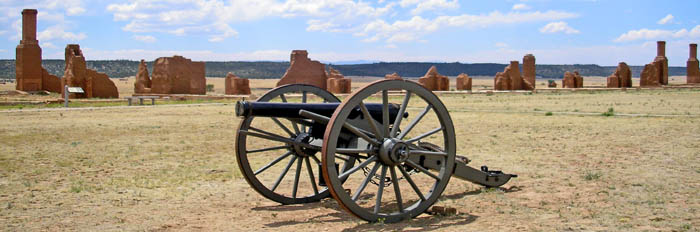
Fort Union, New Mexico, by Kathy Alexander.
On July 4, 1867, Maxwell, who owned an antiquated and rusty six-pound field howitzer, suggested to the troop captain stationed there the propriety of celebrating the day. So the old piece was dragged from its place under a clump of elms, where it had probably been hidden in the grass and weeds since the Mexican-American War and brought near the house. The captain and Maxwell acted the role of gunners, the former at the muzzle, the latter at the breech; the discharge was premature, blowing out the captain’s eye and taking off his arm, while Maxwell escaped with a shattered thumb. As soon as the accident occurred, a sergeant was dispatched to Fort Union on one of the fastest horses on the ranch, the faithful animal falling dead the moment he stopped in front of the surgeon’s quarters, having made the journey of 55 miles in little more than four hours.
The surgeon left the post immediately, arriving at Maxwell’s late that night, but in time to save the officer’s life, after which he dressed Maxwell’s inconsiderable wound. In a few days, however, the thumb grew angry-looking; it would not yield to the doctor’s careful treatment, so he reluctantly decided that amputation was necessary.
After an operation was determined, I prevailed upon Maxwell to come to the fort and remain with me, inviting Kit Carson at the same time that he might assist in catering to the amusement of my suffering guest. Maxwell and Carson arrived at my quarters late in the day after a tedious ride in the big coach, and the surgeon, to allow a prolonged rest on account of Maxwell’s feverish condition, postponed the operation until the following evening.
The next night, as soon as it grew dark — we waited for coolness, as the days were excessively hot — the necessary preliminaries were arranged. When everything was ready, the surgeon commenced. Maxwell declined the anesthetic prepared for him and, sitting in a standard office chair, put out his hand while Carson and I stood on opposite sides, each holding an ordinary kerosene lamp. In a few seconds, the operation was concluded. After the silver-wire ligatures were twisted in their places, I offered Maxwell, who had not as yet permitted a single sigh to escape his lips, half a tumblerful of whiskey. Still, before I had put it to his mouth, he fell over, having fainted dead away. At the same time, great beads of perspiration stood on his forehead, indicative of the pain he had suffered, as the amputation of the thumb, the surgeon told us then, was as bad as that of a leg.
He returned to his ranch when the surgeon pronounced him well, and Carson went to his home in Taos. I saw the latter but once more at Maxwell’s, but he was en route to visit me at Fort Harker, Kansas when he was taken ill at Fort Lyon, Colorado, where he died.
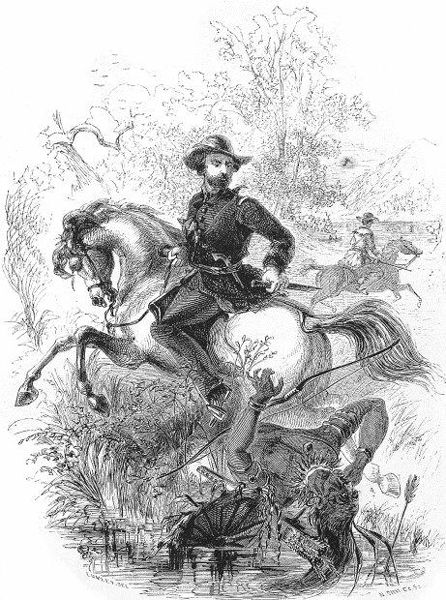
Kit Carson.
How true it now seems to me, as the recollections of my boyish days, when I read of the exploits of Kit Carson, crowd upon my memory! I firmly believed him to be at least ten feet tall, carrying a heavy rifle that required two men to lift it. I imagined he drank out of nothing smaller than a river and picked the carcass of a whole buffalo as quickly as a lady does the wing of a quail. Ten years later, I made the acquaintance of the foremost frontiersman and found him a delicate, reticent, under-sized, wiry man, ideally the opposite of the type my childish brain had created as it is possible to conceive.
At Fort Union, New Mexico, our mail arrived every morning by coach over the Santa Fe Trail, generally pulling up at the sutler’s store, whose proprietor was also the postmaster, about daylight. While Maxwell and Kit were my guests, I sauntered down after breakfast one morning to get my mail and, while waiting for the letters to be distributed, happened to glance at some papers lying on the counter, among which I saw a new periodical — the Day’s Doings, I think it was — that had a full-page illustration of a scene in a forest. In the foreground stood a gigantic figure dressed in the traditional buckskin; on one arm rested an immense rifle; his other arm was around the waist of the conventional female of such sensational journals, while in front, lying prone upon the ground, were half a dozen Indians, evidently slain by the singular hero in defending the impossibly attired female. The legend related how the famous Kit Carson had affected all this. I purchased the paper, returned it to my room, and handed it to several officers who had called upon Maxwell after I showed it to Kit. He wiped his spectacles, studied the picture intently for a few seconds, turned around, and said: “Gentlemen, that may be true, but I ain’t got no recollection of it.”
I passed a delightful two weeks with Maxwell, late in the summer of 1867 when the excitement over the discovery of gold on his ranch had just commenced, and adventurers were beginning to congregate in the hills and gulches from everywhere. The discovery of the precious metal on his estate was the first cause of his financial embarrassment. It was the ruin also of many other prominent men in New Mexico, who expended their entire fortune in the construction of an immense ditch, 40 miles in length — from the Little Canadian or Red River — to supply the placer diggings in the Moreno Valley with water when the melted snow of Old Baldy range had exhausted itself in the late summer. The scheme was a stupendous failure; its ruins could still be seen for years in the deserted valleys, a monument to man’s engineering skill but the wreck of his hopes.
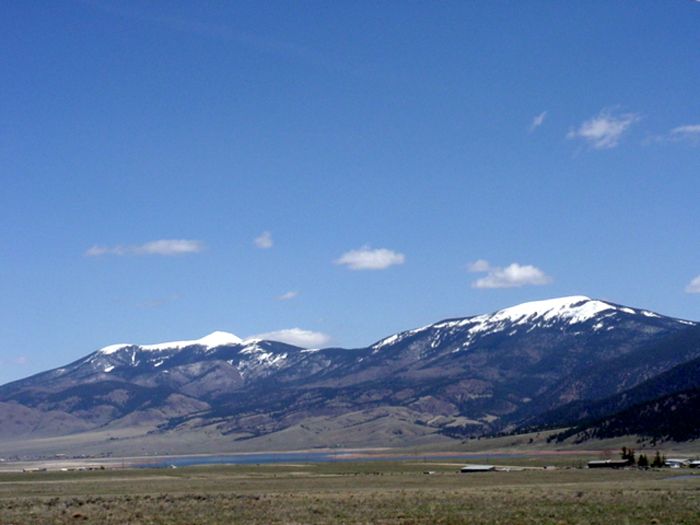
Moreno Valley, New Mexico, by Kathy Alexander.
For some years before the discovery of gold in the mountains and gulches of Maxwell’s Ranch, it was known that copper existed in the region; several shafts had been sunk and tunnels driven in various places, and gold had been found from time to time, but it was kept a secret for many months. Its presence was finally revealed to Maxwell by a party of his miners, who were boring into the heart of Old Baldy for a copper lead that had cropped out and was then lost.
Of course, keeping the world from knowing about the discovery of gold is impossible; such was the case in this instance. Soon commenced squatter immigration, out of which, after the ranch was sold and Maxwell died, grew litigation, which resulted in favor of the company that purchased from or through the first owners after Maxwell’s death.
Under contract with the Interior Department, Maxwell furnished cattle to the Ute nation, the issue of which was made weekly from his vast herds. The cattle, as wild as those from the Texas prairies, were driven by his herders into an immense enclosed field and, there, turned loose to be slaughtered by the Indians.
Maxwell, I would like a horse to witness the novel sight. He immediately ordered a Mexican groom to procure one, but I did not see the peculiar smile on his face as he whispered something to the man I did not catch. The groom returned, leading a magnificent gray, which I mounted. Maxwell suggested I ride down to the large field and wait until the herd arrived. I entered the great corral, patting my horse on the neck now and then to make him familiar with my touch, and attempted to converse with some of the chiefs, who were dressed in their best, painted as if for the war-path, gaily bedecked with feathers and armed with rifles and gaudily appointed bows and arrows; but, I failed very well in drawing them from their normal reticence. The Indian women, a hundred of them, were sitting on the ground, their knives in hand, ready for the labor of cutting the meant.
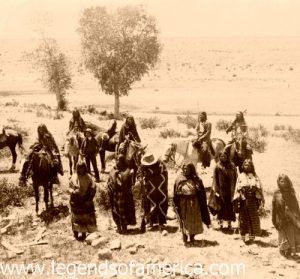
Ute Indians.
Suddenly, a great cloud of dust rose on the trail from the mountains, and on came the maddened animals, shaking the earth with their mighty tread. As soon as the gate was closed behind them and uttering a characteristic yell that was blood-curdling in its ferocity, the Indians charged upon the now doubly frightened herd and commenced to discharge their rifles, regardless of the presence of anyone but themselves. My horse became paralyzed for an instant and stood poised on his hind legs. Then, taking the bit in his teeth, he rushed aimlessly into the midst of the flying herd while the bullets from the guns of the excited Indians rained around my head. I had always boasted of my equestrian accomplishments — I was never thrown but once in my life, and that was years afterward — but, in this instance, it taxed all my powers to keep my seat. In less than 20 minutes, the last beef had fallen, and the warriors, inflated with the pride of their achievement, rode silently out of the field, leaving the women to cut up and carry away the meat to their lodges, more than three miles distant, which they soon accomplished, to the last quivering morsel.
As I rode leisurely back to the house, I saw Maxwell and Kit standing on the broad porch, their sides shaking with laughter at my discomfiture; they had been watching me from the moment the herd entered the corral. It appeared that the horse Maxwell ordered the groom to bring me was a recent importation from St. Louis, Missouri, had never seen an Indian and was as unused to the prairies and mountains as a street-car mule. Kit said that my mount reminded him of one of his antagonists in a duel rode many years ago when he was young. If the animal had not been such “a fourth-of-July” brute, his opponent would in all probability have finished him, as he was a splendid shot, but fortunately escaped, the bullet merely grazing him under the ear, leaving a scar which he then showed me.
One night, Kit Carson, Lucien Maxwell, and I were up in the Raton Mountains above the Santa Fe Trail and, having lingered too long were caught above the clouds against our will, darkness having overtaken us before we were ready to descend into the valley. It was dangerous to undertake the trip over such a precipitous and rocky trail, so we were compelled to make the best of our situation. It was cold, and as we had brought no blankets, we dared not sleep, fearing our fire might go out and we should freeze. We, therefore, determined to make a night of it by telling yarns, smoking our pipes, and walking around at times. After sitting a while, Maxwell pointed toward the Spanish Peaks, whose snow-white tops cast a diffused light in the heavens above them, and remarked that in the deep canyon that separates them, he had had one of the “closest calls” of his life, willingly complying when I asked him to tell us the story.
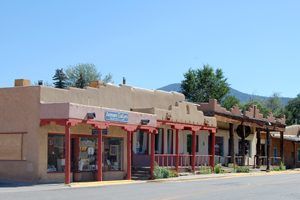
Taos, New Mexico Street by Kathy Alexander.
“It was in 1847. I came down from Taos with a party to go to the Cimarron Crossing of the Santa Fe Trail to pick up a large herd of horses for the United States Quartermaster’s Department. We gathered about a hundred and started back with them, letting them graze slowly as we were in no hurry. When we arrived at the foothills north of Bent’s Fort, Colorado, we came suddenly upon the trail of a large war band of Ute, none of whom we saw, but, from subsequent developments, the Indians must have discovered us days before we reached the mountains. I knew we were not strong enough to cope with the whole Ute nation, and I concluded the best thing for us to do under the ticklish circumstances was to detour and put them off our trail. So we turned abruptly down the Arkansas River, intending to try and get to Taos in that direction, more than 150 miles around. It appeared afterward that the Indians had been following us all the way. When we found this out, some of the men believed they were another party and not the same whose trail we came upon when we turned down the river, but I always insisted they were. When we arrived within a few days’ drive of Taos, we were ambushed in one of the narrow passes of the range and had the bloodiest fight with the Ute on record. There were 13 of us, all told, and two little children whom we were escorted to their friends at Taos, having received them at the Cimarron crossing.
“While we were quietly taking our breakfast one morning and getting ready to pull out for the day’s march, perfectly unsuspicious of the proximity of any, they dashed in upon us, and in less than a minute stampeded all our stock — loose animals as well as those we were riding. While some of the Indians were employed in the running off the animals, 50 of their most noted warriors, splendidly mounted and painted, rushed into the camp, around the fire of which the men and the little children were peacefully sitting and discharging their guns as they rode up, killed one man and wounded another.
“Surprised as we were, it did not turn the heads of the old mountaineers, and I immediately told them to make a break for a clump of timber nearby and that we would fight them as long as one of us could stand up. There, we fought against fearful odds until all were wounded except two. The little children were captured at the beginning of the trouble and carried off immediately. After a while, the Indians got tired of the hard work and, as is frequently the case, went away of their own free will, but they left us in a terrible plight. All were sore, stiff, and weak from their many wounds on foot and without any food or ammunition to procure game with, having exhausted our supply in the unequal battle; besides, we were miles from home, with every prospect of starving to death.
“We could not remain where we were, so as soon as darkness came on, we started to walk to some settlement. We dared not show ourselves by daylight, and all through the long hours when the sun was up, we were obliged to hide in the brush and ravines until night overtook us again and we could start on our painful march.
“We had absolutely nothing to eat, and our wounds began to fester so that we could hardly move at all. We should undoubtedly have perished if, on the third day, a band of friendly Indians of another tribe had not gone to Taos and reported the fight to the commanding officer of the troops there. These Indians had heard of our trouble with the Ute and, knowing how strong they were and our weakness, surmised our condition and so hastened to convey the bad news.
“A company of dragoons was immediately sent to our rescue under the guidance of Dick Wooton, who was and has ever been a warm personal friend of mine. They came upon us about 40 miles from Taos, and never were we more surprised; we had become so starved and emaciated that we had abandoned all hope of escaping what seemed to be our inevitable fate.
“When the troops found us, we had only a few rags, our clothes having been completely stripped from our bodies while struggling through the heavy underbrush on our trail, and we were so far exhausted that we could not stand on our feet. One more day, and we would have been laid out.
“The little children were, fortunately, saved from the horror of that terrible march after the fight, as the Indians carried them to their winter camp, where, if not happy, they were under shelter and fed, escaping the starvation which would certainly have been their fate if they had remained with us. They were eventually ransomed for a cash payment by the government and had not been treated harshly.”

Santa Fe Trail Wagon Sculture in Santa Fe, New Mexico, courtesy of the National Park Service
By Colonel Henry Inman, 1897. Compiled and Edited by Kathy Alexander/Legends of America, updated March 2025.
About the Author: Excerpted from the book The Old Santa Fe Trail by Colonel Henry Inman, 1897. Note: The text is not verbatim, as minor edits have been made throughout the tale. Henry Inman was well known as an officer in the U.S. Army and an author dealing with subjects of the Western plains. During the Civil War, Inman was a Lieutenant Colonel, and afterward, he won the distinction of magazine writer. He wrote several books, including his Old Santa Fe Trail, Great Salt Lake Trail, The Ranch on the Ox-hide, and other similar books dealing with the subjects he knew so well. Colonel Inman left several unfinished manuscripts at his death in Topeka, Kansas, on November 13, 1899.
Also See:
Lucien Maxwell by a Santa Fe Trail Driver
The Largest Land Grant in U.S. History – Maxwell Land Grant
Cimarron – Wild & Baudy Boomtown
Kit Carson – Legend of the Southwest
My Friend, Kit Carson, by a Santa Fe Trail Driver