
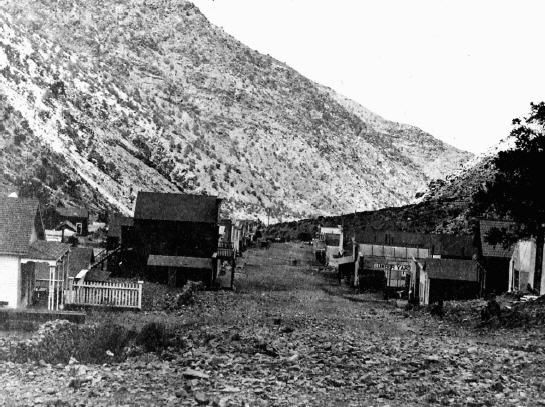
Panamint City, California, 1875
By William Daugherty, 1891
The government explorations in Death Valley and the Panamint Range of mountains bordering it on the west recall the exploits of one of the boldest adventurers among the early mining operators of the Great Basin, as this arid region was called when we were boys and studied geography back in the “States.”
The Panamint mines are situated on the Western slope of the range, some on the lateral spurs running from the main summit, at an elevation of about 9,000 feet above sea level. The summits are 10,000 to 11,000 feet in height, and the descent on the eastern slope is very abrupt into Death Valley, which is about opposite Panamint, 240 feet below sea level, and gives the mountains an appearance of bold and rugged grandeur.
The Panamint mines were discovered in 1872 but not brought to any notice until the summer of 1873. Some of the early prospectors bore very unsavory reputations and did not dare make much effort to attract outside capital, except through some trusted middlemen. The reasons for this were evident in the conclusion of one of the first sales when the owners went to San Francisco to get their money. Wells, Fargo & Co’s agents watched one of them for an old stage robbery. When the money was ready, they demanded from him the restoration of $12,000 to cover losses sustained by his depredations, or an arrest would be the immediate result. He coolly assented, asked for a receipt, and paid the money.
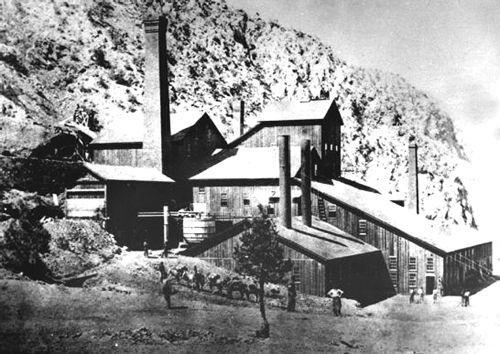
Panamint Stamp Mill.
The success of selling the mines was almost wholly due to the efforts of E.P. Rains, a man who possessed the daring and dash of a Jim Fisk and who would have rivaled his achievements in finance had he been favored with any educational attainments but in this, he was deficient. His knowledge of it bred in him a reckless waste only equaled by his natural prodigality and generous impulse. He coveted money only for the pleasure of spending it and squandered it recklessly, which was born of the spirit of ’49 and his early associations in California.
The history of his efforts to “place” the Panamint mines on the market would fill a volume. Still, the main facts are briefly told as follows: This writer chanced to journey with him on his first trip, when, to reach Panamint, the trip was made from Bakersfield, California by stage, through Havilah and Walkers Pass, on the way to Cerro Gordo. Rains left the stage at Little Owens Lake, procured a horse, and crossed the Coso and Argus Ranges eighty miles to the outdoor camp at Panamint. He soon obtained a bond of the principal mines and returned to San Francisco. His first efforts were unsuccessful, and he had to return for more samples to verify his highly colored statements. He returned and obtained about 1,000 pounds of handsome specimens of copper-stained ore, rich in silver and beautiful in appearance. He could not get this carried out from Little Lake on the stage and had to send it by a slow team through the Mojave Desert to Los Angeles, nearly 300 miles distant. He wouldn’t risk it out of sight and went with it. Arriving in Los Angeles, his plans assumed shape. Creating a boom for the new mines to enlist capital was necessary. There, he again met this writer and, through him, sought introductions. Rains stopped at the Arlington Hotel, then the leading one of Los Angeles, and in the barroom made a display of Panamint ore that set the town agog and, aided by his lavish expenditure of money at the bar, soon created a furor. He made no effort to swell any interests there but gained the confidence of leading citizens and got the Board of Trade to subscribe $4,000 toward building a wagon road to the new mines.

Desert Prospector.
The newspapers were full of Panamint, and he blossomed into print as Colonel Rains. The news reached San Francisco, and a week later, Rains arrived and displayed his samples, and he was the sensation of California Street. His money was all expended, however, and going to Senator Jones, who was just on the eve of starting for Washington, Rains pressed him for a loan and got the Senator’s check for $1,000 to aid in placing the property. Rains started at once to “paint the town red” and succeeded, in one night, in squandering the $1,000 and woke up in the morning in jail.
He soon found a friend to furnish bail, borrowed enough to buy a ticket, and followed Senator Jones to Washington.
Then, he presented his scheme so plausibly that the Senator let him have money in liberal sums to promote the scheme until Rains had borrowed from him $15,000. Then, to organize the company, Senators Jones and Stewart took an interest, and from that slight commencement, they were dragged into the scheme and sunk in less than two years, the magnificent sum of $2,000,000 with their associates. Rains made many thousands out of his operations but squandered it as fast as it came. He finally died in New York penniless and was buried by the California colony there with all the honors due to a pioneer of ’49. Senator Jones was present and spoke of him kindly as having been “a reputable citizen of the Pacific Coast.”
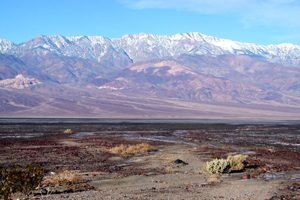
Panamint Mountains, California.
By William Daugherty, Reno Evening Gazette, April 15, 1891. Compiled and edited by Kathy Alexander/Legends of America, updated May 2024.
Also See:
Mining on the American Frontier
Panamint City, California – A Hard-Broiled Hellhole
Pioneers on the Nevada Frontier (Reno Evening Gazette)
About the Author: Written by William Daugherty for the Reno Evening Gazette in 1891. The Reno Evening Gazette was first published on October 12, 1876, and continued for 107 years. In 1977, it was merged with the Nevada State Journal and continues to exist today as the Reno Gazette-Journal. Note: The article is not verbatim, as spelling errors, minor grammatical changes, and editing have occurred for the ease of the modern reader.