
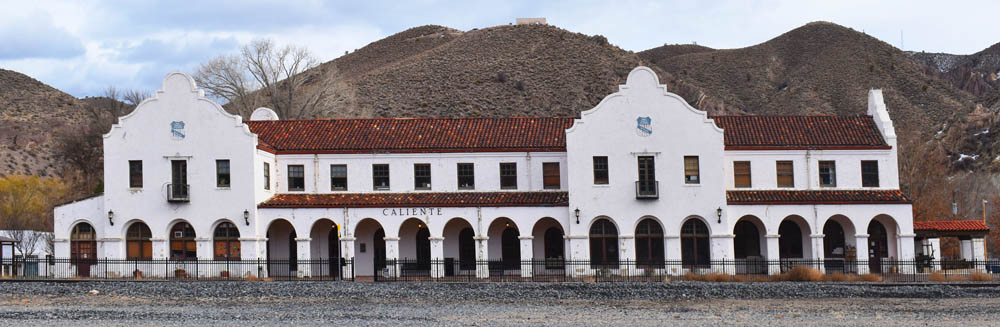
Old Union Pacific Depot in Caliente, Nevada, by Kathy Alexander.
Caliente, Nevada, a historic railroad town, is located in east-central Lincoln County at U.S. Route 93 and Nevada Highway 317. The quiet mountain town, shaded by beautiful cottonwood trees, is the only incorporated community in Lincoln County.
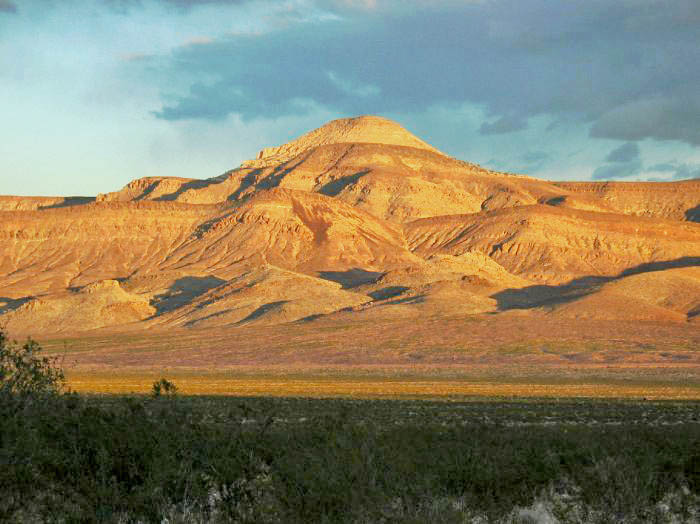
Meadow Valley range, Nevada, courtesy Bureau of Land Management.
Located in a meadow tucked among rugged canyons and sweeping mountain ranges, the earliest settlers were ranchers and farmers who took advantage of Clover Creek and the area’s natural hot springs.
The first pioneers to arrive in the area in the early 1860s were Ike and Dow Barton; two escaped African American slaves from Arkansas.
Another early resident was Mr. Klingensmith, a Bishop in the Mormon Church, who started a ranch in Dutch Flats north of present-day Caliente. Several other ranches, including the Jackman Ranch, were settled in the next years.
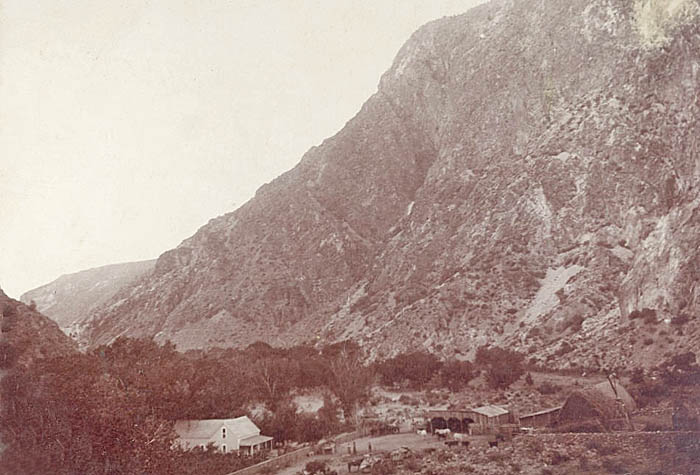
A ranch in Caliente, Nevada, in 1900 — probably the Culverwell Ranch.
In 1874, ranching brothers Charles and William Culverwell purchased the Jackman Ranch and renamed it Culverwell Ranch. The area then became known as “Culverwell.” Along with ranching, people in the area developed orchards, dairies, vineyards, and lush farmland. They found a perfect market for their products among the miners of the nearby boomtowns of Pioche and Delamar.
The Culverwells built some of the earliest stone shelters in the area. It is thought the brothers built several of these stone shelters when they first arrived. Built into a hillside, the stone buildings, measuring 12 feet to 15 feet square, still stand today along Clover Street’s west end.
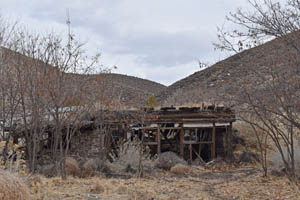
Old stone building built by the Culverwells in Caliente, Nevada by Kathy Alexander.
In 1889, there was a need for a north-south railroad line between Los Angeles, California, and Salt Lake City, Utah. There were soon two railroad lines competing for the opportunity, including the Union Pacific Railroad and Oregon Short Line. These two lines recognized the advantages of working together. However, mining magnate Senator William Clark began his own line, the San Pedro, Los Angeles, & Salt Lake Railroad, and was determined to build his railway first.
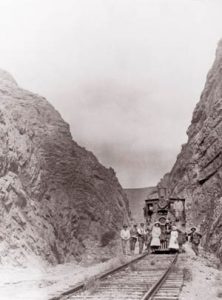
Steam engine in the narrow railroad gorge near Caliente, Nevada.
Only one railway would have sufficient room to navigate the canyon surrounding the Meadow Wash Valley. Within no time, railroad executive E.H. Harriman, directing the Union Pacific Railroad’s work, and William Clark waged a brief political railroad war that also included some underhanded activities. It is said that while one line laid track by day, the other would pull up the tracks each night.
Finally, William Culverwell, who owned the land with his brother, had had enough of the fighting. Using a two-barrel shotgun, he convinced Clark and Harriman to come to an agreement. Afterward, the Union Pacific Railroad assumed control of the project.
In 1901, an official town was founded on land owned by the Culverwell brothers. It was first named “Calientes,” meaning “hot,” for the hot springs in the area. When a post office was established on August 3, 1901, the “s” was dropped from the name, and the community was called “Caliente.” That year, the first train arrived in the new town.
Charles Culverwell owned the hot springs, and by 1901, he had opened the Culverwell Hotel, which featured hot mineral baths. The business also featured a blacksmith shop and a livery stable. Soon, everyone began calling him the “City Mayor.” Though the hotel no longer stands, hot mineral baths can normally be enjoyed at the Caliente Hot Springs Motel and Spa Hotel. However, when we visited in 2021, it was closed to the public and was leased long-term.
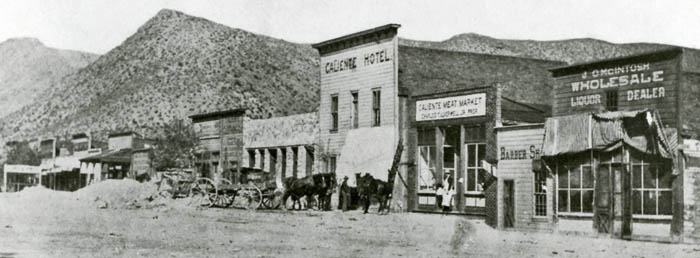
The business district is in Caliente, Nevada, in the early 1900s.
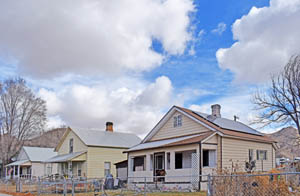
Railroad Row in Caliente, Nevada, today by Kathy Alexander.
In the summer of 1904, the railroad appropriated some $200,000 to build several permanent structures. These included 12 homes that were the beginnings of Company Row, a large roundhouse, a 200-ton coal chute, a station building, a water tank, an oil house, and an artificial ice house. Later, Company Row was doubled in size to include 24 homes. Many of the railroad workers’ cottages still sand today on Spring Street. At that time, United Pacific’s Caliente operations were the best-equipped steam facility between Salt Lake City and Los Angeles.
The Union Pacific Railroad north-south line was completed in 1905, and a two-story wooden structure served as a train depot.
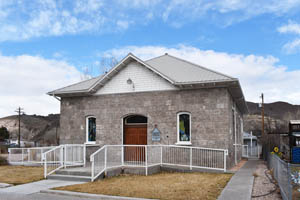
The 1905 stone school in Caliente, Nevada, now serves as a Methodist Church by Kathy Alexander.
In that decade, several business buildings and homes in Caliente still stand today.
A stone school was constructed in 1905. It is an excellent example of the early 1900s “Classic Box” style of architecture. Now used as the Caliente Methodist Church, it stands at the corner of Culverwell and Market Streets.
The “Underhill” Stone Residence was built in 1905. It was used as a residence and a saloon. Initially, it was just one store with a flat roof. By 1920, a second story was added. The home is located at the east end of Clover Street.
Harry Underhill also built the Underhill General Merchandise Store at about the same time. The stone and wood-frame building was used as a general store and a hardware store. Between 1906 and 1907, he built the Underhill Rock Apartments, which were entirely stone on Bank Street. All of these buildings still stand today.

Underhill Rock Apartments in 1910.
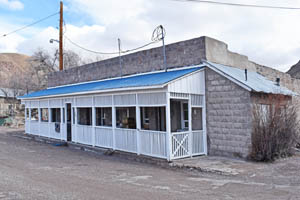
Underhill Rock Apartments in Caliente, Nevada, today by Kathy Alexander.
The Liston Home, also constructed of stone, was built in 1905 or 1906. It, too, is an excellent example of the early 1900s “Classic Box” style of architecture.
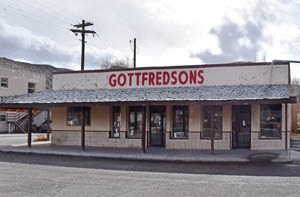
The John Miller buildings in Caliente, Nevada, last served as Gottfredsons Store by Kathy Alexander.
The John Miller Buildings were built in 1907 to serve as a bank with a hotel above but never served for either purpose. At one time, it was used as a cleaners and a tavern called the “Bucket of Blood Saloon,” as well as various other “lively” uses. It was later owned by Red Gottfredson and was operated as a furniture and appliance store. It is located at Clover and Spring Streets.
In 1906, a massive flood, with a wall of water 10-12 feet tall, roared through the canyon. Ruining most everything, the Union Pacific was rebuilt, only to have it happen again in 1910.
Completing the Pioche Branch of the railroad in 1907 made Caliente the connection to the nearby Pioche mines.
By 1910, Caliente was the largest town in Lincoln County, with 1,755 residents, numerous saloons, two hotels, and several barbershops. In the following years, more settlers came to the community, not only to ranch and farm but also because of railroad jobs.
The Richards Railroad Hotel, built between 1910 and 1915 by Harry Underhill, was used primarily as living quarters for railroad workers. This historic building, vacant today, still stands in Caliente toward the east end of Clover Street, where several other historic Underhill buildings stand. Though Underhill was described as an “ornery old cuss,” he appears to have been quite the entrepreneur in early Caliente.
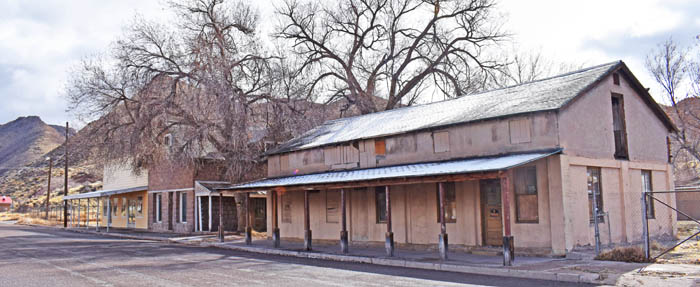
Underhill Row on the east side of Clover Street. The Underhill Store, Underhill House, and the Richards Hotel by Kathy Alexander are from the left.
In about 1918, the historic Smith-Cornelius Hotel was built at the corner of Front and Spring Streets (U.S. Hwy 93.) First called the Smith Hotel, the three-story stucco building was built by Dr. and Mrs. Wesley Smith in a simple vernacular architectural style reflecting the time’s design tastes. The first floor featured three retail spaces, one of which was always a café.
The largest hotel in the area, it advertised new and modern facilities such as hot and cold running water and baths at reasonable rates. The historic hotel pulsed with activity and flourished during the economic boom of the 1920s. During these years, it hosted many visiting dignitaries and notables involved with Caliente’s mining and railroad activities, including President Herbert Hoover, who owned interests in a mine in nearby Pioche.
The hotel changed hands several times until it was sold to Mrs. H. M. J. Cornelius, who continued to call it the Smith Hotel. Later, it was changed to the Scott Hotel, which had gone out of business in 1978. Over the years, the retail businesses included a pool hall, barbershop, pharmacy, beauty shop, and other businesses. One of the oldest surviving buildings in Caliente, it is listed on the National Historic Register today. The building is vacant today.
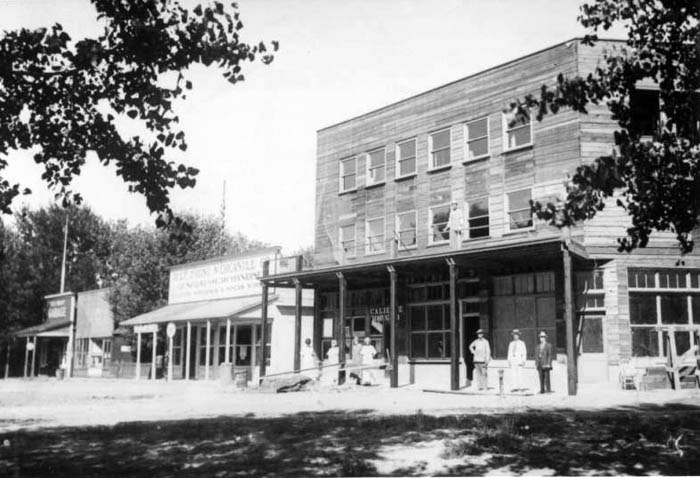
The Smith-Cornelius Hotel in Caliente, Nevada, 1927.
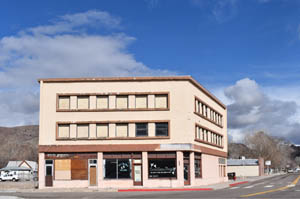
The Smith-Cornelius Hotel and its retail space are empty today. Photo by Kathy Alexander.
The original train depot burned down in 1921. In 1923, a grandiose two-story railroad depot was built in mission-style Spanish architecture at a cost of $83,600. It was designed by John and Donald Parkinson, who were also the architects for the Los Angeles depot.
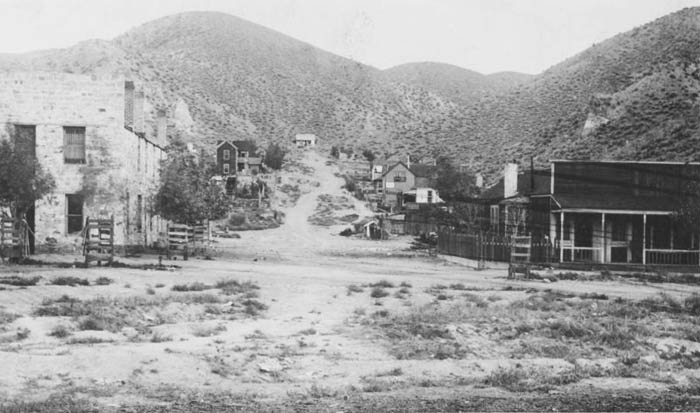
Early day Caliente, Nevada.
The building initially included a 50-room hotel on the upper level and railroad offices, a telegraph office, a restaurant, a passenger waiting room, and a community center on the first floor. Its interior was made of solid oak, including paneling and ornate doors. The building also featured vaulted ceilings and tile floors. A separate adjacent dormitory (now removed) served layover train crews.
Like other railroad towns, Caliente gained a broad right-of-way, and commercial streets were developed on both sides of the railroad tracks. In the 1920s, Caliente became an active division point, helper station, and passenger hub. Besides the depot, a large switching yard was established, and roundhouse and repair facilities were added. During these heydays, 90% of the working residents of Caliente were employed by the railroad.
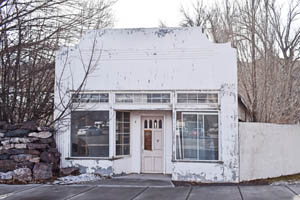
Train Store in Caliente, Nevada, by Kathy Alexander.
There were hopes that Caliente would be the next big resort town in the West. Reaching a population of 5,000, several business buildings were established that still exist today.
In the 1920s, Charles Culverwell built the Train Service Store on West Clover Street near the train depot to serve passengers in addition to the service provided there.
During Caliente’s heyday, it had 47 saloons, four barber shops, two mercantile stores, two blacksmith shops, two hotels, a livery stable, a butcher shop, and a hot springs bathing resort.
Like the rest of America, Caliente was affected by the Great Depression due to layoffs in the mines and the railroad. However, the city rebounded as the nation got involved in World War II. In 1944, the city was incorporated, and the first officially elected Mayor was Thomas Dixon. Mr. Dixon had a fine rose garden, and Caliente was soon dubbed “the Rose City.”
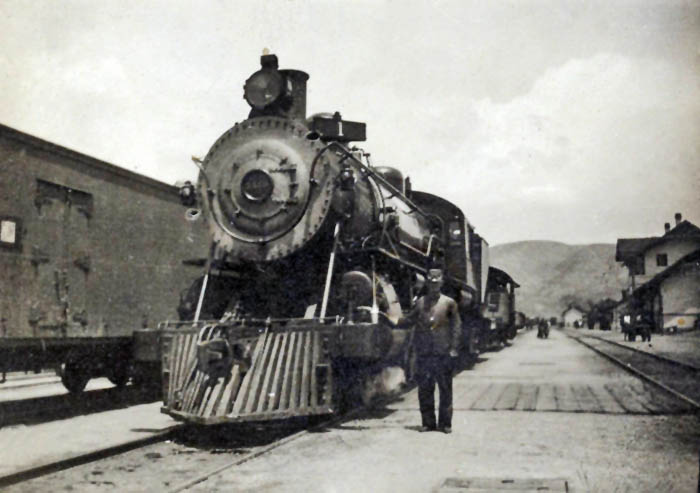
Steam engine in Caliente, Nevvada.
However, after the war, Caliente declined in importance as a railroad center when steam engines were replaced by diesel locomotives in the 1940s and ‘50s. The new diesel locomotives eliminated the need for helpers, fuel, water, and frequent servicing.
As a result, the railroad gradually reduced its workforce in Caliente, and the division point moved to Las Vegas. In 1948, Union Pacific also moved its shop facilities to Las Vegas. Afterward, the railroad removed the roundhouse, water tank, and excess yard tracks.
Immediately, the town’s growth stalled, and its population declined as many followed the railroad jobs. By 1950, Caliente’s population had dropped to 792.
Passenger service continued on the line between Los Angeles and Chicago until the mid-1970s. Today, only freight trains run on the line.
However, in the following decades, the community rebounded due to the establishment of three state parks nearby and traffic on U.S. 93.
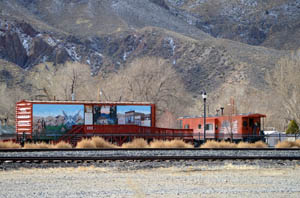
Boxcar Museum in Caliente, Nevada, by Dave Alexander.
In 1970, the beautiful mission-style depot building was turned over to the city of Caliente. The depot is the only station of its type left in Nevada. It has city offices, a library, and the Civic Center today. Next to the old depot is a Boxcar Museum that exhibits memorabilia and photos documenting Caliente’s railroad history.
Caliente is a well-kept and inviting southern Nevada city that offers a wide range of services to visitors, including restaurants, gas stations, motels, a small casino, RV Parks, and a variety of stores.
The city is close to several Nevada State parks, including Beaver Dam, Cathedral Gorge, Spring Valley, Echo Canyon, and Kershaw-Ryan.
Caliente is also home to extensive outdoor recreation opportunities, including more than 40 miles of single-track mountain bike trails in and around town and thousands of motorized off-road tracks and trails in the area. The city also provides three city parks, a public swimming pool, tennis courts, rodeo grounds, a shooting range, and a motocross race track.
A Lincoln County Driving and Walking Tour features many historic sites in Caliente and other communities in the county. It is available online here.
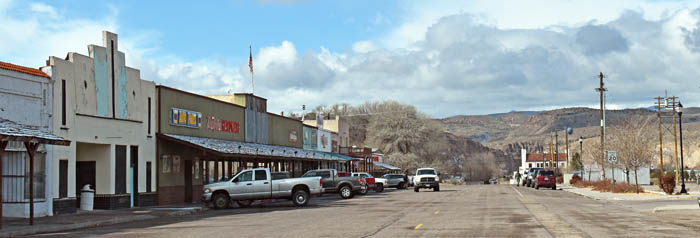
Clover Street in Caliente, Nevada, by Kathy Alexander.
The U.S. Department of the Interior/Bureau of Land Management office is at the southern end of Caliente, adjacent to U.S. 93, with visitor information for travelers.
Today, Caliente’s population is about 1,075, making it the least populated incorporated city in Nevada.
©Kathy Alexander/Legends of America, updated March 2025.
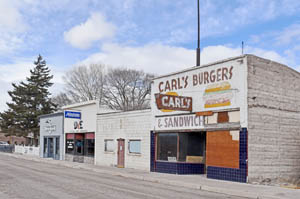
Front Street Building row in Caliente, Nevada, by Kathy Alexander.
Also See:
Sources:
City of Caliente
Lincoln County Walking/Driving Guide
Nevada Magazine
St. George, UT News
Travel Nevada
Wikipedia