
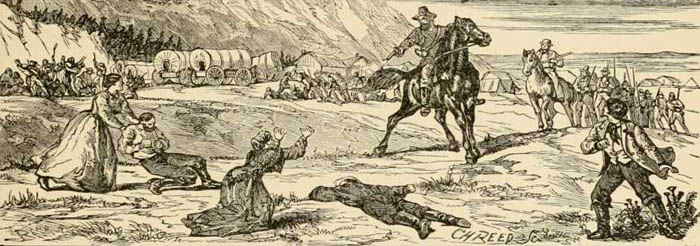
Mountain Meadows Massacre, Utah.
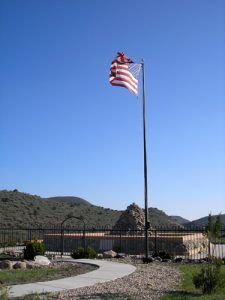
Mountain Meadows Massacre Site by Kathy Alexander.
Rumored Massacre on the Plains, Los Angeles Star, October 3, 1857
Horrible Massacre of Arkansas and Missouri Emigrants, Los Angeles Star, October 10, 1857
The Immigrant Massacre, Daily Alta, San Francisco, October 17, 1857
Murders At Mountain Canon Confirmed, Daily Alta, San Francisco, October 27, 1857
The Federal Government and the Mormons, San Francisco Evening Bulletin, October 27, 1857
The Mormon Murderers, San Francisco Evening Bulletin, October 28, 1857
The Mormons and the Late Massacre, San Francisco Evening Bulletin, November 5, 1857
Killing of Immigrants — Mormons Falsely Accused, Western Standard, San Francisco, November 6, 1857
Brigham Young’s Tactics, Daily Alta, San Francisco, Wed., December 23, 1857
The Utah Expedition, New York Times, February 4, 1858
The Massacre At Mountain Meadows, Harper’s Weekly, August 8, 1859
Mountain Meadows Massacre, an 1889 Account by Hubert Howe Bancroft
Survivor of a Massacre: Mrs. Betty Terry, Arkansas Gazette, September 4, 1938
Martha Elizabeth Baker Terry Personal Account, date unknown
Mountain Meadow Massacre Related by Rebecca Dunlap Evans, Fort Smith Elevator, August 20, 1897
Note: These articles are not verbatim. Obvious spelling and grammatical errors, incorrect names, formatting, and in some cases, archaic language has been changed for accuracy and easier reading.
See our primary article Mountain Meadows Massacre
Rumored Massacre on the Plains, Los Angeles Star, October 3, 1857
 We have just been informed by Judge Brown of San Bernardino, who has arrived in town from that city, that a rumor was prevalent there and had obtained a general belief that a whole train of emigrants from Salt Lake City for San Bernardino, composed of 25 families, comprising 95 persons, men and women, had been cruelly massacred on the road, between the last settlements in Utah Territory and the boundary of this State.
All the company’s property had been carried off, and only the children left, who were picked up on the ground and conveyed to San Bernardino.
This intelligence was brought on by another party who had started from the city after the reported missing company and who had overtaken the mail carrier in the Cajon Pass, where he is said to have encamped on Wednesday night.
No further particulars are known, any names given, or any account of the finding and disposition of the bodies. We give the rumor for what it is worth. The alleged facts are without authenticity as yet, as the party did not arrive in San Bernardino when our informant left.
Although the rumor was generally believed in San Bernardino, we confess our unwillingness to credit such a wholesale massacre.
Horrible Massacre of Arkansas and Missouri Emigrants, Los Angeles Star, October 10, 1857
Over One Hundred Persons Slaughtered by Indians — Mormon Instigation Suspected
A train of emigrants from Missouri and Arkansas for this State were waylayed and cruelly butchered on the route at a place called Santa Clara Cañon, near the rim of the Great Basin, about 300 miles from Salt Lake City. The massacre scene is designated differently as Santa Clara Cañon, the Mountain Springs, and the Mountain Meadows. But all agree on locating it near the rim of the Great Basin and about 50 miles from Cedar City, the most southern of the Mormon settlements.
Of a party of about 130 persons, only 15 infant children were saved. The account was given by the Indians themselves to the Mormons at Cedar City, to which place they brought the children, who were purchased from them by the people of that city. Whether the cause assigned is sufficient to account for the result or whether a different cause is at the bottom of the transaction, we will leave the reader to form his own conclusion. We can scarcely believe that a party traveling along a highway would act in the manner described, that is to poison the carcass of an ox, and also the water, thus endangering the lives of those who were coming after them. Yet this is the story told by all who have spoken of the massacre. It is stated, the emigrants had an ox that died, and they placed poison in the body and also poisoned the water standing in pools for the purpose of killing the Indians; that several of the tribe had died from this cause and that the whole force mustered, pursued the train, and coming up with them at the above-named place, which favored their purpose, attacked and murdered the whole party, except a few infant children. The Indians state that they made but one charge on the party, in which they cut off the more significant portion of the men, and then guarded the outlets of the cañon, and shot the men and women down as they came out for water; that one man was making his escape with a few children, and they followed him, killed him, and took the children 15 in number, the eldest under five years of age. The report was brought to San Bernardino by Messrs. Sidney Tanner and W. Mathews.