
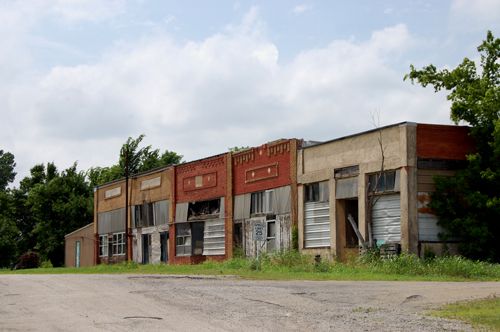
Shamrock Oklahoma Main Street by Kathy Alexander.
The almost abandoned town of Shamrock sits about 13 miles northwest of Depew, Oklahoma. Once a booming oil town with as many as 10,000 people, the town now sits fading with only about 100 residents, crumbling foundations, and long-closed businesses. The town began as a small farming hamlet, with its post office established on July 9, 1910. Shamrock was named by the first postmaster, J.M. Thomas, for his hometown in southern Illinois. By 1913, the town supported two general stores, a restaurant, and a population of 35 people.
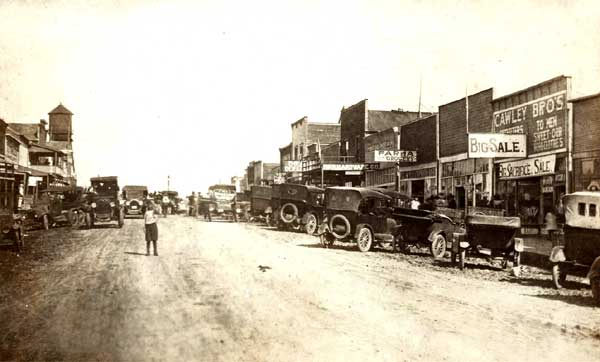
Shamrock, Oklahoma, during its boom days.
However, this all changed when the Cushing Oil Field began to develop two years later. The townsite soon shifted to the southern edge of the oil field and became a boomtown almost overnight. Nearby, numerous oilfield camps sprung up, including Dropright, Gasright, Alright, Downright, Damright, and Justright.
Shamrock took on an Irish character when the new town location was surveyed and platted. Its Main street was named Tipperary Road, and other streets took on monikers such as Cork, Dublin, Ireland, St. Patrick, and Killarney. Buildings were painted green, and the town acquired a Blarney stone. Its first newspaper was called the Shamrock Brogue.
Cushing, some 15 miles to the northwest of Shamrock, really boomed as it soon supported 23 refineries, and before long, the town of Drumright was formed just six miles north of Shamrock.
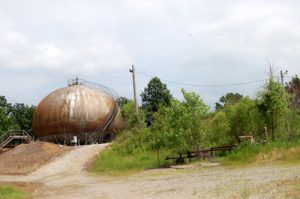
Remnants of better days in Shamrock, Oklahoma by Kathy Alexander.
The Cushing Field became one of the most significant oil discoveries of the early 1900s, producing 300,000 barrels a day by 1915. By 1919, the Cushing-Drumright area accounted for 17 percent of U.S. and three percent of world oil production, becoming known as the “pipeline crossroads of the world.”
During Shamrock’s oil boom, the town was rowdy, with several gambling halls, saloons, brothels, and rugged individuals. At one time, noted oilfield entertainer Ruby Darby performed in a Shamrock pool hall, entertaining her guests by dancing on a pool table.
Shamrock began declining in the mid-1920s as oilfield workers moved on to new boomtowns. Before long, stores, pool halls, hotels, and other businesses began closing as the nearby oilfield camps were deserted. Houses were moved to new locations, and business buildings stood closed up.
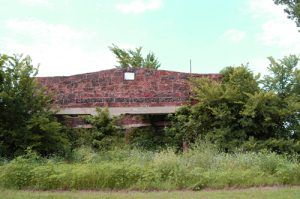
Built in 1927, this abandoned auto dealership is quickly succumbing to the brush, Kathy Weiser-Alexander.
By 1930, Shamrock’s population had decreased to about 700. However, Shamrock still supported a bank Pretty Boy Floyd robbed in 1932. Floyd was also seen casing the Depew Bank from the town’s post office, though he never robbed it.
Although the Cushing Oilfield continued to produce massive amounts of oil, the production had been mostly automated, and the numbers of men were no longer needed. Cumulative production in the Cushing Oilfield exceeded 450,000,000 barrels by 1979.
Though the town is still home to about 100 souls, many buildings are decaying and vandalized. However, in keeping with its old Irish customs, the town still has an annual St. Patrick’s Day parade. It also continues to have an open post office, a Grill, and a grocery store.

The closed Shamrock Museum building was once a general store by Kathy Alexander.
Shamrock is on Highway 16, six miles south of Drumright, Oklahoma. To access it from Route 66, travel approximately 3.5 miles west of Depew, then turn right on Creek County Road N3620 for about 9 miles before entering Shamrock.
©Kathy Alexand/Legends of America, updated February 2025.
Also See:
Oklahoma Photo Print Galleries
See Sources.