
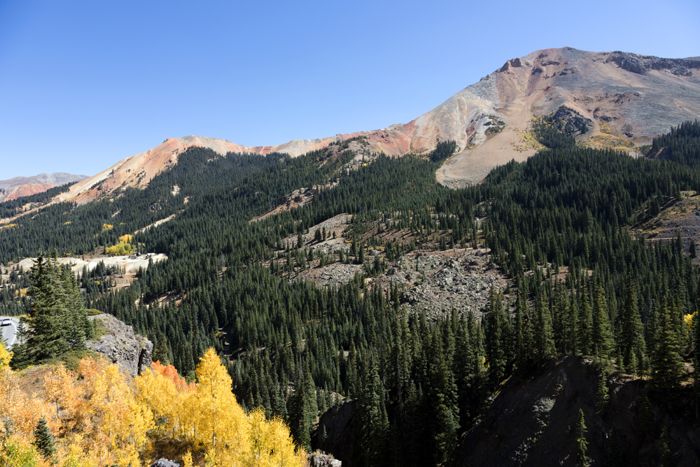
Red Mountain, Colorado by Carol Highsmith.
The Red Mountain Mining District is between Silverton and Ouray along the “Million Dollar Highway” in southwest Colorado. From 1882 to 1893, it was the site of a historic silver boom.
Mining Towns in the District
The Silverton Railroad of the San Juan Mountains
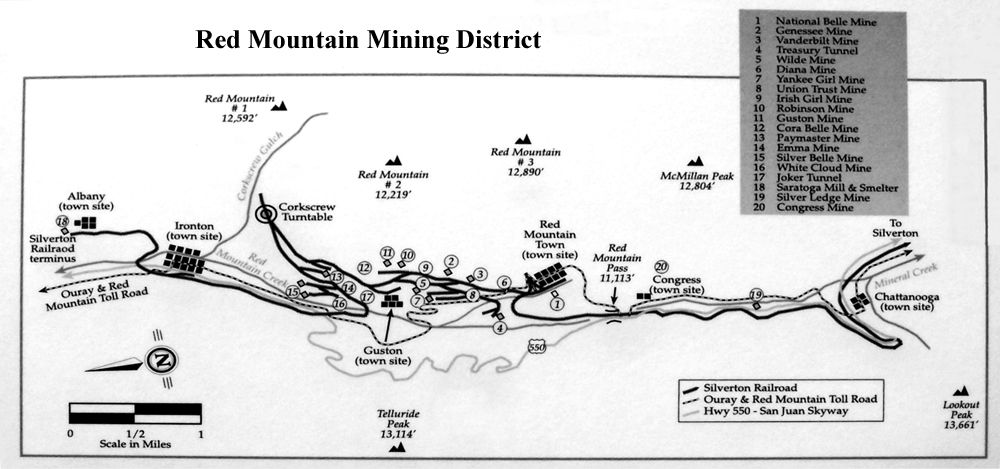
Red Mountain Mining District, Colorado Map.
Only low-grade discoveries were made in the first few years of mining activity. However, valuable columns of silver ore called “pipes” were discovered, and mining began quickly. When John Robinson discovered the fabulously rich Yankee Girl Mine in 1882, the rush was on to Colorado’s newest mining district.
Newspapers spread the word on the East Coast about the valuable ore coming out of the district, piquing the interest of numerous investors. After silver strikes were made at the Guston, Congress, and National Belle mines, Eastern capitalists began sending money into the district, leading to the rapid industrialization of the area. By 1883, nearly 40 mines were sending silver ore to smelters.
The nearby towns of Silverton and Ouray fought to become known as the entry point into the district, with each touting that it was the only way into the area and warning of the dangers faced by those who came from the other direction. The two towns were almost an equal distance from the discoveries, and better transportation was badly needed to bring the rich ore out to market.
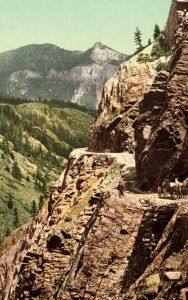
Ouray Toll Road, by Detroit Photographic Co., 1900.
In 1880, a road was built from Ouray across the steep “impassable” cliffs to Red Mountain Pass by the Ouray and San Juan Wagon Road Company. Though progress was made in the first two years, the company was running out of money by 1882. After several attempts to reorganize and refinance, Otto Mears offered to purchase a 54% interest in the toll road company. After putting a larger and more experienced construction crew to work, Mears completed the road in 1883. This road would eventually become known as the famous Million Dollar Highway.
In the meantime, several towns were established in an area of less than eight square miles. These included Albany, Chattanooga, Red Mountain Town (aka Rogersville), Guston, Congress (aka Red Mountain City), and Ironton. Into these mining camps came prospectors, miners, cooks, freighters, prostitutes, gamblers, saloon keepers, boarding house operators, and families, increasing the district’s population to more than 3,000 people.
Otto Mears began building the Silverton Railroad from Silverton to the Red Mountain District in 1887. The following year, the line reached Ironton in November. It was completed in September 1889 and reached its terminus in Albany. The railroad connected the district’s towns to the bustling city of Silverton and allowed the mines to ship medium—and low-grade ore to smelters in Durango and Pueblo. Affluent Eastern and European investors also traveled on the train, who were brought directly to the mines in luxurious coaches.
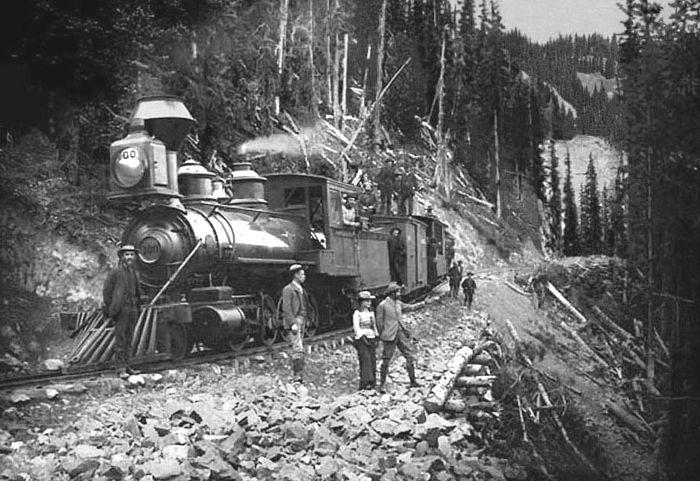
Silverton Railroad, Red Mountain Pass, 1888.
The short 18-mile narrow gauge railroad was nicknamed “The Rainbow Route” because it arched across the steep Red Mountain Divide like a rainbow in the sky. Its Chief Engineer, Charles W. Gibbs, described it as “the steepest, the crookedest, and the best-paying road (railroad) in Colorado.”The railroad had four wyes, a switchback with a covered turntable, a 200-degree loop, and an average grade of 5% over the 11,113 summit of Red Mountain Pass.
The arrival of the railroad was a critical transportation event during this period. It dramatically lowered the costs of mining and living, increased the tonnages of ore that companies could ship, provided a direct link with the Durango Smelter, made a wider variety of goods available at lower prices, and improved the overall quality of life. The railroad was a principal agent that allowed the mining industry to boom.
Life in these high-mountain mining camps was challenging for the people living there. Deadly avalanches were common, and snows were so heavy that work stopped, and the ore couldn’t be shipped out. Nighttime temperatures dipped to 20-30 degrees below zero. When mixed with the local pyrites, water formed sulfuric acid, which ate at the pumps, mine rails, shovels, and mining machinery, often rusting the metal within a month. People died in mining accidents, snow slides, or gunshot wounds. However, very few died of sickness due to the pure water and cold temperatures that contained many potential illnesses that would have flourished elsewhere. There were reportedly only four people over a 20-year span who died from sickness.
After the Silver Panic of 1893, the district dramatically declined. The Silverton Railroad cut back service, shortened the line, and was abandoned in 1921.
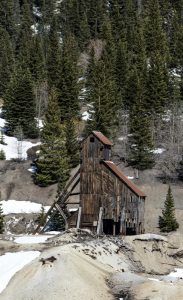
Yankee Girl Gold Mine, Colorado by Carol Highsmith.
After the district’s heyday, some gold was discovered at the Joker and Meldrum tunnels, but the ore lost value the deeper the miners went, and these ventures eventually closed. Mining revived during the First and Second World Wars. In the 1930s, the Idarado Mine opened and continued operating until 1978.
Over 30 million dollars in silver, lead, zinc, copper, and gold were taken from the Red Mountain Mining District in a few short decades. Production would be well over a quarter of a billion dollars at today’s prices.
Over the years, many of the structures of the district fell into disrepair or were salvaged. In 1998, the Red Mountain Project was launched to preserve threatened historic landscapes and structures along the San Juan Skyway and in and around Red Mountain Pass. After years of effort, the Red Mountain Task Force partnered with several organizations and private citizens to purchase over 8,500 acres of historic landscapes. The project protects and stabilizes the district, installs interpretive signs, and constructs miles of hiking trails to provide public access to this once-endangered site.
Little remains of the towns that once prospered in the district, but about 50 structures still exist. The outline of the railroad grade is only faintly visible. Some districts are privately owned and not open to the public, partly due to dangerous structures, open shafts, and ongoing environmental clean-up.
Many of the structures can be seen from the roadside. Those with a four-wheel-drive, high-clearance vehicle can explore the district further. The district can be accessed from Highway 550 from the north on Ouray County Road 31, ten miles south of Ouray. Another portion of the district can be accessed six miles northwest of Silverton along Forest Road 825.
Today, Red Mountain Pass and its surrounding lands are one of Colorado’s great tourist attractions.
©Kathy Alexander/Legends of America, updated January 2025.
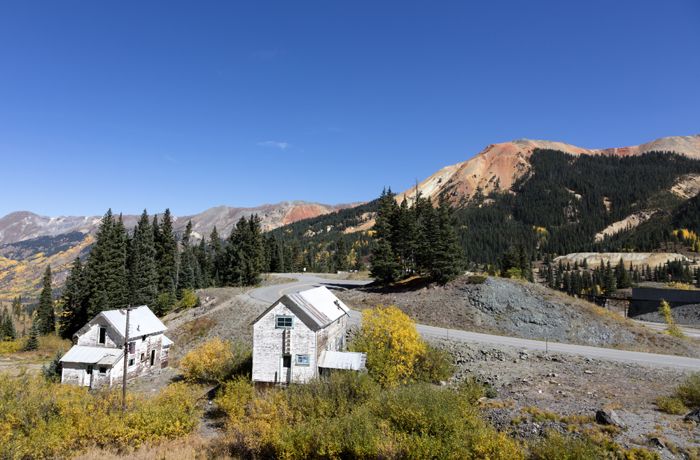
Ironton, Colorado, ghost town by Carol Highsmith.
Also See:
Durango – Railroad Town of the Southwest
Silverton – High in the San Juans
Sources:
American Southwest
Byway Interpretive Signs
Colorado Preservation
Narrow Gauge
Red Mountain Project