

Photo by the Bureau of Land Management.
The Hole-in-the-Wall, a remote pass in the Big Horn Mountains of Johnson County, Wyoming, is a spectacularly scenic part of the Old West. The red sandstone escarpment dominates the area, rich in legend of outlaw activity in the late 1800s.
It was a favorite hiding place for the infamous Butch Cassidy and the Wild Bunch Gang, who often hid out in an 1883 log cabin preserved at the Old Trail Town Museum in Cody, Wyoming. The Wild Bunch included cattle rustlers and train-bank robbers such as William Ellsworth “Elzy” Lay, Harry “Sundance Kid” Longabaugh, Ben “Tall Texan” Kilpatrick, and Harvey “Kid Curry” Logan, William “News” Carver, Laura Bullion, and George “Flat Nose” Curry.
But these criminals weren’t the only ones who made the Hole-in-the-Wall their hideout—other outlaws such as Al Smith, Bob Taylor, Tom O’Day, “Laughing” Sam Carey, Black Jack Ketchum, the Roberts Brothers, and others also utilized the area as both a hiding place and a base of operations to coordinate their outlaw activities. Even Jesse James was said to have visited the Hole-in-the-Wall hideout.
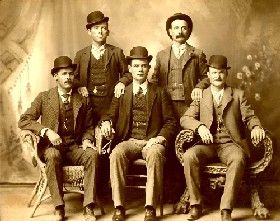
Wild Bunch, aka Hole in the Wall Gang (1896-1901) – Led by Butch Cassidy, the Wild Bunch terrorized the states of Colorado, Wyoming, Montana, Idaho, Utah, and Nevada for five years.
These various groups and individual outlaws were collectively known as the Hole-in-the-Wall Gang. It was not one large organized gang but was made up of several separate gangs operating out of the Hole-in-the-Wall Pass, using it as their base of operations. The gangs formed a coalition, each planning and carrying out its robberies with little interaction with the other gangs. At times, members of one gang would ride along with other gangs, but usually, each gang operated separately, meeting up only when they were each at the hideout at the same time.
Geographically, the hideout had all the advantages needed for a gang attempting to evade the authorities. The area was remote and secluded, easily defended because of its narrow passes, and impossible for lawmen to approach without alerting the outlaws. It contained an infrastructure, with each gang supplying food, livestock, and horses. A corral, livery stable, and numerous cabins were constructed, one or two for each gang. Anyone operating out of there adhered to specific rules of the camp, including a particular way of handling disputes with other gang members and never stealing from another gang’s supplies. There was no leader, with each gang adhering to its chain of command. The hideout was also used to shelter the outlaws to lay up during the harsh Wyoming winters. When the weather was better, the outlaws often used the remote pass to move horses and cattle from the area.
On one occasion, a cattle rancher fought back in what is now known as the Hole-in-the-Wall Fight. It was well-known that cattle rustling had been occurring in the area, with the cattle and outlaws hiding within the Hole-in-the-Wall country. In 1897, Bob Divine of the CY Cattle Company planned a roundup of this area to gather stock belonging to various ranch outfits. He was warned to stay out in an anonymous note that stated: “Don’t stick that damned old gray head of yours in this country again if you don’t want it shot off.”
However, Devine and several other ranchers were not deterred by the threat. On Thursday, July 22, Devine, along with other CY Ranch Cowboys, men from the Ogallala Land and Cattle Company and the Circle L Ranch, Jim Drummond, a Montana livestock inspector; and Joe LaFors, a U.S. Deputy Marshal, all set out to round up the cattle.
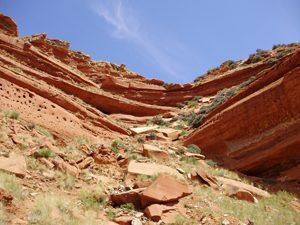
Photo by Bureau of Land Management.
They entered the Hole-in-the-Wall country through the Bar C gap and headed south, passing by the Hole-in-the-Wall ranch. About three miles in, the group came upon Bob, Al Smith, and Bob Taylor, members of the Hole-in-the-Wall Gang.
There was animosity between Bob Divine and Bob Smith, and tension was in the air. Divine asked if they had seen any CY cattle, and Smith replied, “Not a damn one!” Believing Divine’s hand gripped his gun, Smith pulled his six-shooter, and the fight was on. Shots were fired, horses were pitching, and the dust flew.
When the smoke cleared, Bob Smith lay on the ground with a bullet through his back. Divine’s horse had been killed, and he and his son Lee had been wounded. Al Smith escaped after his gun had been shot from his hand. Bob Smith was taken to the Hole-in-the-Wall cabin and died the following day. Bob Taylor was captured, taken to the Natrona County jail, and later released.
Shortly afterward, Divine led a contingent of heavily armed men and two deputies to the Hole and drove several hundred heads of cattle out. Several armed men watched them closely but were not bothered.
From the late 1860s to around 1910, the pass was frequently used by numerous outlaw gangs. Eventually, it faded into history, with gangs using it less frequently. Today, the Hole-in-the-Wall and Middle Fork region contains approximately 80,000 acres of public land, including lands managed by the State of Wyoming and Wyoming Game and Fish Department. This remote area is about 35 miles southwest of Kaycee, Wyoming, and 60 miles north of Casper along the Red Wall Back Country Scenic Byway.
The Middle Fork Powder River is about 20 miles southwest of Kaycee, Wyoming. The Middle Fork Powder River Management Area contains notable sites such as Outlaw Cave, which is rumored to have been used as a hideout by various outlaws. It contains diverse topography and vegetation, ranging in elevation from 5,000 to over 8,000 feet, with numerous steep incised canyons, a red sandstone escarpment known as the Red Wall, and open grassland parks interspersed with ponderosa pine, Douglas-fir, and limber pine forests. The wildlife found here are equally diverse: elk, mule deer, antelope, mountain lions, and eagles, among other small mammals and rodents.
The Middle Fork of the Powder River lies at the bottom of a fairly steep canyon. But, if you can make your way down, the fishing at the bottom is excellent. This “blue ribbon” trout stream contains brown and rainbow trout. Other fishable streams in the area include Blue Creek, Buffalo Creek, and Eagle Creek.
©Kathy Alexander/Legends of America, updated March 2025.

Cody, WY – Old Trail Town – Wild Bunch Cabin, photo by Kathy Alexander.
Also See:
Sources:
Bureau of Land Management
The Vintage News
Wikipedia
Wyoming Historic Marker
Wyoming Tails & Trails