
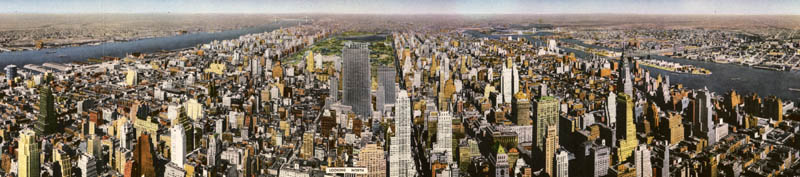
Panoramic View of New York City, by Albert Brabazon, 1945.
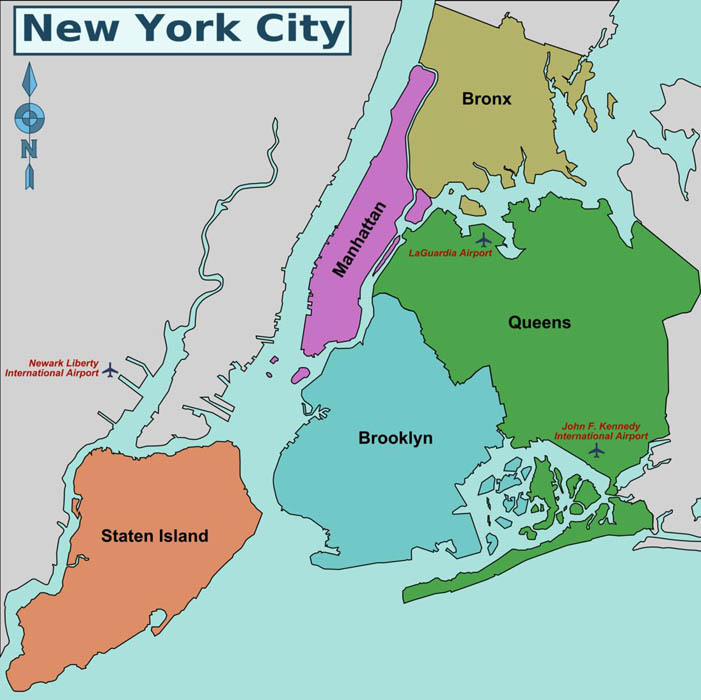
New York City Boroughs Map courtesy of NYCmap360.
New York City, New York, comprises five boroughs, including:
Boroughs are formal subdivisions of cities that have some aspects of self-government. For example, New York City has one mayor, but each borough has its own borough president. Within these boroughs are hundreds of neighborhoods, such as Greenwich Village and SoHo, with definable histories and characters and no formal boundaries.
The boroughs were created during a 1898 consolidation when the city’s current boundaries were established. Each borough is situated in its own county. The boroughs of Queens and the Bronx are also Queens and Bronx Counties. The other three counties are named differently from boroughs. Manhattan is in New York County, Brooklyn is in Kings County, and Staten Island is in Richmond County. All five boroughs were combined in 1898 with New York County, including the Bronx, Kings County, parts of Queens County, and Richmond County, into a single municipality under a new city charter, creating present-day New York City.
All of the former municipalities within the integrated new city disappeared. New York City was initially confined to the island of Manhattan and the smaller surrounding islands that formed New York County. As the city grew north, it began annexing areas of the mainland, absorbing territory from Westchester County into New York County in 1874 (West Bronx) and 1895 (East Bronx). During consolidation in 1898, the area was organized as the Borough of the Bronx but was still part of New York County. Bronx County was separated from New York County in 1914, and the boroughs became adjacent counties. When the western part of Queens County was merged with New York City in 1898, the area became the Borough of Queens. In 1899, the remaining eastern portion of Queens County was split off to become Nassau County on Long Island, after which the borough of Queens and the county were coextensive.
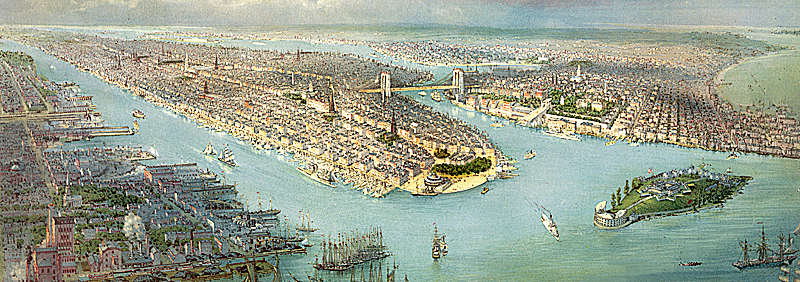
Birdseye view of New York City by L. W. Schmidt, 1880s.
Since 1914, each of New York City’s five boroughs has been coextensive with a county in New York State. Unlike most U.S. cities, which lie within a single county or extend partially into another county, these boroughs constitute a county or are entirely separate and independent of any county.
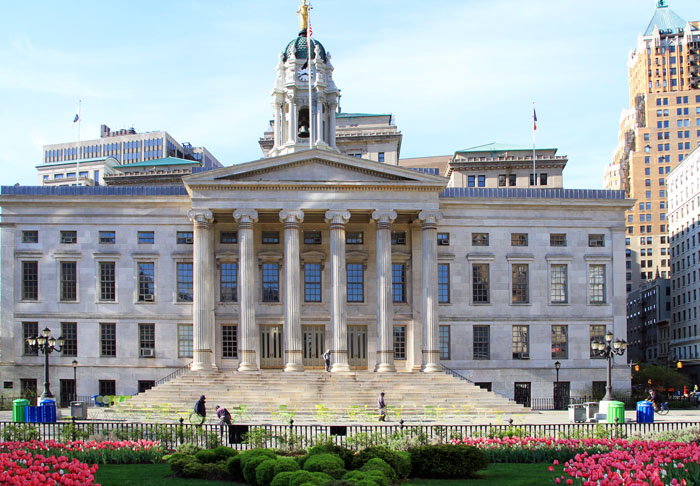
Borough Hall in Brooklyn, New York, courtesy Wikimedia.
A borough president represents each borough. Brooklyn, Queens, and Staten Island each have a Borough Hall with limited administrative functions. The Manhattan Borough President’s office is situated in the Manhattan Municipal Building. The Bronx Borough President’s office is in the Bronx County Courthouse. Since the abolition of the Board of Estimate in 1990, the borough presidents have minimal executive powers, and there is no legislative function within a borough. Executive functions in New York City are the responsibility of the Mayor of New York City, while legislative functions reside with the New York City Council. The borough presidents primarily act as spokespeople, advocates, and ceremonial leaders for their boroughs, have budgets from which they can allocate relatively modest sums of money to community organizations and projects, and appoint the members of the 59 largely advisory community boards in the city’s various neighborhoods. The Brooklyn and Queens borough presidents also appoint trustees to those boroughs’ local public library systems.
Each borough is coextensive with a respective county of New York State, making New York City one of the U.S. municipalities in multiple counties.
If the boroughs were each independent cities, four of them—Brooklyn, Queens, Manhattan, and the Bronx—would be among the ten most populous cities in the United States. Staten Island would be ranked 37th as of 2020.
Manhattan
Manhattan, in New York County, is geographically the smallest and most densely populated borough in the city. It is home to Central Park, Times Square, most of the city’s skyscrapers, and numerous prominent landmarks. Locally known simply as The City, it is the cultural, administrative, and financial center of New York City. It is the headquarters of many major multinational corporations, the United Nations headquarters, Wall Street, and several important universities. Americans often describe Manhattan as the world’s cultural, financial, media, and entertainment capital.
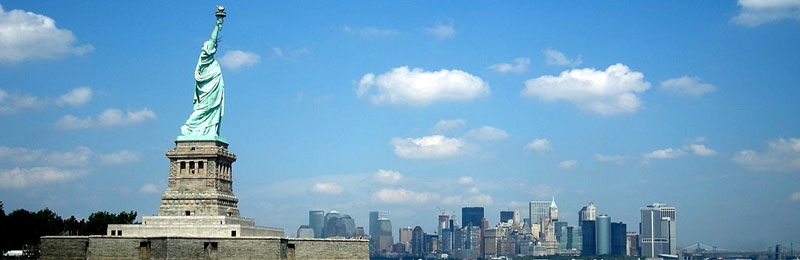
Statue of Liberty and Manhattan, New York.
Most of the borough is situated on Manhattan Island, at the mouth of the Hudson River and the East River, and its southern tip, where the two rivers converge. This area represents the city’s birthplace. Several small islands also compose part of the borough of Manhattan, including the Randalls and Wards Islands, Roosevelt Island in the East River, and Governors Island and Liberty Island to the south in New York Harbor.
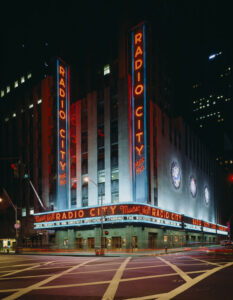
Radio City Music Hall in midtown Manhattan, New York, by Carol Highsmith.
Manhattan Island is loosely divided into three regions: Lower, Midtown, and Uptown. Uptown Manhattan is divided by Central Park into the Upper East Side and the Upper West Side, with Harlem located above the park. The borough also includes a small neighborhood on the mainland called Marble Hill. Marble Hill was originally part of Manhattan Island but is now contiguous with the Bronx after having been severed from Manhattan Island by the construction of the Harlem River Ship Canal south of the neighborhood and having been connected to the mainland by the subsequent filling in of the Harlem River’s original path to the neighborhood’s north. New York City’s remaining four boroughs are collectively referred to as the outer boroughs.
At 72,033 people per square mile in 2015, Manhattan has the highest population density of any U.S. county and more than any individual U.S. city.
Most of the borough is located on Manhattan Island at the mouth of the Hudson River. Several smaller islands are also part of the Manhattan borough, including Randalls Island, Wards Island, Roosevelt Island on the East River, and Governors Island south of New York Harbor. Liberty Island, where the Statue of Liberty stands, is an enclave of Manhattan. Manhattan Island is roughly divided into three regions: Lower, Midtown, and Uptown. Uptown Manhattan is divided into the Upper East Side and Upper West Side by Central Park, with Harlem above the park. The borough also includes a small mainland district called Marble Hill.
Brooklyn
Brooklyn, in Kings County, is the city’s most populous borough. It is situated on the western tip of Long Island and is renowned for its cultural, social, and ethnic diversity, vibrant independent art scene, distinctive neighborhoods, and rich architectural heritage.
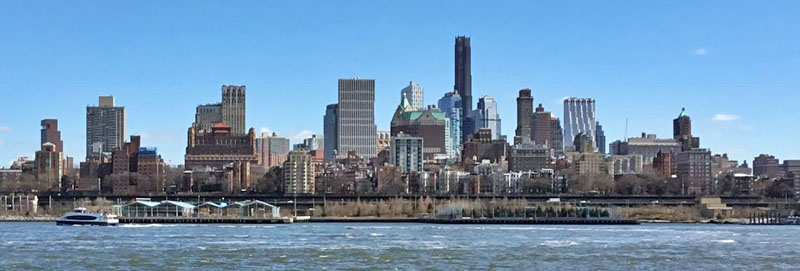
Downtown Brooklyn, New York, from Manhattan, courtesy Wikipedia.
Brooklyn, named after the Dutch town of Breukelen in the Netherlands, was founded in the 17th century. By the 19th century, it had grown into a busy port city. On January 1, 1898, after a long political campaign, Brooklyn, along with other areas, was consolidated and annexed to form the current five-borough structure of New York City.
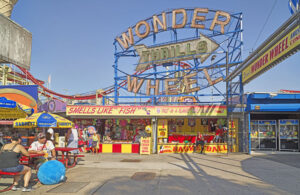
Coney Island arcade games in Brooklyn, New York, by Carol Highsmith.
Downtown Brooklyn is the largest central core neighborhood in the Outer Boroughs. The borough has a long beachfront shoreline, including Coney Island, which was established in the 1870s as one of the earliest amusement grounds in the U.S. Marine Park and Prospect Park are the two largest parks in Brooklyn. Since 2010, Brooklyn has become a thriving hub of entrepreneurship, high-technology startup firms, and postmodern art and design.
Brooklyn shares a border with the borough of Queens. It has several bridge and tunnel connections to the borough of Manhattan, across the East River, and is connected to Staten Island through the Verrazzano-Narrows Bridge. With a land area of 69.38 square miles and a water area of 27.48 square miles, Kings County is New York’s fourth-smallest county by land area and third-smallest by total area. With 2,736,074 residents as of the 2020 United States Census, Kings County is the most populous of the five boroughs of New York City and the most populous county in the State of New York. The population density of Brooklyn was 37,339.9 inhabitants per square mile in 2022, making it the second-most-densely populated county in the United States, behind Manhattan, and it had the ninth-highest population of any county nationwide. If Brooklyn were independent, it would be the fourth most populous city in the U.S., after New York City, Los Angeles, and Chicago.
Queens
Queens, in Queens County, on Long Island northeast of Brooklyn, is geographically the largest borough, the most ethnically diverse county in the United States, and the most ethnically diverse urban area in the world. Historically, this area was a collection of small towns and villages founded by the Dutch, and the borough has since developed commercial and residential prominence. Downtown Flushing became one of the busiest central core neighborhoods in the outer boroughs. Parts of Queens, such as Bellerose and Forest Hills, are relatively suburban.
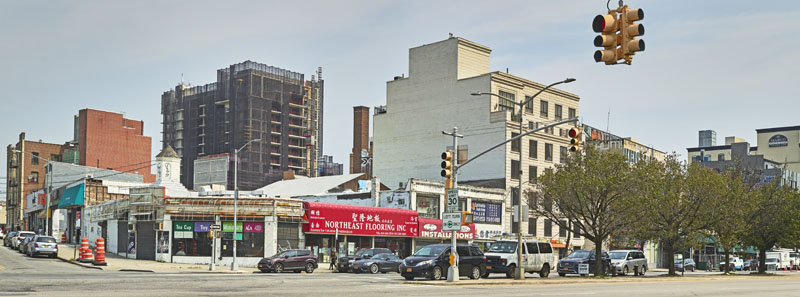
Northern Boulevard in the Flushing neighborhood of Queens, New York, by Carol Highsmith.
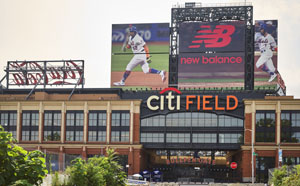
Citi Field Baseball Stadium in Queens, NY, by Carol Highsmith.
Queens was established in 1683 as one of the original 12 counties of the Province of New York. The settlement was named after the English Queen and Portuguese royal princess Catherine of Braganza. From 1683 to 1899, Queens County included Nassau County. Queens became a borough during the consolidation of New York City in 1898, when it was formed by combining the towns of Long Island City, Newtown, Flushing, Jamaica, and western Hempstead. All except Hempstead are considered neighborhoods of Queens today.
Queens is home to the New York Mets’ Citi Field baseball stadium and hosts the annual U.S. Open tennis tournament at Flushing Meadows-Corona Park. It is also home to two of the busiest airports serving the New York metropolitan area: John F. Kennedy International Airport and LaGuardia Airport. The third is Newark Liberty International Airport in Newark, New Jersey.
It is the largest of the five boroughs in New York City by area. It is bordered by the borough of Brooklyn at the western tip of Long Island and by Nassau County to its east. Queens shares water borders with the boroughs of Manhattan, the Bronx, Staten Island, and New Jersey. With a population of 2,405,464 as of the 2020 census, Queens is the second-most populous county in New York state, behind Kings County (Brooklyn), and is therefore also the second-most populous of the five New York City boroughs.
The Bronx
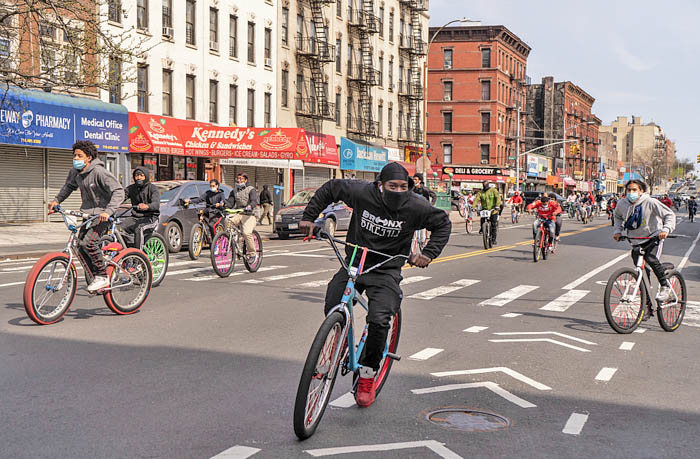
The Bronx, NY by Camilo J. Vergara.
The Bronx is New York City’s northernmost borough and the only one mainly on the mainland. It is south of Westchester County, northeast of Manhattan, across the Harlem River, and north of Queens, across the East River.
The word “Bronx” originated with Swedish-born Jonas Bronck, who established the first European settlement in the area as part of the Dutch colony of New Netherland in 1639. In the 19th and 20th centuries, the Bronx received numerous immigrant and migrant groups as it transformed into an urban community, first from European countries and later from the Caribbean region, as well as immigrants from West Africa and African American migrants from the Southern United States. In 1914, the now-independent Bronx County became the last county created in New York State.
It is the location of Yankee Stadium, the baseball park of the New York Yankees, and home to the largest cooperatively owned housing complex in the United States, Co-op City. The Bronx Zoo, the world’s largest metropolitan zoo, spans 265 acres and houses over 6,000 animals. Pelham Bay Park is the largest park in New York City, at 2,772 acres. The Bronx has a land area of 42 square miles and a population of 1,472,654, as reported in the 2020 census.
Staten Island
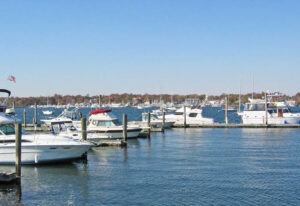
Great Kills Park Marina is on Staten Island, New York, courtesy of the National Park Service.
Staten Island in Richmond County is the most suburban in character of the five boroughs. It is connected to Brooklyn by the Verrazzano-Narrows Bridge and to Manhattan by the free Staten Island Ferry. The ferry is one of the most popular tourist attractions in New York City as it provides unsurpassed views of the Statue of Liberty, Ellis Island, and lower Manhattan.
Originally home to the Lenape Indians, the island was settled by Dutch colonists in the 17th century. It was one of the 12 original counties of New York State. Staten Island was consolidated with New York City in 1898. It was formerly known as the Borough of Richmond until 1975, when its name was changed to the Borough of Staten Island. Staten Island has sometimes been referred to as “the forgotten borough” by its inhabitants, who feel neglected by the city government. It has also been called the “borough of parks” due to its 12,300 acres of protected parkland and over 170 parks.
It is the southernmost borough at the southern tip of the U.S. state of New York. The borough is separated from the adjacent state of New Jersey by the Arthur Kill and the Kill Van Kull and from the rest of New York by New York Bay. Staten Island has a population of 495,747 according to the 2020 Census. It is the least populated of New York City’s boroughs, but the third-largest in land area, at 58.5 square miles; it is also the city’s most densely populated and suburban borough. In central Staten Island, the Greenbelt spans approximately 2,500 acres, including 28 miles of walking trails and one of the last undisturbed forests in the city. The Greenbelt comprises seven city parks, designed in 1984 to protect the island’s natural lands.
The boroughs have hundreds of distinct neighborhoods, many with a definable history and character that sets them apart. If the boroughs were each an independent city, four of them, Brooklyn, Queens, Manhattan, and The Bronx, would be among the ten most populous cities in the United States.
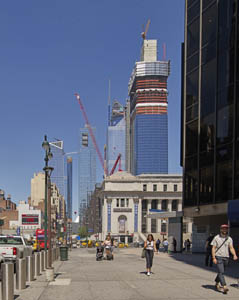
Buildings at Penn Station in New York City by Carol Highsmith.
©Kathy Alexander/Legends of America, updated July 2025.
Also See:
Sources:
Academic Accelerator
New York City Boroughs Explained
Sample Contents Library
Wikipedia – Brooklyn
Wikipedia – Burroughs
Wikipedia – Queens
Wikipedia – Staten Island
Wikipedia – The Bronx